


Dehydrated Vegetables Market USD 180.7 Billion by 2036: Outlook
NEWARK, Del., October 28, 2026 — The global dehydrated vegetables market is gaining momentum as food manufacturers, ingredient processors, and foodservice businesses increasingly rely on shelf-stable vegetable ingredients for soups, sauces, seasonings, ready meals, and packaged food products. Growing demand for convenient food preparation, longer ingredient shelf life, and consistent product quality is creating opportunities for dehydrated vegetable suppliers across industrial food manufacturing and ingredient distribution.
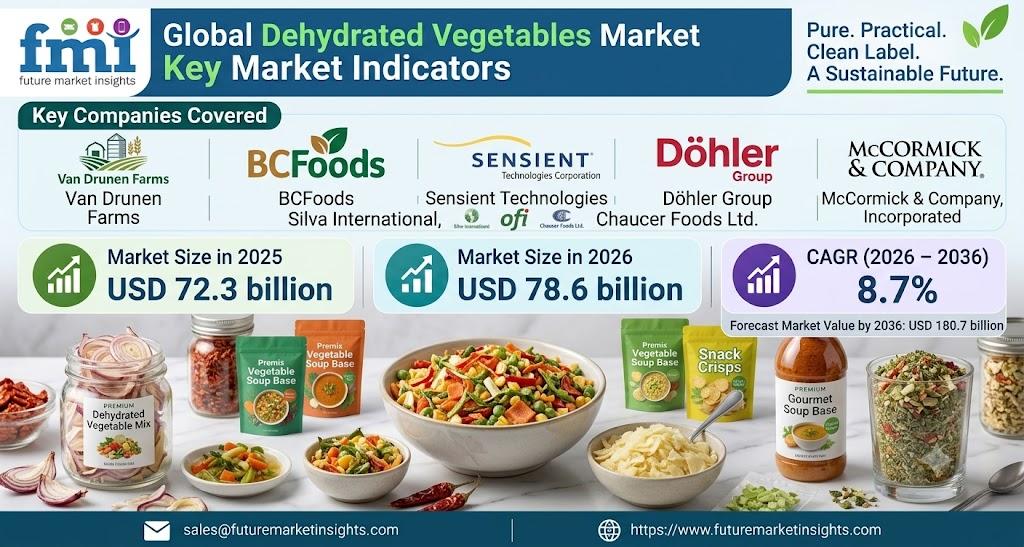
According to the latest market intelligence report published by Future Market Insights (FMI), the global dehydrated vegetables market is estimated to reach USD 78.6 billion in 2026, up from USD 72.3 billion in 2025. The market is projected to reach USD 180.7 billion by 2036, expanding at a compound annual growth rate (CAGR) of 8.7% from 2026 to 2036.
The market includes dehydrated vegetables supplied in powder, granule, flake, chopped, sliced, and cubed formats. These ingredients serve food manufacturers, retail consumers, and foodservice operators. Advances in dehydration technologies, growing applications for vegetable powders, and demand for convenient ingredient formats are creating opportunities for processors, agricultural suppliers, and food ingredient distributors.
Get Detailed Market Forecasts, Competitive Benchmarking & Industry Insights — Request a Sample Report: https://www.futuremarketinsights.com/reports/sample/rep-gb-4161
Dehydrated Vegetables Market Size and Growth Forecast
FMI’s forecast highlights an expanding commercial opportunity for vegetable processors, ingredient manufacturers, contract growers, and food ingredient distributors. As food manufacturers seek dependable vegetable ingredients with longer storage potential, suppliers can benefit from efficient drying operations, reliable agricultural sourcing, and consistent product specifications.
Key dehydrated vegetables market indicators include:
- Market size in 2025: USD 72.3 billion
- Market size in 2026: USD 78.6 billion
- Forecast market value by 2036: USD 180.7 billion
- Forecast CAGR, 2026–2036: 8.7%
- Leading product type: Beans, accounting for 29.1% of product-type revenue in 2026
- Leading product form: Powder and granules, accounting for 51.2% of form revenue in 2026
- Leading product nature: Conventional products, accounting for 95.2% of the nature segment in 2026
- Leading end-use segment: Food manufacturers, accounting for 73.3% of end-use demand in 2026
- Leading distribution channel: Direct supply, accounting for 81.5% of channel revenue in 2026
- Leading drying technology: Vacuum drying, accounting for 24.5% of technology revenue in 2026
- Fastest-growing profiled country: United Kingdom, with a projected CAGR of 13.4% through 2036
These indicators highlight the importance of processing efficiency, product consistency, crop sourcing, and industrial customer relationships as manufacturers pursue opportunities in the expanding dehydrated vegetables category.
Key Trends Shaping the Dehydrated Vegetables Market
- Beans Maintain a Leading Position in Product Demand
Beans account for 29.1% of product-type revenue in 2026, making them the leading product category in FMI's assessment. Dehydrated beans can serve as shelf-stable ingredients for soups, ready meals, sauces, snack mixes, and other processed food applications.
For manufacturers, this creates opportunities to improve drying efficiency, develop application-specific ingredient grades, and strengthen relationships with food processors. Consistent quality, dependable sourcing, and appropriate rehydration characteristics remain important considerations for industrial buyers.
- Powder and Granule Formats Support Industrial Food Production
Powder and granules account for 51.2% of form revenue in 2026. These formats are useful in dry-blending operations because they can be incorporated into seasonings, soups, sauces, seasoning mixes, and other formulations.
Ingredient suppliers can explore investments in milling, particle-size control, moisture management, and packaging technologies. Vegetable powders can also support product development in snacks, bakery products, and selected beverage and nutrition applications, subject to formulation requirements.
- Conventional Products Retain the Largest Market Share
Conventional dehydrated vegetables account for 95.2% of the nature segment in 2026. Established agricultural supply networks and the ability to source ingredients at industrial volumes support their position among large-scale food manufacturers.
Suppliers can strengthen their competitive position through quality assurance, traceability, consistent specifications, and cost-efficient processing. Organic products may offer opportunities in specialized premium categories, although certification, sourcing, and handling requirements can affect production costs.
- Food Manufacturers Remain the Primary End Users
Food manufacturers account for 73.3% of end-use demand in 2026. Industrial food producers use dehydrated vegetables in soups, sauces, seasonings, ready meals, packaged foods, and other processed products.
For ingredient suppliers, long-term procurement agreements and customized specifications can support recurring business. Manufacturers can differentiate themselves through dependable delivery, food-safety documentation, consistent ingredient quality, and technical support during product development.
- Direct Supply Strengthens Industrial Procurement Relationships
Direct supply accounts for 81.5% of distribution-channel revenue in 2026. Direct procurement allows food manufacturers and processors to coordinate ingredient specifications, quality requirements, order volumes, and delivery schedules with suppliers.
Businesses can strengthen these relationships through technical collaboration, supply-chain transparency, and reliable production planning. However, indirect distribution can remain important for smaller buyers and customers requiring access to a broader range of ingredients.
- Vacuum Drying Supports Technology Diversification
Vacuum drying accounts for 24.5% of technology revenue in 2026. Dehydration technologies differ in processing costs, operating conditions, throughput, and their effects on the color, texture, and functional characteristics of vegetables.
Processors can evaluate vacuum drying alongside air drying, freeze drying, spray drying, and drum drying according to the intended application and commercial requirements. Selecting an appropriate technology involves balancing ingredient quality, energy consumption, production capacity, and final product cost.
Regional Opportunities: United Kingdom Leads Forecast Growth
FMI’s country-level projections identify several markets offering opportunities for dehydrated vegetable manufacturers and distributors.
- United Kingdom: Projected to grow at a CAGR of 13.4% from 2026 to 2036.
- Spain: Forecast to expand at a CAGR of 10.6% over the same period.
- Germany: Expected to record a CAGR of 8.2%.
- Canada: Projected to grow at a CAGR of 6.6%.
- Russia: Forecast to expand at a CAGR of 6.2%.
- Mexico: Expected to record a CAGR of 5.8%.
- Brazil: Projected to grow at a CAGR of 4.7%.
- United States: Forecast to expand at a CAGR of 4.3%.
The United Kingdom leads the profiled countries in projected growth, followed by Spain and Germany. These markets offer potential opportunities for suppliers serving industrial food manufacturers, particularly where procurement teams require shelf-stable ingredients and consistent product specifications.
Spain also presents opportunities for suppliers serving established food-processing businesses, while Germany's agricultural production base can support domestic vegetable processing.
For companies evaluating international expansion, these projections provide a starting point for assessing market-entry opportunities. Agricultural availability, energy costs, food-safety regulations, import requirements, processing infrastructure, and local competition remain important considerations when developing regional strategies.
Top Companies in the Dehydrated Vegetables Market
FMI identifies the following companies among the notable participants in its competitive assessment of the dehydrated vegetables market:
- Van Drunen Farms — A supplier of dehydrated and freeze-dried ingredients for food manufacturers.
- BCFoods — A supplier of dehydrated vegetables, herbs, spices, and specialty ingredients.
- Silva International — A processor of dehydrated vegetables, fruits, and herbs into customized ingredients.
- ofi (Olam Food Ingredients) — An ingredient supplier with global sourcing and processing capabilities.
- Sensient Technologies Corporation — A company serving food manufacturers with specialty ingredients and agricultural ingredient solutions.
- Chaucer Foods Ltd. — A specialist in freeze-dried food ingredients and fruit and vegetable products.
- Döhler Group — A supplier of natural ingredients and ingredient systems for food and beverage manufacturers.
- McCormick & Company, Incorporated — A global flavor company using herbs, spices, and vegetable ingredients in seasoning solutions.
Competition spans integrated vegetable processors, freeze-dried ingredient specialists, and broader food ingredient and flavor businesses. Relevant competitive factors include agricultural sourcing, processing capacity, drying technology, product quality, price competitiveness, technical support, and distribution reach.
This list identifies notable companies discussed in the market assessment and should not be interpreted as a ranking by market share.
Business Outlook: Opportunities for Manufacturers and Suppliers
The projected expansion of the dehydrated vegetables market creates opportunities across agricultural sourcing, vegetable processing, specialty ingredient manufacturing, packaging, and industrial distribution.
Processors can evaluate investments in efficient dehydration systems, powder milling, automated handling, and quality-control capabilities. Suppliers may also benefit from developing application-specific vegetable ingredients for soups, sauces, seasonings, ready meals, and packaged foods.
Ingredient distributors can strengthen their offerings through dependable sourcing, product traceability, and technical assistance. Food manufacturers, meanwhile, can assess the use of dehydrated ingredients to simplify storage, support production planning, and reduce reliance on fresh vegetable preparation for selected applications.
However, sustained commercial performance will depend on more than market growth alone. Businesses must consider crop availability, seasonal price fluctuations, energy consumption, inventory management, drying-related quality changes, and food-safety requirements.
Companies that balance processing efficiency, ingredient quality, supply reliability, and competitive pricing will be better positioned to pursue opportunities in the dehydrated vegetables category.
About the Dehydrated Vegetables Market Report
Future Market Insights’ Dehydrated Vegetables Market report examines market size, forecast growth, product types, product forms, conventional and organic categories, end uses, drying technologies, distribution channels, regional opportunities, and the competitive landscape.
The report covers the 2026–2036 forecast period and includes country-level projections across key markets, helping manufacturers, ingredient suppliers, distributors, and investors assess emerging commercial opportunities.
Explore the Full Dehydrated Vegetables Market Report: https://www.futuremarketinsights.com/reports/dehydrated-vegetables-market
Frequently Asked Questions
What is the projected size of the dehydrated vegetables market by 2036?
The global dehydrated vegetables market is projected to reach USD 180.7 billion by 2036, according to FMI.
What is the expected CAGR for 2026–2036?
The market is forecast to grow at a CAGR of 8.7% during 2026–2036.
Which product type leads the dehydrated vegetables market?
Beans account for 29.1% of product-type revenue in 2026.
Which product form holds the leading position?
Powder and granules account for 51.2% of form revenue in 2026.
Which end-use segment leads the market?
Food manufacturers account for 73.3% of end-use demand in 2026.
Which drying technology has the largest share?
Vacuum drying accounts for 24.5% of technology revenue in 2026.
Which country has the fastest projected growth?
The United Kingdom leads the profiled countries, with a forecast CAGR of 13.4% from 2026 to 2036.
Which companies are identified in the competitive assessment?
Notable companies include Van Drunen Farms, BCFoods, Silva International, ofi, Sensient Technologies Corporation, Chaucer Foods Ltd., Döhler Group, and McCormick & Company, Incorporated.
Related Food & Agriculture Industry Reports
Fruit Powders Market https://www.futuremarketinsights.com/reports/fruit-powders-market
Health and Wellness Product Market https://www.futuremarketinsights.com/reports/health-and-wellness-products-market
Wheat Germ Oil Market https://www.futuremarketinsights.com/reports/wheat-germ-oil-market
Micellar Casein Market https://www.futuremarketinsights.com/reports/micellar-casein-market
Ursolic Acid Market https://www.futuremarketinsights.com/reports/ursolic-acid-market
About Future Market Insights
Future Market Insights (FMI) is an ESOMAR-certified market research and consulting firm providing syndicated, customized, investment, and social media research across industries, including food and beverage, healthcare, chemicals, technology, and consumer products. FMI delivers market intelligence, competitive analysis, and strategic insights to help organizations evaluate emerging opportunities and make informed business decisions. The company has offices in the United States, the United Kingdom, the UAE, and India.
Media Contact
For Press & Corporate Inquiries
Rahul Singh
AVP – Marketing and Growth Strategy
Future Market Insights, Inc.
Phone: +91 8600020075
For Sales: sales@futuremarketinsights.com
For Media: Rahul.singh@futuremarketinsights.com
Website: https://www.futuremarketinsights.com

 English
 Arabic
 French
 Spanish
 Portuguese
 Deutsch
 Turkish
 Dutch
 Italiano
 Russian
 Romaian
 Greek