


How Can Gangnammould Plastic Bucket Mould Support Daily Use
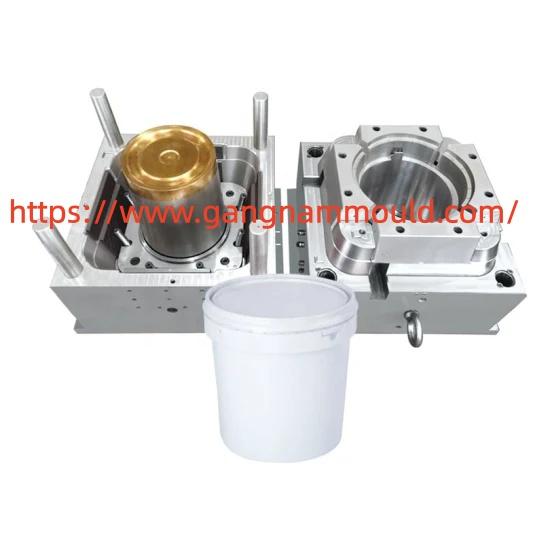
Plastic Bucket Mould design has a direct influence on the durability, usability, and appearance of finished containers. Products used for household cleaning, agricultural work, construction materials, and industrial storage may face different loads and operating conditions. Their service life depends on several connected factors, including material selection, wall structure, handle support, cooling control, and dimensional accuracy. For manufacturers and buyers, reviewing these details early can help establish realistic product requirements and reduce avoidable changes during development.
One important factor is how weight is distributed across the product. A container may carry water, cleaning solutions, powders, or other materials, so its walls and base need to suit the intended load. If the structure is poorly balanced, certain areas may experience greater stress during lifting or transport. Engineers should examine the relationship between overall dimensions, wall thickness, base geometry, and expected contents. The design should provide suitable support without adding unnecessary material that could increase production costs.
The base deserves particular attention because it carries the contents during storage and handling. A flat bottom may suit some applications, while other products benefit from carefully arranged reinforcement features. Ribs can increase stiffness in selected areas without requiring a substantial increase in overall wall thickness. Their position and dimensions should be evaluated together with material flow and cooling behavior. Poorly proportioned reinforcement can contribute to surface depressions or uneven shrinkage, so structural changes should be assessed before manufacturing begins.
Handle connections are another important consideration. When a filled container is lifted, force is transferred through the handle attachment points and surrounding walls. If these areas are not designed for the expected load, repeated handling may lead to deformation or cracking. Buyers should explain whether the product will have a fixed handle, a movable metal handle, or another carrying arrangement. Engineers can then review the attachment geometry, local reinforcement, and clearance needed for comfortable handling. Sample testing under representative conditions can help identify areas that require adjustment.
Material selection also affects long term performance. Polypropylene and high density polyethylene are commonly used for many reusable containers, but their properties vary by grade and formulation. Some applications require greater impact resistance, while others place greater emphasis on stiffness, chemical compatibility, or performance at different temperatures. Buyers should describe the substances the container will hold and the environment in which it will be used. This information helps the manufacturer assess suitable resin options and confirm whether additional testing is appropriate.
Cooling design influences how consistently a component retains its intended shape after injection. Sections with different thicknesses may cool at different rates, creating shrinkage variation or distortion. A carefully planned cooling layout can help control temperature distribution throughout the production cycle. Engineers should pay particular attention to the base, rim, handle attachment areas, and other sections where material may accumulate. These regions can require different cooling considerations depending on the geometry and selected resin.
The release process is equally important. After the material has cooled, the finished part must leave the tooling without excessive force or surface damage. Appropriate draft angles, rounded internal corners, and well positioned ejector components can help support smoother removal. Deep features and textured surfaces may require additional attention during design review. Addressing these factors before steel machining begins can reduce the risk of scratches, deformation, and repeated tooling adjustments.
Consistency between production batches matters to businesses that supply distributors, retailers, and industrial customers. Differences in rim dimensions, overall height, or base shape may affect compatibility with lids, stacking arrangements, and storage equipment. Buyers should identify critical dimensions and establish acceptable tolerances before sample approval. A clear inspection plan can include dimensional measurements, visual checks, handle performance, and tests related to the intended use. Written acceptance criteria also help both parties evaluate samples using the same expectations.
Manufacturing preparation should include a review of the drawings and production equipment. Three dimensional files can help engineers assess geometry, identify potential manufacturing difficulties, and discuss adjustments before machining starts. Buyers should provide estimated quantities, target material grades, surface requirements, and details about any matching components. Open communication at this stage gives the engineering team a clearer understanding of the project and supports more informed decisions about tooling structure, cooling, and ejection.
Maintenance planning is worth discussing before the project is confirmed. Cooling channels, moving mechanisms, and wear surfaces may need periodic inspection as production continues. Buyers should ask about routine servicing, spare components, and technical support arrangements. A practical maintenance plan can help manufacturers organize production schedules and address wear before it causes avoidable interruptions. These considerations are particularly relevant when a product is expected to remain in regular production over an extended period.
For businesses planning new container designs or updating existing products, Gangnammould provides a starting point for discussing custom tooling requirements and manufacturing arrangements. Buyers can visit https://www.gangnammould.com/ to review the company website and prepare drawings, material preferences, target dimensions, and production estimates for an inquiry. Sharing these details early helps both parties assess design options, clarify technical expectations, and develop a manufacturing plan suited to the intended application.

 English
 Arabic
 French
 Portuguese
 Deutsch
 Turkish
 Dutch
 Italiano
 Russian
 Romaian
 Portuguese (Brazil)
 Greek