


Last-Mile Delivery Optimisation: Strategies for Better Customer Experience
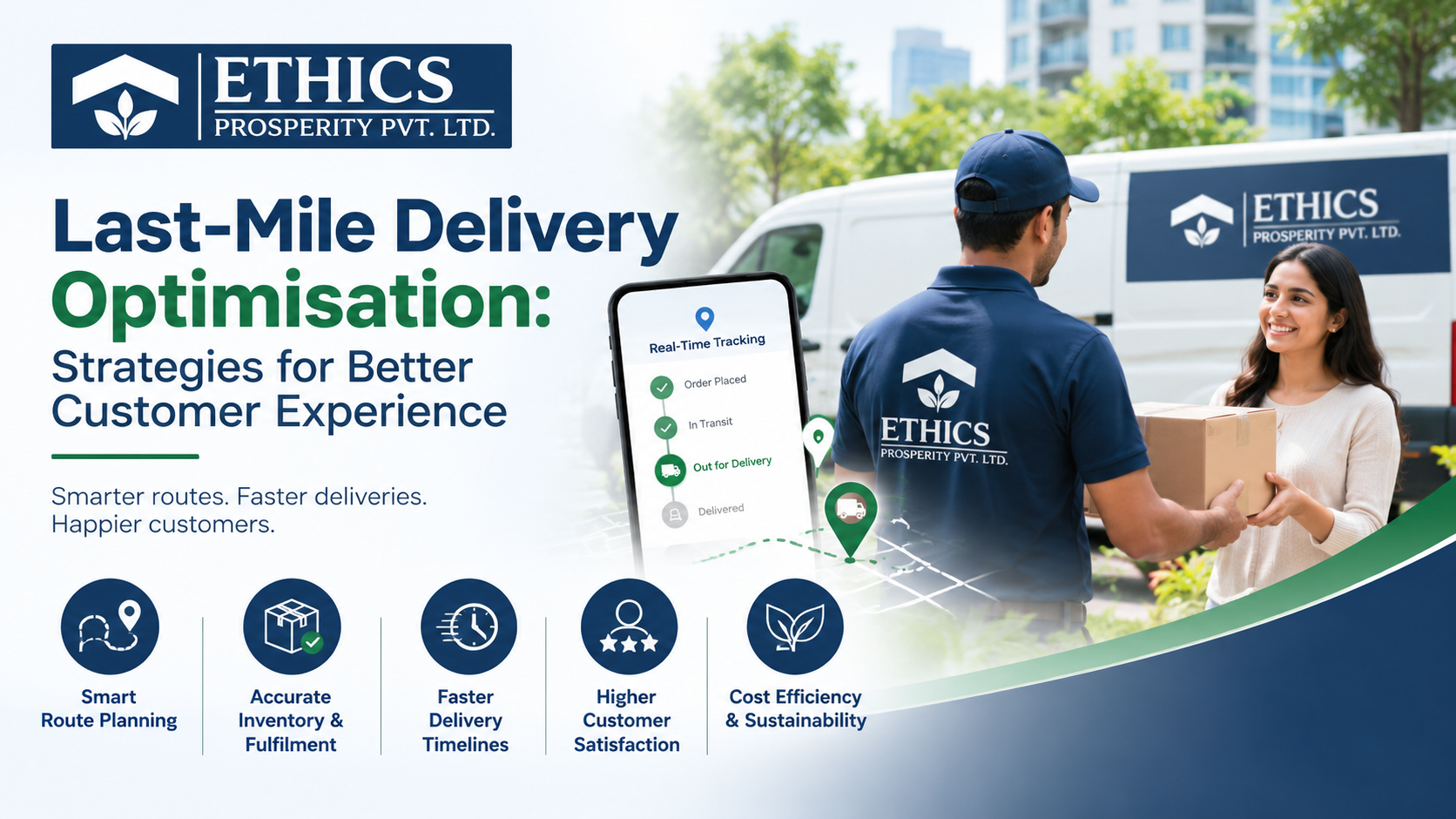
The final stage of a shipment can have a significant impact on customer satisfaction and overall logistics expenditure. Whether a business delivers products to retail outlets, distributors, offices, or individual consumers, the last mile requires careful coordination between order processing, inventory availability, transportation, and delivery schedules.
Last-mile delivery becomes particularly challenging when businesses serve multiple locations, handle time-sensitive orders, or experience fluctuating demand. Traffic congestion, failed delivery attempts, inaccurate addresses, and limited delivery visibility can increase costs and disrupt service commitments.
Last-mile delivery optimisation helps businesses address these challenges through better route planning, reliable delivery information, efficient dispatch processes, and continuous performance monitoring.
What Is Last-Mile Delivery Optimisation?
Last-mile delivery optimisation involves improving the final movement of goods from a distribution centre, warehouse, retail outlet, or local fulfilment facility to the intended recipient.
The objective is to complete deliveries accurately and within the agreed timeframe while managing transportation costs and available resources.
Depending on the operating model, optimisation may include route planning, shipment consolidation, vehicle allocation, delivery scheduling, customer notifications, and proof-of-delivery management.
An effective strategy balances speed, reliability, capacity utilisation, and cost rather than focusing exclusively on faster delivery.
Four Strategies to Improve Last-Mile Performance
1. Use Data-Driven Route Planning
Delivery routes should account for destination locations, traffic patterns, vehicle capacity, delivery time windows, and the number of shipments assigned to each driver.
Route planning software can help identify practical delivery sequences and reduce unnecessary travel. Dispatch teams should also retain procedures for adjusting routes when traffic, weather, or customer availability changes.
For businesses operating in dense urban areas, route planning should consider local access restrictions, parking limitations, and delivery-site requirements.
2. Improve Order and Address Accuracy
Incorrect addresses, incomplete customer details, and inaccurate order information can lead to failed delivery attempts.
Businesses can reduce these problems by validating address information, confirming delivery instructions, and ensuring that shipment labels match order records.
Clear coordination between order management, warehouse dispatch, and delivery teams also helps prevent shipments from leaving the facility with incomplete information.
3. Increase Delivery Visibility
Shipment tracking helps businesses and customers understand delivery progress.
Depending on the available systems, tracking may include dispatch confirmation, milestone updates, estimated arrival information, and proof of delivery.
When delays occur, timely communication can help customers prepare for revised delivery schedules. Internally, exception alerts allow operations teams to investigate problems and take corrective action.
4. Improve Shipment Consolidation
Combining compatible deliveries can improve vehicle utilisation and reduce the cost per shipment. However, consolidation must account for delivery deadlines, destination proximity, product handling requirements, and customer commitments.
Businesses should compare the savings from consolidated routes with the potential cost of delayed orders or additional handling.
Technology Supporting Last-Mile Logistics
Digital tools can help connect warehouse dispatch, transportation planning, shipment tracking, and customer communication.
Transportation Management Systems can support route planning and carrier coordination. Mobile delivery applications can record shipment status and proof of delivery. Analytics can identify recurring delays, high-cost routes, and destinations with frequent failed delivery attempts.
Technology should be supported by reliable data and clear procedures for managing delivery exceptions.
KPIs for Measuring Last-Mile Performance
Businesses should monitor on-time delivery, first-attempt delivery success, cost per delivery, vehicle utilisation, customer complaints, and failed delivery rates.
These metrics should be evaluated together. A high first-attempt delivery rate, for example, may still be accompanied by excessive costs if routes are poorly planned.
Conclusion
Last-mile delivery optimisation helps businesses improve delivery reliability, use transportation resources more effectively, and provide better shipment visibility. Consistent performance depends on accurate order information, practical route planning, appropriate technology, and well-defined operational procedures.
Businesses seeking to strengthen the connection between warehousing, fulfilment, and distribution can explore Ethics Prosperity's supply chain capabilities to evaluate how coordinated operations may support their logistics requirements.

 English
 Arabic
 French
 Spanish
 Portuguese
 Deutsch
 Turkish
 Dutch
 Italiano
 Russian
 Romaian
 Greek