


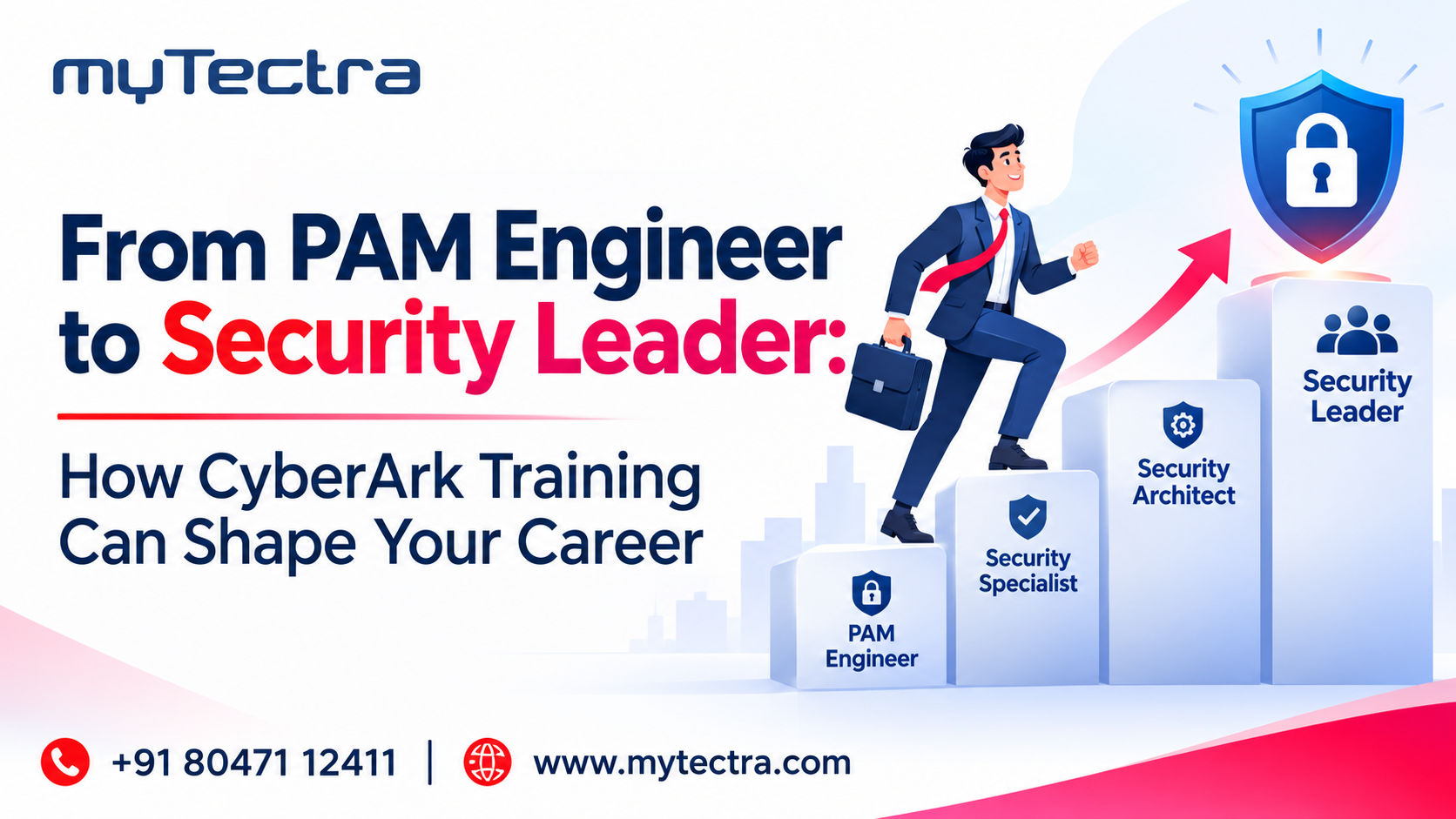
From PAM Engineer to Security Leader: How CyberArk Training Can Shape Your Career
CyberArk training will not make you a cybersecurity team leader on its own. What it does is put you inside the part of security where most serious breaches begin, which is privileged access, and give you hands-on, project-level experience that leaders are expected to have. Combine that with a recognised certification, a broader identity security skill set, and deliberate leadership practice, and it becomes one of the more credible routes from technical specialist to security manager or architect.
This guide explains why, what the role actually looks like day to day, how long the climb realistically takes, and how to choose a course in Bangalore that is worth your time.
What is CyberArk, and why do employers care?
CyberArk is a Privileged Access Management (PAM) platform. It protects the accounts that hold elevated power inside an organisation: administrator logins, service accounts, database credentials, and the secrets that applications use to talk to each other. It stores those credentials in an encrypted vault, rotates passwords automatically, controls who can use them, and records privileged sessions for audit.
The reason this matters is simple. Attackers rarely need to break everything. They need one account with enough access. Organisations that control and monitor those accounts shrink the damage a single stolen password can cause.
The market backs this up. CyberArk was named a Leader in the 2025 Gartner Magic Quadrant for Privileged Access Management, its seventh consecutive year in that position. And in February 2026, Palo Alto Networks completed its roughly $25 billion acquisition of CyberArk. CyberArk remains available as a standalone product while Palo Alto Networks integrates it across its wider security platform, with a stated focus on securing human, machine and AI agent identities.
For your career, that means CyberArk skills now sit inside one of the largest security vendors' portfolios, and identity has become a core pillar of enterprise security strategy rather than a niche.
Can CyberArk training really lead to a leadership role?
Yes, but indirectly, and it helps to be clear about the mechanism. Leadership in security is rarely handed out for knowing a tool. It comes from owning outcomes. PAM work gives you unusually good chances to do that, for three reasons.
1. PAM projects are cross-functional by nature. Onboarding privileged accounts means working with infrastructure, network, database, application, audit and compliance teams. You learn to negotiate priorities, explain risk in plain language, and get people to change how they work. These are management skills in practice.
2. The work is visible to auditors and executives. Access reviews, session recording, dual control and reporting feed directly into compliance evidence. When you can show an auditor exactly who accessed which system and when, you become the person leadership trusts with the next programme.
3. It forces architectural thinking. Designing Safes, access matrices, policies, backup and disaster recovery means making decisions about trade-offs: security versus convenience, resilience versus cost. That is the same muscle a security architect or manager uses.
What does a CyberArk professional actually do?
A typical week might include onboarding a new set of Windows and Linux accounts, adjusting a platform policy after an audit finding, troubleshooting a failed password rotation, reviewing who has access to a sensitive Safe, and supporting a disaster recovery test. Senior people spend more time on design, vendor and stakeholder conversations, and mentoring.
The core components you will work with are:
- Vault: the secure, encrypted repository for credentials.
- Central Policy Manager (CPM): automates password changes and verification.
- Password Vault Web Access (PVWA): the web interface for users and administrators.
- Privileged Session Manager (PSM): proxies and records privileged sessions.
A solid course teaches all four, plus the supporting pieces: authentication methods, LDAP integration, backup, and disaster recovery.
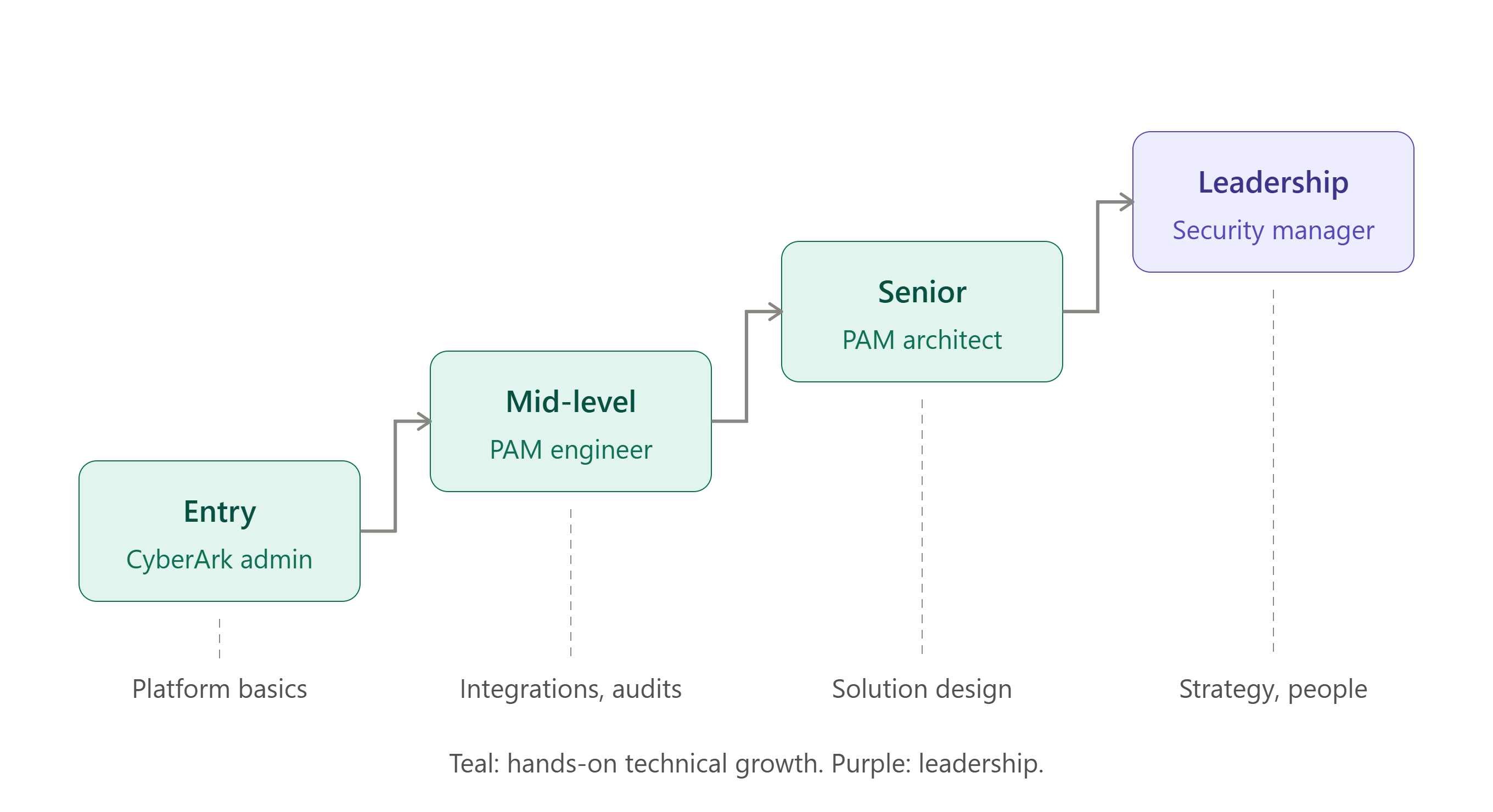
A realistic career path
Timelines vary by person, employer and how much hands-on exposure you get, so treat the stages below as a map rather than a schedule.
|
Stage |
Typical roles |
What you are building |
|---|---|---|
|
Entry |
CyberArk Administrator, PAM Support Engineer, Identity Security Analyst |
Platform fundamentals, onboarding accounts, troubleshooting |
|
Mid |
PAM Engineer, CyberArk Developer, Delivery Engineer |
Installations, integrations, automation, handling audits |
|
Senior |
CyberArk Architect, IAM Lead, Security Consultant |
Solution design, DR and scale, cross-team delivery |
|
Leadership |
Security Manager, Head of Identity Security, Information Security Leader |
Strategy, budget, risk, hiring and mentoring |
The jump from mid to senior is where most people stall, and it is rarely a technical problem. It usually comes down to whether you have led a delivery end to end, presented to non-technical stakeholders, and widened your knowledge beyond one product.
Which certifications matter?
CyberArk's own certifications are the clearest signal that you can work with the product. CyberArk Defender (PAM) is the usual starting point, covering core concepts and day-to-day administration. Sentry and delivery-focused certifications suit people who deploy and manage the platform at scale. Exams are taken with CyberArk, so check its official site for current exam names, requirements and fees before you plan.
As you move toward management, broader credentials help you speak the language of governance and risk. Common choices are CISSP, CISM and Security+, along with a cloud security certification relevant to your employer's stack. Job postings for CyberArk roles in Bangalore frequently list Defender and Sentry as preferred, so the vendor certifications tend to open doors, and the broader ones help you walk through them later.
Skills to add beyond CyberArk
Leaders see the whole picture. Once you have a year or two of hands-on PAM work, widen your range in this order:
- Identity and Access Management (IAM) and identity governance: how joiner, mover and leaver processes connect to privileged access.
- Cloud and DevOps security: secrets management for pipelines, containers and cloud accounts.
- Zero Trust principles: least privilege, just-in-time access and continuous verification.
- Machine and AI agent identities: the fastest-growing source of privileged access, and a major theme in where the industry is heading.
- Risk, governance and compliance: how to translate technical controls into business risk, budgets and audit language.
The leadership habits that move people up
Technical skill gets you to senior. These habits get you past it:
- Lead one thing end to end. A PAM rollout, a migration, or an access review cycle. Own the plan, the stakeholders and the outcome.
- Write and present. Turn a technical finding into a one-page recommendation for a non-technical reader.
- Mentor someone. Teaching a junior colleague how to onboard accounts forces you to explain your reasoning clearly.
- Learn the business. Know which systems earn revenue and which regulations apply to your sector, then prioritise accordingly.
How to choose CyberArk training in Bangalore
Whatever provider you consider, judge it on these points:
- Hands-on labs. You should install and configure the Vault, CPM, PVWA and PSM yourself, not just watch demonstrations.
- Coverage of operations, not only setup. Backup, troubleshooting and disaster recovery are where real incidents happen.
- A syllabus you can read before paying. Ask for the full module list and compare it with the components above.
- Trainers who work in the field. Ask about their project experience.
- A free demo class. It is the cheapest way to judge teaching quality.
- Honest claims about outcomes. Be cautious of guaranteed jobs or salary promises. Training gives you skills and a certificate; hiring decisions belong to employers.
One option in the city is myTectra's CyberArk Training in Bangalore, which offers classroom batches in Bangalore and live online sessions. Its syllabus runs across 13 modules covering the Vault, CPM, PVWA and PSM, policy and Safe management, account integration for Windows and Unix/Linux, vault backup, troubleshooting and disaster recovery. The course lists basic networking and Windows administration as prerequisites, includes hands-on labs and projects, and provides lifetime access to session recordings. You can view the full syllabus and request a free demo on the course page before deciding.
Is it a good fit for you?
CyberArk training suits you if you are a system or network administrator, a vault administrator, a security analyst, or an IT professional moving into security. It is a weaker fit if you have no interest in infrastructure work, since much of the early job is installation, integration and troubleshooting. If you are unsure, take a demo class and read a few current PAM job descriptions in your target companies first.
Frequently asked questions
What is CyberArk used for?
CyberArk secures, controls and monitors privileged accounts such as administrator, service and application accounts. It vaults credentials, rotates passwords automatically, limits who can use them and records privileged sessions for audit.
Is CyberArk still relevant after the Palo Alto Networks acquisition?
Yes. Palo Alto Networks completed the acquisition in February 2026 and stated that CyberArk's identity security products remain available as a standalone platform while being integrated into Palo Alto's wider security portfolio.
Do I need coding skills to learn CyberArk?
Not to start. Basic networking and Windows administration are enough for most beginner courses. Scripting, REST APIs and automation become more useful as you move into developer and architect roles.
Which CyberArk certification should a beginner take first?
CyberArk Defender (PAM) is the usual starting point. Check CyberArk's official site for current exam details.
How long does it take to move into a leadership role?
There is no fixed timeline. It depends on the projects you lead, your certifications, your communication skills and your employer. Treat the path as a progression of responsibility rather than a countdown.
Can freshers get CyberArk jobs?
Entry roles such as CyberArk administrator or support engineer exist, but many employers prefer some IT infrastructure background. Hands-on lab work and a certification help freshers stand out.
Is CyberArk training available online in India?
Yes. Several providers, including myTectra, offer live online batches alongside classroom training in cities such as Bangalore.
What should I check before paying for a course?
Read the full syllabus, confirm there are hands-on labs, ask about trainer experience, attend a free demo, and be wary of guaranteed placement or salary claims.
The bottom line
CyberArk skills give you a real foothold in a high-demand, high-trust area of security. Leadership comes from what you do with that foothold: the projects you own, the certifications you earn, the adjacent skills you learn, and the people you help along the way. If you are ready to start, review the CyberArk training syllabus and demo options in Bangalore, compare it against the checklist above, and take a demo class before you commit.

 English
 Arabic
 French
 Spanish
 Portuguese
 Deutsch
 Dutch
 Italiano
 Russian
 Romaian
 Portuguese (Brazil)
 Greek