


Food Intolerance Test vs. Food Allergy Test: Key Differences Explained
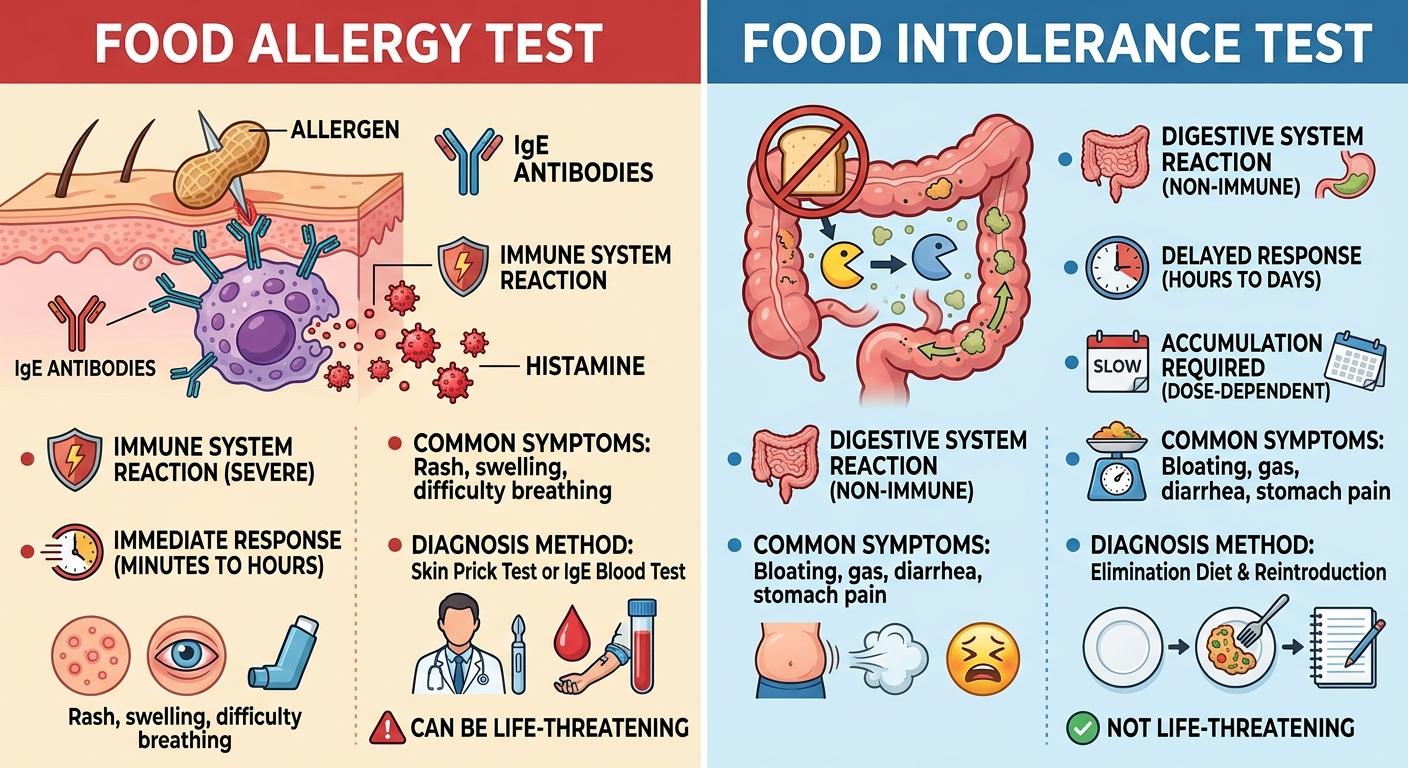
Digestive discomfort after eating certain foods does not always mean you have an allergy. A food intolerance test may be considered when symptoms such as bloating, gas or abdominal discomfort repeatedly follow particular meals, while suspected allergic reactions require a different medical assessment. Although both conditions can involve the same foods, they have different causes, symptoms and testing approaches. Understanding that distinction helps you choose the right next step instead of unnecessarily removing foods from your diet.
For people experiencing recurring symptoms, the most important question is not simply which test covers more ingredients. It is whether the testing method is appropriate for the symptoms and whether the results can support a meaningful clinical decision.
1. What Is the Difference Between Food Intolerance and Food Allergy?
The main difference is how the body responds to a particular food.
A food allergy involves the immune system reacting to a food protein it mistakenly identifies as harmful. In many immediate food allergies, this response involves immunoglobulin E (IgE) antibodies. Symptoms can develop within minutes, although some allergic conditions have delayed reactions.
Food intolerance generally does not involve the same immune response. It often occurs when the digestive system has difficulty processing a food component or when a person is sensitive to a particular ingredient. Symptoms may depend on the amount consumed and can take several hours to appear.
For example, someone with lactose intolerance may experience bloating, abdominal cramps and diarrhoea after consuming milk because their body does not produce enough lactase to digest lactose effectively. Someone with a milk allergy, however, reacts to milk proteins through an immune mechanism.
This distinction matters because an intolerance may cause significant discomfort without producing the potentially life-threatening reactions associated with some food allergies.
2. Food Intolerance vs. Food Allergy: Symptoms to Recognise
Symptoms can overlap, particularly when digestive problems are involved. However, the pattern, timing and severity of a reaction can provide useful clues.
Common signs of food intolerance
Food intolerance symptoms are often digestive and may become more noticeable after eating larger portions of a particular food.
Common symptoms include:
-
Bloating and excessive gas
-
Abdominal cramps or discomfort
-
Diarrhoea or changes in bowel movements
-
Nausea
-
Indigestion
-
A feeling of fullness after eating
Lactose intolerance is a well-known example. Other food-related symptoms may be associated with fermentable carbohydrates, certain additives or other digestive conditions.
Common signs of food allergy
An allergic reaction can affect several body systems, not just the digestive tract. Symptoms may include:
-
Hives, itching or a raised skin rash
-
Swelling of the lips, face, tongue or throat
-
Wheezing, coughing or difficulty breathing
-
Vomiting or abdominal pain
-
Dizziness or light-headedness
-
A sudden drop in blood pressure
A severe allergic reaction, known as anaphylaxis, can be life-threatening. Breathing difficulty, throat or tongue swelling, faintness or rapidly worsening symptoms after eating require immediate emergency medical attention. Do not wait for a test appointment or attempt to manage a suspected severe reaction at home.
Importantly, symptom timing alone cannot confirm the diagnosis. Some allergic conditions cause delayed symptoms, and digestive disorders can produce symptoms that resemble food reactions.
3. How Are the Two Conditions Diagnosed?
The correct investigation depends on the suspected condition. There is no single blood test that reliably identifies every food allergy, intolerance or digestive problem.
Tests used to investigate food intolerance
A clinician usually begins by reviewing symptoms, eating habits, medical history and the timing of reactions. Depending on the suspected trigger, the investigation may involve:
Food and symptom diary: Recording meals, portion sizes, symptoms and their timing can help identify recurring patterns. It is more useful to track symptoms consistently than to remove several foods at once.
Elimination and reintroduction: A healthcare professional may recommend temporarily removing a suspected food and then reintroducing it in a planned way to see whether symptoms improve and return. This should be structured, particularly when several foods or nutritional requirements are involved.
Hydrogen breath testing: This is commonly used when lactose or certain carbohydrate malabsorption problems are suspected. After consuming a measured amount of the relevant substance, breath samples are collected to assess hydrogen levels.
Targeted blood tests: Blood investigations may help assess other conditions that cause similar symptoms. For example, coeliac disease requires specific testing and should be investigated before starting a gluten-free diet, as avoiding gluten can affect test accuracy.
A broad food panel should not replace these targeted investigations.
Tests used to diagnose food allergies
When an allergy is suspected, the process usually starts with a detailed allergy-focused medical history. A doctor may ask which food caused the reaction, how quickly symptoms appeared, how much was eaten and whether the same response occurred on previous occasions.
Depending on that history, testing may include:
-
Skin-prick testing: A small amount of suspected allergen is placed on the skin. The clinician checks for a localised reaction.
-
Specific IgE blood testing: A blood sample is analysed for IgE antibodies associated with particular food allergens.
-
Oral food challenge: Under medical supervision, a person consumes a carefully measured amount of a suspected food while being monitored for a reaction.
Skin-prick and specific IgE tests can help identify sensitisation, but a positive result does not automatically prove that eating the food causes an allergy. An oral food challenge may be recommended by an allergy specialist when the diagnosis remains uncertain. It must be conducted in an appropriate medical setting, not attempted independently at home.
4. Can a Food Intolerance Test Detect a Food Allergy?
No. These tests are not interchangeable, even when they examine some of the same foods.
Some commercially available intolerance panels measure IgG antibodies against a range of food items. These results indicate antibody reactivity, but they do not establish that a food is causing symptoms. IgG antibodies can reflect normal exposure to foods, and professional allergy organisations do not recommend food-specific IgG testing to diagnose food allergy or intolerance.
This is an important distinction when reviewing large panels that list dozens or hundreds of ingredients. A long list of results does not necessarily mean the test has identified the cause of digestive symptoms.
Similarly, a negative intolerance panel cannot rule out an IgE-mediated allergy. Anyone with a history of hives, swelling, breathing symptoms or another suspected allergic reaction needs an appropriate allergy assessment.
What should you check before choosing a panel?
Before booking any investigation, consider:
-
What biological marker does the test measure?
-
Is it designed to investigate allergy, intolerance or another aspect of health?
-
Does the provider explain what a positive result means?
-
Is medical or nutritional guidance available to interpret the findings?
-
Will the results lead to a practical, evidence-informed next step?
These questions help prevent confusion between a screening result and a confirmed diagnosis.
5. Understanding At-Home Food Testing Options in Dubai
At-home testing can make sample collection more convenient for people who prefer not to travel to a clinic or laboratory. However, convenience should not be confused with diagnostic accuracy. The type of test and its intended purpose remain more important than where the sample is collected.
In Dubai, Valeo Health lists several options under its intolerance and allergy testing category, including standard and comprehensive food reactivity panels, a 44-panel food allergy test and broader allergy packages. Its website also describes at-home testing, digital result analysis and access to health guidance.
The comprehensive food reactivity panel is described as measuring IgG antibody reactivity across more than 280 food items. It is important to understand that this type of result is not equivalent to a clinically confirmed food intolerance diagnosis, nor does it replace specific IgE testing or an allergist's assessment.
For someone considering testing, the sensible approach is to discuss recurring symptoms with a qualified healthcare professional first. Ask which investigation is appropriate and whether the selected panel can answer the actual medical question.
If you are exploring at-home services, review the test description, sample collection process, laboratory information and available support before booking. A clinician or appropriately qualified dietitian should help interpret findings in the context of your symptoms and nutritional needs.
6. What Should You Do After Receiving Your Results?
Test results are only useful when they are interpreted correctly. Avoid treating every elevated marker as proof that a food must be removed permanently.
If a clinician identifies a likely intolerance, management may involve reducing portion sizes, choosing suitable alternatives or limiting a particular ingredient. For lactose intolerance, for example, some people can tolerate small amounts of lactose or selected lower-lactose products.
If an allergy is diagnosed, the management plan is different. It may require strict avoidance of the confirmed allergen, checking food labels, understanding cross-contact risks and knowing when and how to use prescribed emergency medication.
Do not start a highly restrictive diet based only on a commercial panel. Removing dairy, wheat, eggs, nuts and other food groups without professional guidance can make it harder to meet nutritional requirements. This is especially important for children, pregnant individuals and people with existing health conditions.
Persistent digestive symptoms also deserve further investigation. Irritable bowel syndrome, inflammatory bowel disease, coeliac disease, infections and other gastrointestinal conditions can produce symptoms that people may mistakenly attribute to food intolerance.
7. How to Choose the Right Investigation for Your Symptoms
The most appropriate test depends on the reaction you experience.
If symptoms mainly involve bloating, gas or diarrhoea after particular foods, a medical review can help determine whether breath testing, targeted blood investigations or a supervised dietary assessment is suitable.
If you experience hives, facial swelling, wheezing or rapid symptoms after eating, seek an allergy assessment rather than relying on an intolerance panel. Any signs of anaphylaxis require emergency care.
The goal is not to test every food available. It is to identify the likely cause of symptoms using an appropriate method and avoid unnecessary dietary restrictions.
When Is a Food Intolerance Test Worth Considering?
A targeted investigation may be worth discussing with a healthcare professional when digestive symptoms repeatedly follow certain foods, interfere with daily activities or remain unexplained. The right approach depends on the suspected trigger, and a broad IgG panel should not be treated as a definitive diagnosis. A symptom history, appropriate clinical tests and professional interpretation provide a more reliable foundation for deciding what to eat.
Frequently Asked Questions
1. Can food intolerance turn into a food allergy?
Food intolerance does not normally develop into a food allergy because the two conditions involve different mechanisms. However, a person can have both conditions, and new or changing symptoms should be assessed rather than assumed to be an intolerance.
2. Which test is more accurate for identifying food allergies?
There is no single test suitable for every case. Skin-prick testing and specific IgE blood tests help identify possible allergic sensitisation. A medically supervised oral food challenge is the reference standard when further confirmation is needed.
3. Can a blood test identify all food intolerances?
No. Different conditions require different investigations. Lactose intolerance, for example, may be assessed using a hydrogen breath test, while coeliac disease requires specific blood testing and sometimes further investigations. A general blood panel cannot diagnose every possible food-related digestive problem.
4. Are food IgG tests reliable for identifying foods that cause bloating?
Food-specific IgG results are not considered a reliable way to diagnose food intolerance. They may reflect normal exposure to foods rather than an adverse reaction. Results should not be used alone to create a restrictive diet.
5. Should I stop eating a food before getting tested?
Do not remove several food groups without medical advice. In particular, people being investigated for coeliac disease should continue eating gluten until the recommended testing is completed, unless their clinician advises otherwise. If you suspect a serious food allergy, avoid deliberately eating the suspected trigger and seek medical assessment.
Conclusion
Food intolerance and food allergy can produce overlapping symptoms, but they require different approaches to diagnosis and management. Digestive discomfort may call for a review of eating patterns and targeted gastrointestinal investigations, while suspected allergic reactions need an allergy-focused assessment. Understanding what a test measures is essential before making dietary decisions.
For people exploring at-home testing in Dubai, Valeo Health offers a range of food reactivity and allergy testing options. Choosing between them should start with the symptoms being investigated and the clinical purpose of the test, not simply the number of foods included in a panel.
Medical Disclaimer: This article is for general educational purposes and does not replace medical advice, diagnosis or treatment. Food allergy can cause life-threatening reactions. Seek emergency medical care if you experience breathing difficulty, throat or tongue swelling, faintness or other signs of anaphylaxis. Always consult a qualified healthcare professional before starting an elimination diet or interpreting food-related test results.

 Arabic
 French
 Spanish
 Portuguese
 Deutsch
 Turkish
 Dutch
 Italiano
 Russian
 Romaian
 Portuguese (Brazil)
 Greek