


How Self-Attention Works in Transformer Models
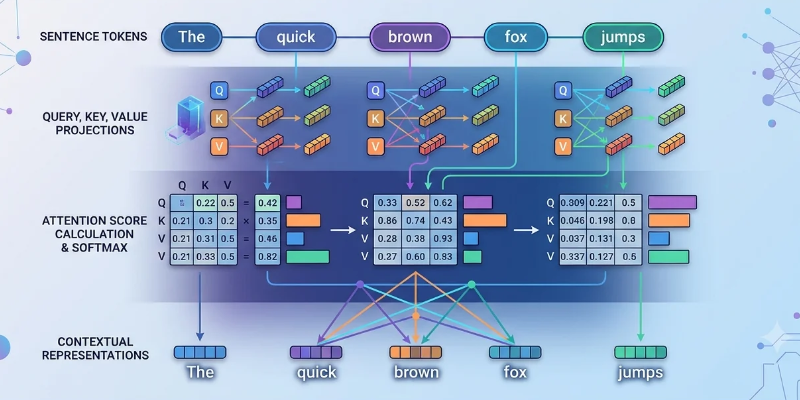
Artificial Intelligence has changed how computers understand and process human language. One of the key technologies behind this progress is the Transformer architecture. It allows AI models to understand relationships between words and generate meaningful responses. At the heart of this architecture is a mechanism called self-attention. It helps models identify which words are important when processing a sentence. If you want to build a strong foundation in Generative AI concepts and practical applications, consider enrolling in a Generative AI Course in Vellore at FITA Academy to develop your technical knowledge and skills.
What is Self-Attention in Transformer Models?
Self-attention is a process that enables a model to comprehend the relationships between various words in a sentence. Instead of processing every word separately, it examines how each word relates to the other words in the same sentence.
For example, consider the sentence "The dog chased the ball because it was moving." To understand the meaning of "it," the model needs to identify its relationship with the other words. Self-attention helps the model focus on relevant words and understand the context.
This mechanism allows Transformer models to capture relationships between words, even when they appear far apart in a sentence.
Why is Self-Attention Important?
Traditional language processing models often process text sequentially. This can make it difficult to capture relationships between distant words.
Self-attention addresses this limitation by allowing each word to consider other words in the input simultaneously. This helps the model understand sentence structure, word meaning, and context more effectively.
Some important benefits of self-attention include:
-
Context Understanding: It helps models understand words based on their surrounding context.
-
Long-Range Relationships: It identifies connections between words that are far apart.
-
Parallel Processing: It allows multiple words to be processed together during training.
-
Better Language Understanding: It helps models capture relationships and meaning across sentences.
These capabilities make self-attention an important part of modern language models and Generative AI applications.
How Does Self-Attention Work?
Self-attention works by converting input words into numerical representations and calculating how much attention each word should receive from other words.
The process involves three important components called Query, Key, and Value.
1. Query
A Query represents what a particular word is looking for in other words. It helps the model identify which information is useful for understanding the current word.
2. Key
A Key represents the information associated with each word. The model compares Queries with Keys to identify how relevant different words are to one another.
3. Value
A Value contains the actual information that the model uses to create a meaningful representation. Once the attention scores are calculated, the model combines the Values based on their importance.
Together, Query, Key, and Value help the Transformer identify relationships between words and understand their context.
Understanding the Self-Attention Process Step by Step
The self-attention mechanism follows a sequence of operations to understand input text.
Step 1 – Input Embeddings: Each word is converted into a numerical representation called an embedding.
Step 2 – Query, Key, and Value Generation: The model transforms each embedding into three separate representations.
Step 3 – Attention Score Calculation: The model compares Queries and Keys to calculate how strongly different words are related.
Step 4 – Softmax Calculation: The scores are converted into attention weights. These weights determine how much importance each word receives.
Step 5 – Weighted Value Combination: The model combines the Value representations according to their attention weights.
Step 6 – Contextual Representation: The resulting representation contains information from relevant words, helping the model understand the input more effectively.
This process allows Transformer models to build contextual representations of words and capture meaningful relationships within text.
What is Multi-Head Self-Attention?
Multi-head self-attention is an advanced version of the self-attention mechanism. Instead of using a single attention operation, it uses multiple attention heads to examine different relationships within the input.
For example, one attention head might focus on grammatical relationships, while another may identify connections between subjects and actions. Each head processes information independently, and their outputs are combined to create a richer representation.
This approach helps Transformer models understand different aspects of language simultaneously.
Real-World Applications of Self-Attention
Self-attention plays an important role in several modern AI applications.
-
Chatbots: Helps AI assistants understand user questions and generate relevant responses.
-
Machine Translation: Identifies relationships between words when translating languages.
-
Text Summarization: Helps models identify important information in lengthy documents.
-
Text Generation: Supports the generation of meaningful and contextually relevant sentences.
-
Sentiment Analysis: Helps models understand the relationships between words when identifying emotions and opinions.
These applications demonstrate how self-attention supports modern Natural Language Processing and Generative AI systems.
Self-attention is one of the most important components of Transformer models. It helps AI systems understand relationships between words, identify relevant information, and generate contextually meaningful outputs. By using Query, Key, and Value representations, the mechanism allows models to process language more effectively. Understanding self-attention also provides a foundation for learning advanced AI technologies, including Large Language Models and Generative AI. If you want to strengthen your understanding of these concepts and explore broader AI technologies, take an Artificial Intelligence Course in Vellore to enhance your understanding and cultivate hands-on abilities for the changing AI sector.

 English
 Arabic
 French
 Spanish
 Deutsch
 Turkish
 Dutch
 Italiano
 Russian
 Romaian
 Portuguese (Brazil)
 Greek