


How Traffic Survey Data Helps Improve Traffic Flow in UAE
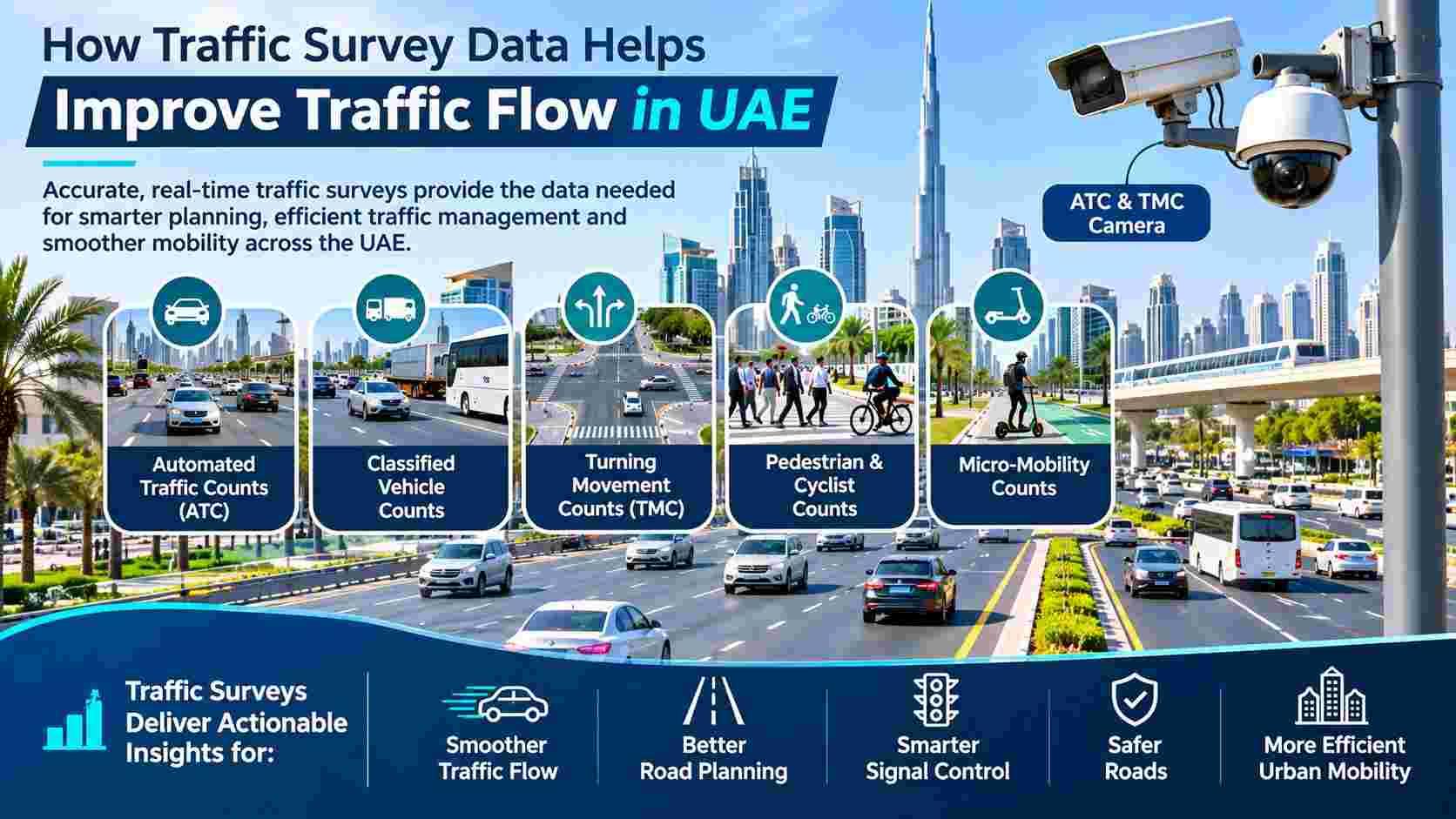
Traffic Surveys turn guesses about congestion into measured facts, and across the Emirates that evidence helps engineers, developers, and authorities decide where to retime signals, widen a turn, add a crossing, or leave a road alone. This guide shows how each type of count answers a specific flow problem and how the results become real improvements.
Why Flow Problems Need Evidence
Everyone has an opinion about congestion. Drivers blame signals, residents blame new buildings, and shop owners blame parking. Opinions are useful clues, but they cannot tell an engineer how many vehicles use a junction, how long queues last, or which movement causes the delay.
Fixing the wrong problem is expensive. A widened road that does not address the real bottleneck wastes budget, and a signal change made without data can move the queue instead of removing it. Reliable counts show where the pressure truly lies before any money is spent.
The approach is simple: describe the symptom, choose the count that explains it, study the pattern, apply a fix, and measure again. The sections below follow that path.
Matching the Symptom to the Count
When the Daily Pattern Is Unknown
Automated Traffic Counts (ATC) record every vehicle that passes a point, day and night, for days or weeks. They reveal peak hours, weekday and weekend differences, seasonal changes, and the effect of events, which gives planners the baseline that every other study depends on.
When the Mix of Vehicles Matters
Classified Vehicle Counts sort traffic into cars, vans, buses, trucks, and motorcycles. The mix matters because a heavy truck takes more road space, slows climbs, wears pavements faster, and needs wider turns than a small car, so classification guides lane design and maintenance plans.
When Queues Build at Junctions
Turning Movement Counts (TMC) record how many vehicles turn left, go straight, or turn right from each approach, usually in fifteen-minute blocks. This shows exactly which movement fills the queue, so engineers can adjust signal phases, add a turning bay, or change lane markings with confidence.
When People on Foot Feel Unsafe
Pedestrian & Cyclist Counts show how many people cross, where they cross, and when. High numbers at an unmarked spot argue for a new crossing, while heavy cycling flows support protected lanes, shaded paths, and safer junction design.
When Scooters and Bikes Join the Mix
Micro-Mobility Counts capture electric scooters, shared bikes, and similar devices that now share paths and roads in many districts. The data shows where they ride, where they conflict with walkers or cars, and which routes deserve dedicated space.
How the Data Is Collected
An ATC & TMC Camera records video that software then counts and classifies, with trained staff checking samples for accuracy. Cameras can be set up quickly, work day and night, and keep footage for review if a result needs to be checked again later.
Teams that want to see how this works in practice can read about professional traffic data collection services in the UAE before planning their own programme.
From Counts to Fixes
Signal Timing and Phasing
Counts show which approaches need more green time at which hours. Timing plans can then follow the real pattern of the morning peak, midday, evening peak, and weekend, instead of one fixed plan for the whole day.
Lane Use and Turning Bays
A heavy left turn may justify a dedicated lane, while an underused lane may be better as a bus or bike lane. Movement data tells designers which change brings the largest gain for the smallest cost.
Crossings, Schools, and Public Transport
People counts and timing records guide the placement of crossings, school zone measures, bus stops, and shelters. Safer, more convenient options encourage walking and transit and reduce pressure on the road.
Parking, Access, and Freight
Entry and exit counts at car parks, loading areas, and construction gates show when vehicles queue back onto public roads. Staggered delivery times or extra bays often solve the problem without expensive building work.
Proving That the Fix Worked
The best programmes measure again after a change. Repeating the same count at the same place and time of year shows whether queues shortened, speeds improved, and conflicts fell. Good before and after comparisons give decision makers evidence for the next investment and help refine the design if results fall short.
Clear reporting makes results easy to share. Charts of hourly flow, tables of turning movements, annotated photos, and a short summary of findings help councils, developers, and residents understand what changed and why.
Standards, Rules, and Privacy
Traffic work in the Emirates follows guidance from the Roads and Transport Authority in Dubai, the Department of Municipalities and Transport and the Integrated Transport Centre in Abu Dhabi, and the Ministry of Energy and Infrastructure at federal level. Reports commonly refer to the Institute of Transportation Engineers and the Highway Capacity Manual for methods and level of service ratings, and strategic goals such as Dubai 2040 and Plan Abu Dhabi 2030 shape what authorities want to measure.
Camera footage can include people and number plates, so the Personal Data Protection Law, Federal Decree Law Number 45 of 2021, applies. Good practice includes using footage only for counting, restricting access, setting short retention periods, and aligning storage with ISO 27001.
Local Conditions Across the Emirates
A Traffic Surveys UAE programme must handle strong sun, glare, dust, sudden rain, and wide differences between weekday and weekend patterns. Equipment should be tested in all conditions, and counts should be timed to avoid school holidays, Ramadan changes, and major events unless those are the subject of the study.
Traffic Surveys Dubai projects often focus on dense corridors, mixed use districts, interchanges, and fast-growing neighbourhoods, where heavy peaks, tourism, and events create complex patterns. Evidence supports signal coordination, public transport priority, and people first street design.
Traffic Surveys Abu Dhabi projects often cover island and mainland links, industrial areas, new communities, and long arterial routes, where freight, commuting, and development approvals all play a role. Clear, well documented counts help projects move through approval smoothly.
Every site is different, so a UAE traffic count specialist can recommend the right method, duration, and timing for your question.
Proof Points That Build Trust
Ask providers for evidence of quality. A trustworthy team supplies a written method statement, a site plan showing camera positions, calibration and accuracy checks, sample reports, trained field staff, and a clear schedule from setup to final delivery.
Experience across roads, junctions, developments, and public spaces also matters, because it teaches practical lessons about where to place equipment and how to avoid common errors. Ask for references from comparable projects and for raw data in a format your engineers can use.
Conclusion
Reliable Traffic Surveys give UAE planners the evidence to ease congestion, and Automated Traffic Counts (ATC) reveal the daily pattern behind every queue. Classified Vehicle Counts and Turning Movement Counts (TMC) show who is on the road and where they turn, while Pedestrian & Cyclist Counts and Micro-Mobility Counts protect people outside cars. An ATC & TMC Camera collects this evidence safely and repeatably. A Traffic Surveys UAE programme, including Traffic Surveys Dubai and Traffic Surveys Abu Dhabi projects, should always compare results before and after each change. Contact Top Precision today to plan your count programme.
FAQs
1. Why do engineers use Classified Vehicle Counts on busy roads?
They show how many cars, vans, buses, and trucks use a road, which guides lane widths, pavement design, and signal timing.
2. What do Turning Movement Counts (TMC) reveal at a junction?
They show how many vehicles turn left, go straight, or turn right from each approach, which pinpoints the movement that causes queues.
3. How do Pedestrian & Cyclist Counts support safer streets?
They show where and when people cross or ride, which supports decisions on crossings, protected lanes, and signal phases.
4. Why are Micro-Mobility Counts becoming important?
Electric scooters and shared bikes now use paths and roads in many districts, and counts show where they conflict with other users.
5. Where do Traffic Surveys Dubai add the most value?
Dense corridors, interchanges, mixed use districts, and fast-growing neighbourhoods benefit most because peaks and events create complex patterns.

 English
 Arabic
 French
 Spanish
 Portuguese
 Deutsch
 Turkish
 Dutch
 Italiano
 Russian
 Romaian
 Greek