


Feed Enzymes Market Research Report 2026-2036: Trends, Growth, and Forecast Analysis
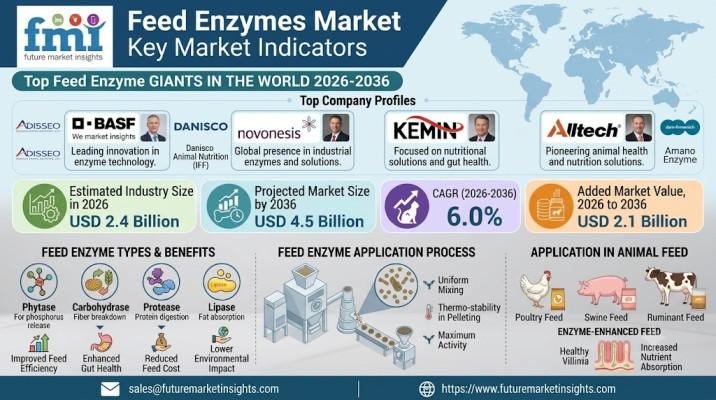
NEWARK, Del., November 10, 2026 — The global Feed Enzymes Market is estimated to reach USD 2.4 billion in 2026. According to Future Market Insights (FMI), the market is projected to grow to USD 4.5 billion by 2036, registering a compound annual growth rate (CAGR) of 6.0% between 2026 and 2036.
The market outlook reflects increasing demand for improved animal nutrition, enhanced feed conversion efficiency and optimized livestock productivity. Feed enzymes play an important role in breaking down complex feed components, improving nutrient availability and supporting better utilization of animal feed ingredients.
As livestock producers increasingly prioritize feed efficiency, animal performance and cost-effective nutrition strategies, feed manufacturers are focusing on enzyme-based formulations designed to improve the digestibility of key feed components and support different animal nutrition requirements.
Get the Request a Sample Report latest market insights and forecasts: https://www.futuremarketinsights.com/reports/sample/rep-gb-6366
Feed Enzymes Market Metric Value
- Estimated Market Size in 2026: USD 2.4 billion
- Projected Market Size by 2036: USD 4.5 billion
- CAGR, 2026 to 2036: 6.0%
- Market Forecast Period: 2026–2036
- Quantitative Units: USD Billion
The Short Version
- Nutrient-efficient animal feed is supporting demand: Feed enzymes help improve nutrient availability and extract greater nutritional value from existing feed ingredients.
- Lipase is a leading enzyme category: Lipase accounts for 17.0% of the enzyme type category in 2026, supported by its role in dietary fat utilization.
- Poultry nutrition is an important application area: Feed conversion efficiency, nutrient density and consistent feed quality are important purchasing considerations.
- Species-specific enzyme formulations are gaining importance: Livestock physiology and feed composition influence enzyme performance and product selection.
- Asia-Pacific markets present growth opportunities: South Korea is projected to record an 8.0% CAGR, followed by the USA at 7.0% between 2026 and 2036.
Growth Driver
The feed enzymes market is supported by increasing demand for efficient animal nutrition, improved feed conversion and better utilization of essential nutrients. Feed enzymes help break down complex feed components, making nutrients more accessible to livestock and supporting optimized feed formulations.
Feed manufacturers and livestock producers are increasingly evaluating enzyme-based solutions as part of broader animal feed additive strategies. These solutions can help nutritionists improve the nutritional value of existing feed ingredients while managing formulation costs and maintaining animal performance.
The growing importance of large-scale livestock production is also strengthening the commercial relevance of feed enzymes. Poultry, swine, ruminants and aquaculture operations have different nutritional requirements, creating demand for specialized enzyme combinations and application-specific formulations.
Lipase, phytase, protease, xylanase, cellulase and amylase address different nutritional challenges. Their commercial value depends on their ability to improve nutrient availability, maintain activity during feed processing and deliver measurable benefits under specific feeding conditions.
Key factors supporting market expansion include:
- Nutrient utilization efficiency: Improved nutrient availability is encouraging the adoption of enzyme-based feed formulations.
- Livestock productivity: Producers are focusing on feed conversion, animal performance and consistent nutritional outcomes.
- Poultry feed demand: Large-scale poultry production is supporting interest in enzymes that improve energy and nutrient utilization.
- Specialized enzyme development: Manufacturers are expanding enzyme portfolios to address different feed substrates and livestock requirements.
- Feed formulation economics: Enzymes can help nutritionists extract greater value from existing feed ingredients.
- Processing stability: Enzyme activity under commercial feed manufacturing conditions is an important product qualification factor.
Where Growth Is Strongest
- The global feed enzymes market is projected to expand from USD 2.4 billion in 2026 to USD 4.5 billion by 2036, registering a CAGR of 6.0%.
- Lipase accounts for 17.0% of the enzyme type category in 2026, reflecting its importance in improving dietary fat utilization.
- South Korea is expected to record the highest CAGR among the profiled countries at 8.0%, followed by the USA at 7.0%.
- Germany is projected to expand at 6.0%, while the UK and Japan are expected to register CAGRs of 5.0% and 4.0%, respectively.
- Growth opportunities are emerging across enzyme types, livestock categories, feed formulations and regional markets.
- Poultry, swine, ruminants and aquaculture applications are creating opportunities for species-specific enzyme solutions.
Who Is Moving: Market Developments and Competitive Landscape
Competition in the feed enzymes market is influenced by enzyme activity, production capabilities, formulation performance, processing stability, application research and distribution networks.
Manufacturers are strengthening their competitive positioning through enzyme innovation, fermentation capabilities, broader product portfolios and application-specific technical support.
Market participants can strengthen their positioning through:
- Expanding enzyme production and fermentation capabilities.
- Developing multi-enzyme formulations for different livestock categories.
- Improving enzyme stability during feed processing and storage.
- Strengthening application research and species-specific validation.
- Expanding partnerships with feed mills, premix suppliers and livestock producers.
- Developing solutions that improve nutrient utilization and feed formulation economics.
Key Competitive Factors
The competitive landscape is shaped by enzyme effectiveness, substrate compatibility, manufacturing efficiency, processing stability, regulatory authorization and commercial distribution capabilities.
Companies with diversified enzyme portfolios and strong technical support can address a broader range of animal nutrition requirements. Suppliers that demonstrate consistent enzyme activity under commercial feed manufacturing conditions can also strengthen customer confidence and long-term purchasing relationships.
FMI identifies BASF SE, Novonesis, dsm-firmenich, Kemin Industries Inc. and Alltech Inc. among the notable companies covered in the market.
Key Market Developments
- Novonesis: Completed the acquisition of dsm-firmenich's share in the Feed Enzyme Alliance in June 2025, bringing its research, production, sales and distribution activities under Novonesis.
- Kemin Industries: Acquired CJ Youtell Biotech in September 2025, expanding its fermentation facilities and upstream enzyme manufacturing capabilities.
- BASF SE: Began evaluating strategic options for its feed enzyme business in October 2025, including its established product brands and innovation pipeline.
- dsm-firmenich: Announced an agreement in February 2026 to divest its Animal Nutrition & Health business to CVC Capital Partners, with completion expected by the end of 2026.
Strategic Opportunities for Market Participants
- Develop advanced enzyme formulations: Invest in lipase, phytase, protease and carbohydrate-degrading enzyme technologies.
- Expand multi-enzyme portfolios: Develop combinations addressing different nutritional requirements and feed substrates.
- Strengthen poultry nutrition solutions: Focus on enzyme applications that support feed conversion and nutrient availability.
- Invest in fermentation technologies: Improve enzyme production efficiency, manufacturing capacity and product consistency.
- Enhance processing stability: Develop formulations that maintain activity during feed manufacturing, storage and handling.
- Strengthen regulatory and technical capabilities: Provide species-specific efficacy evidence and application support.
- Build distribution partnerships: Collaborate with feed manufacturers, premix suppliers and livestock nutrition companies.
Explore the market outlook, forecast analysis and competitive landscape in the Full Report: https://www.futuremarketinsights.com/reports/feed-enzymes-market
Where to Be Careful
- Raw material price volatility: Changes in feed ingredient and enzyme production input costs can influence manufacturing expenses.
- Species-specific performance: Enzyme effectiveness can vary depending on livestock physiology, feed composition and nutritional requirements.
- Processing stability: High-temperature feed processing and storage conditions can affect enzyme activity and product performance.
- Regulatory requirements: Manufacturers must comply with applicable feed additive authorization, safety and efficacy requirements across different markets.
- Product qualification challenges: Feed mills require reliable application evidence before adopting new enzyme formulations.
- Competitive pressure: Competition among enzyme manufacturers and alternative feed additives can influence pricing and market positioning.
Analyst Perspective
The feed enzymes market's projected 6.0% CAGR reflects an expanding commercial opportunity within the global animal nutrition and feed additives industry. As livestock producers increasingly prioritize feed efficiency, nutrient availability and production economics, enzyme-based solutions are becoming important components of modern animal nutrition strategies.
The growing application of lipase, phytase, protease and carbohydrate-degrading enzymes is creating opportunities for manufacturers to address specific nutritional challenges across poultry, swine, ruminants and aquaculture.
Companies investing in fermentation technologies, multi-enzyme platforms, processing stability and species-specific application research can strengthen their competitive positioning over the forecast period.
The commercial message is clear: the future of feed enzymes is increasingly connected to measurable nutrient utilization, optimized feed formulations and specialized animal nutrition solutions. Businesses developing advanced enzyme technologies and reliable application support can capitalize on the market's projected expansion.
Market Definition and Scope
The feed enzymes market includes commercial supplier market value from enzyme products used in animal feed applications, covering:
- Lipase: Enzymes supporting the utilization of dietary fats.
- Phytase: Enzymes that improve phosphorus availability from phytate-containing feed ingredients.
- Protease: Enzymes supporting protein breakdown and amino acid availability.
- Carbohydrate-degrading enzymes: Including xylanase, cellulase, amylase and beta-glucanase for different feed substrates.
- Other specialized enzymes: Including pectinase, lactase, hemicellulase, chitinase and alpha-galactosidase.
Category Scope Note: The market covers feed-use enzyme products across the specified enzyme type and livestock categories, including attributable enzyme value in preparations and blends counted once. Finished animal feed, downstream animal products, non-enzyme additives and non-feed enzyme applications are excluded.
Market Breakdown: Enzyme Type, Livestock and Region.
Livestock Categories: Poultry, Swine, Ruminants, Aquaculture and Others.
Regional Coverage: North America, Latin America, Western Europe, Eastern Europe, East Asia, South Asia and Pacific, and the Middle East and Africa.
Related Food & Agriculture Industry Reports
Cassava Flour Market https://www.futuremarketinsights.com/reports/cassava-flour-market
Blueberries Market https://www.futuremarketinsights.com/reports/blueberries-market
Organic Spice Market Share Analysis https://www.futuremarketinsights.com/reports/organic-spice-market-share-analysis
Capsaicin Market Share Analysis https://www.futuremarketinsights.com/reports/capsaicin-market-share-analysis
Europe Savory Ingredients Market https://www.futuremarketinsights.com/reports/europe-savory-ingredients-market
About Future Market Insights (FMI)
(FMI) is a market intelligence and consulting company providing research, market sizing, forecasts, industry trends and competitive assessments to support business planning and investment decisions across global industries.
Media Contact
For Press & Corporate Inquiries
Rahul Singh
AVP – Marketing and Growth Strategy
, Inc.
Phone: +91 8600020075
For Sales: sales@futuremarketinsights.com
For Media: Rahul.singh@futuremarketinsights.com

 English
 Arabic
 French
 Spanish
 Portuguese
 Turkish
 Dutch
 Italiano
 Russian
 Romaian
 Portuguese (Brazil)
 Greek