


Warehouse Humanoid Robots Market Trends Indicate USD 6,203.6 Million by 2036
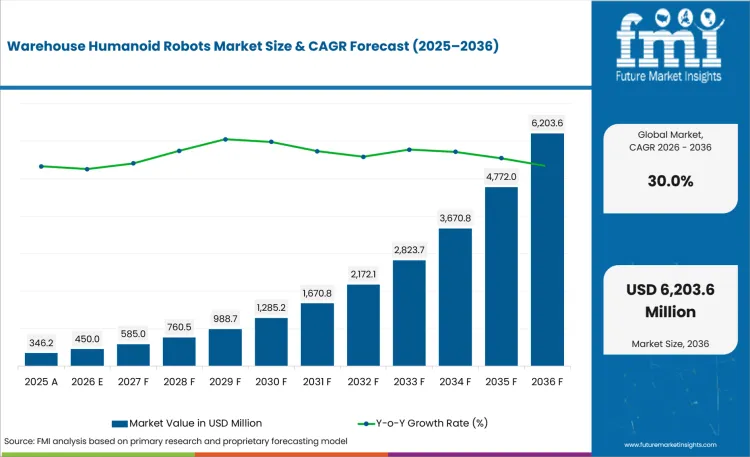
The global Warehouse Humanoid Robots Market is projected to grow from USD 450.0 million in 2026 to USD 6,203.6 million by 2036, registering a compound annual growth rate (CAGR) of 30.0% during the forecast period, according to Future Market Insights (FMI).
Warehouse humanoid robots are gaining attention as logistics operators explore automation for tasks that remain difficult to perform with conventional fixed systems. Designed around human-like movement and reach, these robots can potentially transfer goods between conveyors, carts, storage areas, and workstations built for human workers.
As warehouses expand their use of automated material-handling systems, humanoid robots are emerging as a potential solution for bridging manual workflow gaps. Their ability to operate in environments designed for people may create new opportunities for flexible automation, particularly where facilities want to automate existing processes without extensive infrastructure changes.
Get Detailed Market Forecasts, Competitive Benchmarking & Industry Insights — Request a Sample Report: https://www.futuremarketinsights.com/reports/sample/rep-gb-34072
Warehouse Humanoid Robots Market: Key Metrics
- Market Value (2026): USD 450.0 million
- Forecast Value (2036): USD 6,203.6 million
- Global CAGR (2026–2036):0%
- Leading Form Factor: Bipedal humanoids, accounting for 52.0% of the market in 2026
- Leading Application: Tote handling, representing 94.4% of the market in 2025
- Leading Component: Hardware, accounting for 54.0% of the market in 2026
- Key Demand Drivers: Warehouse labor constraints, repetitive material handling, flexible automation, and integration with existing logistics infrastructure
What Is Driving Demand for Warehouse Humanoid Robots?
Warehouse operations continue to rely on manual transfers between conveyors, carts, storage systems, and workstations. While automated guided vehicles and autonomous mobile robots can transport goods across facilities, certain handling activities still require physical interaction with individual items and containers.
Humanoid robots are being developed to address these workflow gaps. Their human-like form factor can potentially allow them to interact with equipment and workspaces designed around human reach, movement, and operating height.
The opportunity is particularly relevant in facilities seeking to improve throughput without completely redesigning their infrastructure. However, commercial adoption depends on reliable object handling, safe human-robot interaction, battery endurance, and the ability to recover from unexpected operating conditions.
Five Key Trends Shaping the Warehouse Humanoid Robots Market
- Bipedal Humanoids Strengthen Their Market Position
Bipedal humanoids are projected to account for 52.0% of the market in 2026. Their two-legged configuration is designed to support movement through human-oriented environments, including aisles, workstations, and warehouse areas with existing infrastructure.
- Tote Handling Creates a Major Application Opportunity
Tote handling represented 94.4% of the market in 2025, highlighting the importance of container transfers in warehouse automation. Humanoid robots can potentially support repetitive movement of totes between workstations, conveyors, and other handling points, provided they achieve consistent gripping and placement accuracy.
- Hardware Remains a Major Component Category
Hardware is expected to account for 54.0% of the market in 2026. Motors, actuators, sensors, robotic hands, batteries, and structural components are central to robot performance. Improvements in these systems can influence payload capacity, movement precision, operating duration, and equipment reliability.
- Integration with Existing Warehouse Automation Gains Importance
Humanoid robots are increasingly being considered alongside conveyors, automated storage and retrieval systems, autonomous mobile robots, and warehouse management software. Coordinated workflows can allow transport automation and humanoid systems to perform complementary tasks across the same facility.
Key Application Areas Creating Growth Opportunities
Warehouse humanoid robots could support several activities across logistics and industrial facilities:
- Tote Handling: Moving containers between conveyors, carts, picking stations, and packing workstations.
- Order Fulfillment: Supporting repetitive handling activities within picking and fulfillment operations.
- Material Transfer: Moving goods between workstations and designated handling areas.
- Inventory Operations: Assisting with selected repetitive handling tasks during stock movement and replenishment.
- Manufacturing Logistics: Supporting material movement between production lines, storage areas, and assembly workstations.
Competitive Landscape: Key Companies
The Warehouse Humanoid Robots Market includes robotics developers, industrial automation companies, and technology providers developing human-like robotic systems for material handling and logistics applications.
Notable companies and technology developers in the broader humanoid robotics ecosystem include:
- Agility Robotics
- Figure AI
- Boston Dynamics
- Apptronik
- Tesla
- UBTECH Robotics
- Fourier Intelligence
- Unitree Robotics
- Sanctuary AI
- 1X Technologies
Competition is increasingly shaped by manipulation capabilities, payload performance, navigation, safety systems, battery life, and integration with warehouse software. Companies that demonstrate reliable performance in repetitive warehouse tasks may gain an advantage as logistics operators move from pilot programs toward larger deployments.
What This Means for Industry Participants
The rapid projected expansion creates opportunities for humanoid robot manufacturers, robotic component suppliers, AI developers, warehouse automation integrators, sensor manufacturers, and logistics technology providers.
For robot manufacturers, priorities include improving dexterity, developing reliable robotic hands, increasing payload capacity, and reducing the frequency of human intervention. Software providers can support task planning, object recognition, fleet coordination, and integration with warehouse management systems.
Future Market Outlook
The Warehouse Humanoid Robots Market is entering an emerging phase of industrial commercialization, supported by demand for flexible automation and the need to address manual handling activities that conventional warehouse systems may not fully automate.
Although technical reliability, deployment costs, safety validation, and operational consistency remain important challenges, improvements in artificial intelligence, robotic manipulation, and autonomous navigation are creating new possibilities for warehouse applications.
About the Warehouse Humanoid Robots Market Report
Future Market Insights' report provides an in-depth assessment of the global Warehouse Humanoid Robots Market, covering market dynamics, technology developments, competitive positioning, and growth opportunities from 2026 to 2036.
The study examines key market dimensions, including:
- Form Factor: Bipedal humanoids and other applicable humanoid configurations.
- Application: Tote handling and other warehouse material-handling activities.
- Component: Hardware, software, and services.
- End-use Industries: Warehousing, logistics, e-commerce fulfillment, distribution, and manufacturing.
- Regional Coverage: North America, Latin America, Europe, East Asia, South Asia, Oceania, and the Middle East and Africa.
Related Reports
Hydronic Underfloor Heating Market- https://www.futuremarketinsights.com/reports/hydronic-underfloor-heating-market
Europe Multi Attachment Loaders Market- https://www.futuremarketinsights.com/reports/europe-multi-attachment-loaders-market
End Suction Pump Market- https://www.futuremarketinsights.com/reports/end-suction-pump-market
About Future Market Insights (FMI)
Future Market Insights (FMI) is a market research and consulting firm providing actionable insights, syndicated research, and strategic analysis to businesses across industries. FMI helps organizations understand evolving market dynamics, identify growth opportunities, and make informed business decisions through data-driven research.
Media Contact
Rahul Singh
AVP – Marketing and Growth Strategy
Future Market Insights, Inc.
Phone: +91 8600020075
Email: sales@futuremarketinsights.com
Rahul.singh@futuremarketinsights.com
Website: www.futuremarketinsights.com

 English
 Arabic
 Spanish
 Portuguese
 Deutsch
 Turkish
 Dutch
 Italiano
 Russian
 Romaian
 Portuguese (Brazil)
 Greek