


How LLMs Understand and Generate Human Language
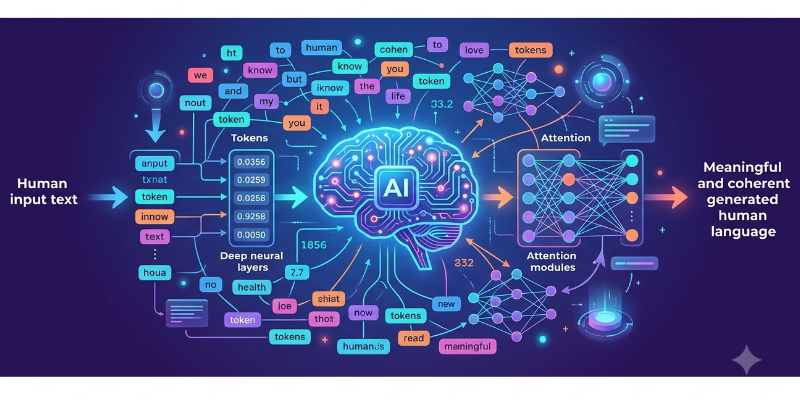
Large Language Models (LLMs) have changed how people interact with technology. From answering questions and writing articles to summarizing documents and generating creative content, these models can perform many language-related tasks. But have you ever wondered how machines understand human language and create meaningful responses? LLMs use advanced artificial intelligence techniques to process text, identify patterns, and predict suitable words based on the given context.
Understanding how these models work can help you explore the growing field of Generative AI. If you want to build practical knowledge of these technologies, consider enrolling in a Gen AI Course in Bangalore at FITA Academy to explore modern AI concepts and develop relevant technical skills.
What Are Large Language Models?
Large Language Models are AI systems trained on large amounts of text data. They learn language patterns, sentence structures, grammar, and relationships between words. This training helps them generate responses that sound natural and meaningful.
Unlike traditional software programs that follow fixed instructions, LLMs use patterns learned during training to respond to different inputs. They can answer questions, translate languages, explain complex topics, and assist with writing tasks.
Popular examples of LLM-based systems include ChatGPT, Google Gemini, and Claude. These tools use advanced language models to understand user prompts and generate relevant responses.
How Do LLMs Understand Human Language?
Large language models do not comprehend language in the same manner that humans do. Instead, they process text mathematically and identify relationships between different language elements.
1. Tokenization
The first step is tokenization. An LLM breaks the input text into smaller units called tokens. A token can represent a complete word, part of a word, or even a punctuation mark.
For example, when a user enters a sentence, the model converts it into tokens that it can process. This makes it easier for the system to analyze and interpret the input.
2. Embeddings
After tokenization, the model converts tokens into numerical representations called embeddings. These numbers help the model identify relationships between words and their meanings.
For example, words such as "king" and "queen" have related representations because they share certain language patterns. Embeddings help LLMs recognize these connections and understand the context of a sentence.
3. Understanding Context Through Attention
One of the most important technologies behind modern LLMs is the Transformer architecture. It uses a mechanism called self-attention to identify relationships between words in a sentence.
For example, consider the sentence "The child dropped the glass because it was slippery." The attention mechanism helps the model examine how different words relate to one another.
This ability to consider surrounding words helps LLMs understand context and generate more relevant responses.
How Do LLMs Generate Human Language?
After processing the input, an LLM generates a response by predicting the next token based on the previous tokens and the available context.
1. Next Token Prediction
Large language models produce text by creating one token sequentially. They calculate which token is most suitable to follow the existing sequence.
The model repeats this process until it produces a complete response. This approach allows it to generate paragraphs, explanations, stories, and other forms of content.
2. Probability and Response Generation
LLMs use probability calculations to select suitable tokens. They consider different possible words and assign probabilities based on patterns learned during training.
The model then selects a token according to its generation settings. Temperature is one setting that influences how predictable or varied the responses can be.
3. Maintaining Context
LLMs use the available conversation context to generate relevant answers. This helps them maintain connections between previous messages and the current question.
However, their ability to remember information within a conversation depends on the model's context window and system design.
How Can You Learn More About LLMs and Artificial Intelligence?
Comprehending LLMs entails familiarity with various key concepts, such as machine learning, deep learning, neural networks, and natural language processing. These concepts explain how modern AI systems process information and generate intelligent responses.
Building a strong foundation in these areas can help you understand the technology behind modern AI applications. If you want to strengthen your technical knowledge and explore practical AI applications, take an Artificial Intelligence Course in Bangalore to develop your understanding of machine learning, deep learning, and emerging AI technologies.
Large Language Models use tokenization, embeddings, attention mechanisms, and next-token prediction to process and generate human language. Although they can produce responses that sound natural, they do not understand information exactly like humans. Instead, they identify patterns and relationships learned from training data.
As Generative AI continues to evolve, understanding how LLMs work will become increasingly valuable. Learning these fundamental concepts provides a strong starting point for exploring advanced AI technologies and their real-world applications.
Also check: Generative AI Strengthening Intelligent Business Operations

 Arabic
 French
 Spanish
 Portuguese
 Deutsch
 Turkish
 Dutch
 Italiano
 Russian
 Romaian
 Portuguese (Brazil)
 Greek