


Understanding Supported Ball Valve Construction
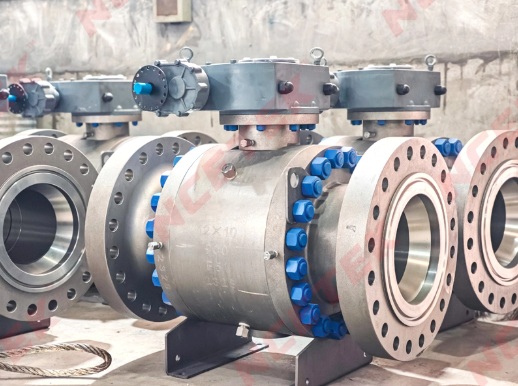
Large industrial pipelines require flow control equipment capable of handling substantial operating loads while maintaining reliable shutoff performance. A Cast Steel Trunnion Mounted Ball Valve combines a supported ball structure with a cast steel pressure-containing body, making it a commonly considered configuration for selected medium- and high-pressure pipeline applications. Understanding its construction helps engineers evaluate its suitability for oil and gas transportation, petrochemical facilities, and other industrial systems.
The main characteristic of a trunnion-mounted design is that the ball is supported by mechanical trunnions rather than relying entirely on the valve seats to position it. The upper and lower support arrangements help maintain the ball's position within the body during operation. This construction influences how pressure-related forces are transferred through the valve and can be advantageous in larger sizes and applications involving significant differential pressure.
When the valve is open, the passage through the ball aligns with the pipeline to allow fluid movement. Rotating the ball approximately 90 degrees places the solid portion across the flow path and closes the valve. Because the ball is mechanically supported, the seats can move or respond according to the particular sealing design. This arrangement may help control seat loading and operating torque under suitable operating conditions.
The valve body provides the main pressure-containing structure. Cast steel construction allows manufacturers to produce relatively complex body geometries and integrate features required for internal components and pipeline connections. The selected casting material must correspond to the design pressure, operating temperature, fluid characteristics, and applicable material specifications.
Common material considerations include carbon steel grades and other suitable cast alloy materials. Stainless steel or specialized alloys may be required when corrosion resistance or temperature performance becomes a major concern. The correct selection depends on the transported medium and project conditions. Material grade, heat treatment, mechanical properties, and inspection requirements should be clearly stated in the technical specification.
Casting quality is an important part of the manufacturing process. The production of a pressure-containing body requires appropriate control of mold preparation, molten metal composition, pouring conditions, solidification, and subsequent processing. Depending on the material and product requirements, heat treatment may be necessary to obtain the specified mechanical properties. Casting inspection methods may include visual examination, dimensional verification, and nondestructive examination where required.
After casting, the body undergoes machining to establish accurate interfaces for the ball, seats, stem, end connections, and other components. Machining accuracy is essential because the internal geometry determines how the assembled components fit together. Incorrect dimensions or alignment can affect seat positioning, ball movement, sealing contact, and assembly consistency.
The sealing system is another major consideration. Trunnion-mounted designs commonly incorporate seat assemblies that move toward the ball under selected loading conditions. Depending on the design, sealing forces may be influenced by springs, fluid pressure, or a combination of mechanical and pressure-assisted arrangements. The precise configuration determines the valve's behavior under different pressure conditions.
Soft-seated and metal-seated configurations may both be available in this general structural category. Soft seats can provide suitable sealing characteristics within their pressure and temperature limitations. Metal seats may be considered for selected high-temperature, abrasive, or demanding applications. Buyers should review the actual seating material, leakage requirements, and operating limitations instead of assuming that all products use the same sealing arrangement.
Body cavity pressure management should also be reviewed. When the ball is closed, fluid may become trapped inside the body cavity. Changes in temperature or fluid conditions can cause pressure to increase. Depending on the seat arrangement and project requirements, a cavity pressure-relief mechanism or another suitable engineering solution may be required. The manufacturer should clarify the intended pressure-relief direction and the design's relevant operating characteristics.
The stem and operating system transmit movement to the ball. The stem must provide adequate mechanical strength and incorporate suitable sealing components to limit external leakage. Manual gearboxes, pneumatic actuators, hydraulic actuators, and electric actuators may be considered according to valve size, operating torque, automation requirements, and available power sources. Actuator selection should follow the calculated torque requirements for the specific operating conditions.
Applications include long-distance oil and gas pipelines, gas transmission facilities, petroleum processing plants, storage terminals, and industrial distribution networks. These environments may involve different combinations of pressure, temperature, fluid composition, and operating frequency. For underground or remote pipeline installations, buyers should also consider external protection, access for maintenance, and compatibility with the installation arrangement.
Inspection and testing are essential for verifying the completed product. Depending on the applicable standards and project specifications, procedures may include body pressure testing, seat leakage testing, dimensional inspection, material verification, and operational testing. Nondestructive examination of castings may be specified to evaluate potential internal or surface discontinuities. The inspection scope should be established before production so that acceptance criteria are clear.
API and ASME specifications may apply to particular designs, materials, dimensions, and testing procedures. However, compliance depends on the exact product configuration and specified standard. Procurement teams should confirm the applicable requirements in technical documents rather than relying on general product descriptions. Material certificates, pressure test records, and inspection documentation can provide additional support during project acceptance.
For large infrastructure projects, manufacturing coordination is also important. Buyers may need approved drawings, connection dimensions, face-to-face measurements, operating device details, and spare parts information. Clear communication between the manufacturer, engineering contractor, and procurement team helps ensure that the supplied equipment fits the pipeline design.
Zhejiang Naishi Valve Co., Ltd. manufactures industrial valve products under the NCETEK and Naishi Valve brands for different flow control requirements. When evaluating a Cast Steel Trunnion Mounted Ball Valve, buyers should examine casting quality, pressure design, seat configuration, machining precision, and testing documentation together. Further information about available industrial valve products and configurations can be found at https://www.ncevalve.com/product/.

 English
 Arabic
 French
 Portuguese
 Deutsch
 Turkish
 Dutch
 Italiano
 Russian
 Romaian
 Portuguese (Brazil)
 Greek