


CAESAR II Training: Build Expertise in Industrial Pipe Stress Engineering
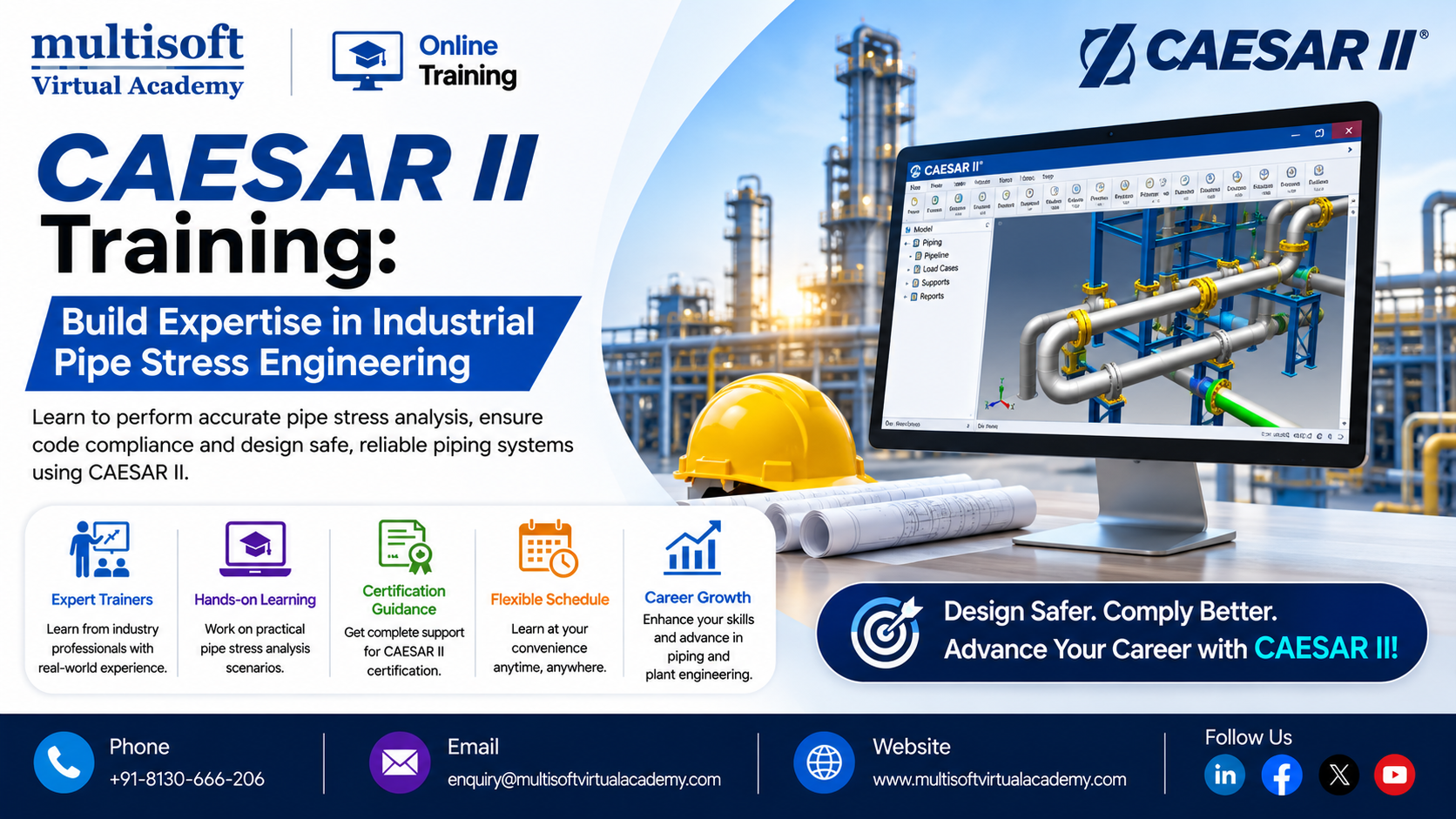
Industrial piping networks are designed to operate under challenging conditions. From high-temperature steam lines to pressurized chemical pipelines, every system must accommodate mechanical loads, thermal movement, and operational changes. Engineers need reliable methods to evaluate these conditions before piping systems are installed or modified. CAESAR II provides a dedicated environment for performing these engineering calculations and assessing piping system behaviour.
CAESAR II Training introduces professionals to the software tools and engineering methods used in piping stress analysis. It helps learners understand how to develop analytical models, define operating conditions, examine stress levels, and evaluate support reactions. The training also introduces important piping design standards and the practical considerations involved in industrial engineering projects.
For mechanical engineers, piping designers, and professionals working with engineering, procurement, and construction companies, CAESAR II knowledge can provide a useful technical foundation for handling complex piping systems.
How CAESAR II Helps Engineers Evaluate Piping Systems
CAESAR II is a piping stress analysis application developed by Hexagon. It enables engineers to study the response of piping systems under different operating and environmental conditions.
A piping network may experience several types of loads during its service life. These include internal pressure, equipment weight, fluid weight, temperature changes, wind, seismic activity, and other external forces. The combined effect of these conditions can influence pipe movement, stress distribution, and support loads.
CAESAR II helps engineers create a mathematical representation of the piping arrangement and calculate its response to defined loading conditions.
Its engineering applications include:
- Evaluating sustained and thermal expansion stresses.
- Calculating piping displacements and support reactions.
- Assessing equipment connection forces and moments.
- Reviewing the effects of restraints and support arrangements.
- Performing static and dynamic analysis.
- Comparing calculated stresses with applicable code limits.
- Preparing engineering reports for technical review.
The software supports engineering decisions, but accurate results depend on correct model inputs, suitable assumptions, and qualified technical evaluation.
Why Is CAESAR II Knowledge Valuable in Modern Engineering?
Industrial facilities increasingly require engineering professionals who can work with specialized design and analysis applications. Understanding piping behaviour is essential for developing reliable systems and identifying potential mechanical issues.
Better Understanding of Piping Flexibility
Piping systems must accommodate movement caused by temperature variations and operating conditions. A rigid arrangement may create excessive loads at supports or connected equipment.
Training helps learners understand piping flexibility and examine how geometry, restraints, and support positions influence system behaviour.
Accurate Evaluation of Operating Loads
Piping systems are exposed to several load combinations. Engineers need to determine how these loads affect the system under different operating scenarios.
A structured learning program explains the relationship between pressure, temperature, weight, and external loading conditions.
Improved Support Arrangement Knowledge
Supports and restraints influence how forces are distributed throughout a piping network. Incorrect assumptions about support conditions can affect analysis results.
Learning CAESAR II helps professionals understand the modelling of anchors, guides, line stops, restraints, and spring supports.
Better Engineering Coordination
Piping stress analysis interacts with mechanical equipment, structural engineering, and process design. Engineers must communicate analysis findings to other disciplines.
Software knowledge combined with engineering fundamentals helps professionals participate more effectively in technical reviews and design discussions.
What Will You Learn in a CAESAR II Training Program?
A professional CAESAR II Training Course should provide a balanced combination of software instruction and engineering theory. The following learning areas can help participants develop a broader understanding of piping stress analysis.
Piping Stress Analysis Fundamentals
Before working with advanced software functions, learners should understand the basic mechanical principles involved in piping analysis.
Important concepts include:
- Stress and strain relationships.
- Primary and secondary stresses.
- Sustained and expansion stress categories.
- Allowable stress limits.
- Thermal expansion and contraction.
- Piping flexibility requirements.
- Load combinations and design conditions.
- Basic failure theories.
These concepts provide the foundation for understanding analysis calculations and evaluating the results.
Creating Piping Models in CAESAR II
Model development is one of the most important activities in piping stress analysis. Engineers must represent the physical piping arrangement accurately so that the software can calculate its behaviour.
Training may cover:
- Starting and organizing analysis projects.
- Understanding the software interface.
- Defining node numbers and piping elements.
- Entering pipe dimensions and material data.
- Modelling elbows, tees, reducers, and valves.
- Defining equipment connections.
- Reviewing model geometry.
- Identifying input errors.
Practical exercises help learners understand how engineering drawings and piping layouts are translated into an analytical model.
Static Analysis and Stress Evaluation
Static analysis evaluates piping behaviour under defined loading conditions. It helps engineers determine whether the system can accommodate the specified loads within applicable design limits.
The training may introduce:
- Deadweight analysis.
- Internal pressure calculations.
- Operating load conditions.
- Thermal expansion stress.
- Sustained stress evaluation.
- Occasional loading.
- Load case development.
- Stress summary interpretation.
Learners also explore how different loading combinations influence calculated stresses and displacements.
Thermal Expansion and Equipment Connections
Temperature variations can cause significant changes in piping dimensions. These movements may transfer forces and moments to connected equipment.
Training introduces the role of thermal expansion in piping design and explains how engineers evaluate flexibility and connected equipment loads.
Relevant exercises may involve pump connections, compressor piping, heat exchanger arrangements, and vessel nozzles.
Supports, Restraints, and Spring Hangers
Piping support design is an important part of mechanical analysis. Supports control system movement and transfer loads to structural components.
Learners may explore:
- Anchor and guide modelling.
- Directional restraints.
- Line stops.
- Spring hanger concepts.
- Support reaction calculations.
- Friction considerations.
- Restraint behaviour during operating conditions.
Understanding these features helps professionals evaluate how support arrangements affect piping stress and movement.
Dynamic Analysis and Special Loading Conditions
Certain industrial applications require more than conventional static analysis. Dynamic conditions may result from machinery vibration, seismic activity, pressure surges, or other time-dependent events.
Depending on the training syllabus, learners may study:
- Modal analysis.
- Natural frequency calculations.
- Harmonic analysis.
- Response spectrum methods.
- Time history analysis.
- Seismic load assessment.
- Transient loading concepts.
- Dynamic result interpretation.
These subjects require additional engineering knowledge and should be taught through relevant practical examples.
Reporting and Analysis Documentation
Engineering analysis must be communicated clearly to project teams. CAESAR II provides output information that engineers can review and use in technical documentation.
Training may include stress reports, displacement summaries, support reaction reports, load case results, and model review procedures.
The objective is to help learners interpret engineering findings rather than simply generate software reports.
Practical Applications of CAESAR II in Industrial Projects
CAESAR II is relevant to engineering activities where piping systems must be assessed for mechanical integrity and operational requirements.
Refinery piping: Refineries contain complex networks that transport petroleum products, steam, gases, and process fluids. Stress analysis helps engineers evaluate thermal movement and mechanical loading.
Offshore engineering: Offshore piping systems may experience environmental loads, equipment movement, and challenging operating conditions. Analysis helps assess relevant piping design requirements.
Power generation facilities: Steam and water piping systems operate under specific pressure and temperature conditions. Engineers use stress analysis to evaluate their mechanical response.
Petrochemical installations: Process piping in petrochemical facilities requires careful consideration of material properties, operating conditions, and support arrangements.
Chemical manufacturing: Piping systems transporting chemicals and process materials must be evaluated according to the relevant engineering specifications.
Industrial plant modifications: Existing piping arrangements may require analysis when equipment is replaced, operating conditions change, or additional connections are introduced.
CAESAR II Analysis Workflow: From Drawings to Engineering Results
Understanding the analysis workflow helps professionals connect theoretical knowledge with actual project activities.
1. Engineering data collection: Review piping isometrics, line lists, equipment information, material specifications, and operating parameters.
2. Model preparation: Develop the piping model with appropriate dimensions, components, node locations, and material properties.
3. Load definition: Enter the required operating conditions and define relevant pressure, temperature, weight, and external loading cases.
4. Support configuration: Add suitable restraints and support conditions based on the project design information.
5. Calculation and verification: Run the analysis and examine input warnings, modelling issues, and calculation results.
6. Engineering assessment: Review stresses, displacements, equipment loads, and support reactions against applicable requirements.
7. Design review: Identify areas requiring further investigation and coordinate any necessary modifications with the engineering team.
8. Documentation: Prepare reports and communicate the analysis findings to relevant project stakeholders.
The precise workflow depends on the project scope, applicable codes, and engineering procedures.
Important Piping Codes and Standards to Understand
Piping stress analysis must be performed with reference to appropriate engineering codes and project requirements. Professionals learning CAESAR II should become familiar with commonly used standards.
ASME B31.3: This code addresses process piping used in industries such as chemical processing, petroleum refining, and related facilities.
ASME B31.1: This standard covers power piping applications, including piping systems associated with power generation and other relevant installations.
ASME B31.4: This standard addresses pipeline transportation systems for liquid hydrocarbons and other applicable liquids.
ASME B31.8: This standard covers gas transmission and distribution piping systems.
The applicable code depends on the system's purpose, design conditions, and project specifications. Learners should also understand that code editions and requirements can change.
Who Should Consider CAESAR II Online Training?
A structured CAESAR II Online Training program can benefit professionals from different engineering backgrounds.
- Mechanical engineers interested in piping stress calculations.
- Piping engineers working on industrial design projects.
- Stress analysis professionals seeking software expertise.
- Piping designers interested in understanding mechanical evaluation.
- Chemical engineers involved in process plant development.
- Engineering graduates preparing for specialized technical roles.
- EPC professionals involved in piping design coordination.
- Experienced engineers looking to update their software knowledge.
Basic understanding of mechanical engineering, piping components, and technical drawings can help participants progress through the course.
Career Opportunities After CAESAR II Training
Specialized software knowledge can strengthen an engineer's professional profile. CAESAR II skills may complement qualifications and experience in piping engineering, mechanical design, and industrial project execution.
Potential career opportunities include:
- Piping Stress Engineer
- CAESAR II Analysis Engineer
- Mechanical Piping Engineer
- Piping Design Engineer
- Stress Analysis Consultant
- Industrial Plant Engineer
- Mechanical Project Engineer
- Piping Engineering Specialist
Employers generally consider practical experience, engineering fundamentals, software proficiency, and familiarity with applicable codes when evaluating candidates. Completing training can support skill development but does not guarantee a particular position or salary.
How to Select the Right CAESAR II Course
Choosing a suitable course requires more than comparing training duration or course fees. Consider the following factors before making a decision.
Course coverage: Check whether the syllabus includes static analysis, dynamic analysis, piping supports, thermal expansion, equipment loads, and code compliance.
Practical exercises: Prefer courses that include realistic piping models and guided analysis activities.
Trainer knowledge: Review the instructor's experience with piping stress analysis and industrial engineering applications.
Software availability: Confirm the CAESAR II version used during training and whether participants receive access to a practice environment.
Learning flexibility: Compare live online sessions, one-to-one training, and self-paced learning options.
Certification information: Understand whether the course provides a completion certificate or prepares learners for a separate professional certification assessment.
Frequently Asked Questions
What is the main purpose of CAESAR II?
CAESAR II is used to evaluate piping systems through stress analysis. It calculates stresses, movements, support reactions, and other engineering parameters under specified loading conditions.
Can beginners learn CAESAR II?
Yes. Beginners with mechanical or related engineering knowledge can start with stress analysis fundamentals before progressing to model development and advanced calculations.
Is CAESAR II used in oil and gas engineering?
Yes. It is used for piping stress analysis in relevant oil and gas, refinery, petrochemical, and other industrial engineering projects.
Does CAESAR II support dynamic analysis?
Yes. The software supports several dynamic analysis methods, subject to the analysis requirements and appropriate modelling assumptions.
Which piping standards are relevant to CAESAR II?
Commonly referenced standards include ASME B31.1, ASME B31.3, ASME B31.4, and ASME B31.8. The correct standard depends on the application.
What skills are important for a piping stress engineer?
A piping stress engineer should understand mechanical behaviour, piping components, loading conditions, thermal expansion, support arrangements, applicable codes, and engineering analysis software.
Conclusion
Industrial piping systems require careful engineering evaluation to accommodate operating loads, thermal movement, pressure variations, and external forces. Developing proficiency in CAESAR II can help professionals understand how piping models are created, analysis calculations are performed, and engineering results are evaluated against applicable design requirements. Combining software practice with mechanical engineering fundamentals can provide a valuable foundation for working on complex industrial projects. Multisoft Virtual Academy provides CAESAR II Training designed to help aspiring and experienced professionals develop piping stress analysis knowledge and strengthen their technical capabilities for industrial engineering applications.
Originally Content Posted at: https://www.multisoftvirtualacademy.com/blog/caesar-ii-training-build-expertise-in-industrial-pipe-stress-engineering

 English
 French
 Spanish
 Portuguese
 Deutsch
 Turkish
 Dutch
 Italiano
 Russian
 Romaian
 Portuguese (Brazil)
 Greek