
Understanding the Difference Between GANs and Diffusion Models
Generative Artificial Intelligence has transformed the way machines create realistic images, videos, and other digital content. Two important technologies behind AI-powered image generation are Generative Adversarial Networks (GANs) and Diffusion Models. Both models can generate realistic images, but they use different approaches to learn patterns and produce new content. Grasping these technologies is crucial for anyone looking into contemporary AI applications. If you want to build a strong foundation in artificial intelligence, consider enrolling in an AI Course in Ahmedabad at FITA Academy to develop your technical knowledge and practical skills.
What Are Generative Adversarial Networks (GANs)?
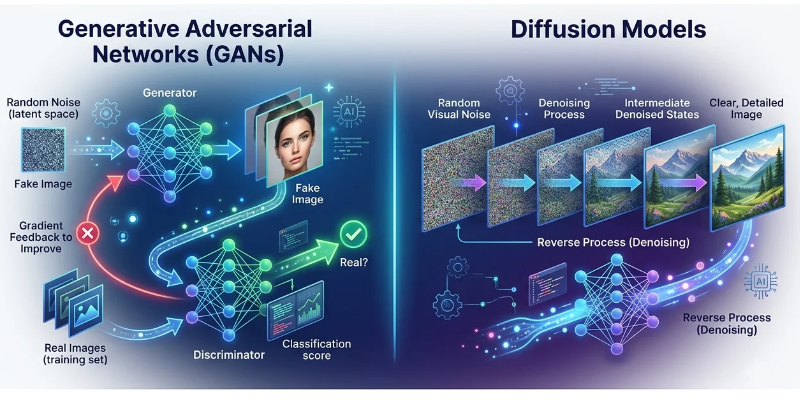
Generative Adversarial Networks, commonly known as GANs, are deep learning models that generate new data based on patterns learned from existing datasets. GANs use two neural networks called the Generator and the Discriminator.
The Generator creates artificial images that look similar to real images. The Discriminator examines these images and tries to identify whether they are real or artificially generated.
Both networks compete with each other during training. The Generator continuously improves its output to fool the Discriminator, while the Discriminator learns to identify generated content more accurately. This competition helps GANs produce increasingly realistic results.
What Are Diffusion Models?
Diffusion Models are generative AI models that create new content by learning how to remove noise from data. They are widely used in modern AI image-generation applications.
During training, a diffusion model gradually adds random noise to original images until their visual information becomes almost unrecognizable. The model then learns how to reverse this process by removing noise step by step.
During image generation, the model starts with random noise and gradually transforms it into a meaningful image. This process allows diffusion models to generate detailed and creative visuals based on text descriptions or other inputs.
How GANs and Diffusion Models Generate Images
GANs generate images through competition between two neural networks. The Generator produces an image, while the Discriminator assesses its legitimacy. This process continues until the Generator becomes capable of producing convincing images.
Diffusion Models follow a different approach. They begin with random noise and gradually remove unwanted patterns through multiple processing steps. Each step improves the visual structure until a complete image is generated.
The main difference is that GANs learn through competition, while Diffusion Models learn through a gradual noise-removal process.
Advantages and Limitations of GANs
GANs offer several advantages for applications that require fast image generation. Their ability to generate realistic images makes them useful in image enhancement, facial synthesis, and creative design.
However, GANs can be challenging to train because both networks must maintain a balance. One common problem is mode collapse, where the Generator produces limited varieties of images instead of representing the full diversity of the training dataset.
Advantages and Limitations of Diffusion Models
Diffusion Models are known for generating high-quality images with detailed textures and diverse visual patterns. They also offer greater flexibility for image editing, text-to-image generation, and creative applications.
However, their generation process can require significant computing resources. Since images are created through multiple denoising steps, generating results may take longer than with GANs. If you want to understand these architectures, explore modern AI applications, and gain practical knowledge of generative technologies, Generative AI Course in Ahmedabad is an opportunity to enhance your abilities and investigate this fast-evolving sector.
Real-World Applications of GANs and Diffusion Models
Both technologies have important applications across different industries.
GAN applications include:
-
Generating realistic human faces and synthetic images.
-
Improving image resolution and quality.
-
Creating synthetic training data for machine learning.
-
Supporting creative design and digital art.
Diffusion Model applications include:
-
Generating images from text descriptions.
-
Editing and restoring damaged images.
-
Creating digital artwork and illustrations.
-
Supporting visual content creation and product design.
GANs and Diffusion Models are two important technologies in Generative AI. GANs use competition between two neural networks to create realistic images, while Diffusion Models generate images by gradually removing noise. Both approaches have unique strengths, limitations, and applications. Understanding their differences provides a strong foundation for exploring advanced generative AI technologies and their growing role in modern industries.
Also check: How Algorithms Turn Data into Predictions

 English
 French
 Spanish
 Portuguese
 Deutsch
 Turkish
 Dutch
 Italiano
 Russian
 Romaian
 Portuguese (Brazil)
 Greek