


Contrast Media Market Forecast Driven by Growing Medical Imaging Volumes
A medical image is only as useful as the details it reveals. In many diagnostic procedures, healthcare professionals need more than a conventional scan to distinguish between healthy and abnormal tissues, assess blood flow, or identify subtle structural changes. Contrast media address this requirement by improving the visibility of specific organs, vessels, and tissues during imaging examinations. Their role is becoming increasingly important as diagnostic procedures expand across oncology, cardiovascular care, neurology, and other clinical specialties.
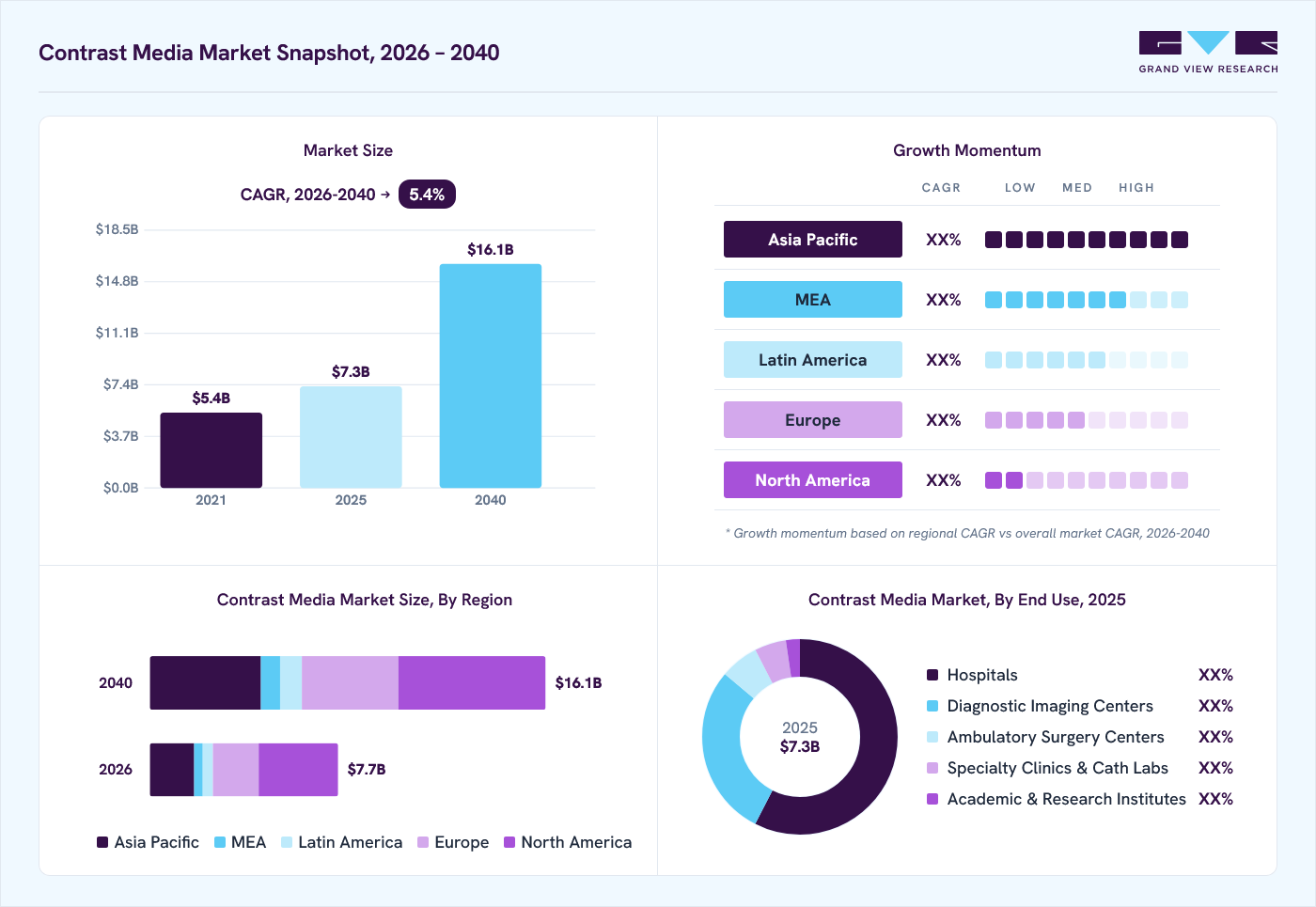
The contrast media market was valued at USD 7.3 billion in 2025 and is estimated to reach USD 7.7 billion in 2026. It is projected to reach USD 16.1 billion by 2040, growing at a CAGR of 5.4% from 2026 to 2040. Increasing imaging volumes, chronic disease prevalence, and advancements in contrast formulations are supporting market development.
Go Deeper! Ask Prism AI about the Contrast Media Market.
Why Imaging Procedures Continue to Generate Demand
CT, MRI, X-ray, and ultrasound examinations are widely used to investigate diseases, evaluate injuries, and monitor treatment outcomes. Contrast agents improve the differentiation of anatomical structures and can help physicians identify abnormalities that may be difficult to visualize through conventional imaging alone.
The rising burden of neurological disorders is particularly relevant to the industry. This application accounted for 28.3% of market revenue in 2025. MRI examinations using gadolinium-based contrast agents help clinicians assess brain tumors, vascular abnormalities, inflammatory conditions, and other neurological concerns. Increasing diagnostic requirements for cancer and cardiovascular diseases are also supporting the use of contrast-enhanced procedures.
As imaging becomes more integrated into early detection and treatment monitoring, demand for reliable contrast formulations is expected to remain an important part of diagnostic healthcare.
The Modality Divide: CT, MRI and Ultrasound
X-ray and computed tomography represented the largest modality segment, accounting for 69.2% of market revenue in 2025. The extensive use of CT examinations in emergency medicine, oncology, cardiovascular assessment, and routine diagnosis supports this position. Iodinated and barium-based agents are widely used to enhance visualization across these procedures.
Ultrasound is expected to register the fastest growth during the forecast period. Contrast-enhanced ultrasound uses microbubble agents to improve the visualization of blood flow, tissue perfusion, and vascular structures. Its ability to provide real-time imaging without ionizing radiation is encouraging interest across selected clinical applications.
MRI represents another important area of contrast media utilization. Gadolinium-based agents are commonly used to improve tissue differentiation and support the assessment of neurological, oncological, and cardiovascular conditions. Research into alternative formulations is also expanding the range of technologies available to imaging providers.
Iodinated Formulations Hold a Strong Commercial Position
Iodinated contrast media accounted for 64.3% of market revenue in 2025, making them the leading product category. Their established role in CT, angiography, and X-ray procedures, together with broad clinical applicability, supports continued demand. Common formulations include iohexol, iodixanol, iopamidol, and iopromide.
Microbubble contrast media are anticipated to grow at the fastest rate. These injectable gas-filled agents enhance ultrasound signals and support the assessment of cardiac structures, blood flow, and tissue vascularity. Their use can be particularly valuable in selected patients who require alternatives to conventional CT or MRI contrast procedures.
Gadolinium-based and barium-based products also serve important diagnostic requirements. Meanwhile, research into novel non-gadolinium formulations reflects growing interest in developing agents with improved safety characteristics and imaging performance.
Hospitals Remain the Main Point of Utilization
Hospitals accounted for 57.5% of market revenue in 2025. Their advanced imaging infrastructure, specialist radiology departments, and ability to manage complex and emergency cases make them major users of contrast agents. Intravenous administration represented the largest route category, with a 48.1% share in 2025, reflecting its widespread application in CT and MRI examinations.
Diagnostic imaging centers are gaining importance as outpatient procedures expand. These facilities offer specialized imaging services and can provide convenient access to examinations outside traditional hospital settings. Increasing investment in imaging equipment and diagnostic infrastructure is supporting their role in the market.
Connected Imaging and Product Reliability
Contrast media development is increasingly connected with improvements in the broader imaging workflow. Automated injectors, synchronized administration systems, dose-monitoring software, and digital patient records can help coordinate contrast delivery with imaging protocols. These interconnected solutions create opportunities to improve documentation, traceability, and procedural efficiency.
However, product recalls, manufacturing quality requirements, regulatory approvals, and supply interruptions remain important industry concerns. Manufacturers must maintain consistent formulation quality while meeting stringent safety and performance standards. Healthcare providers also need dependable product availability to avoid disruptions to scheduled diagnostic procedures.
The continued expansion of diagnostic imaging, combined with formulation research and connected delivery technologies, is reinforcing the importance of contrast media in modern clinical practice.
Request a Sample Report to Explore Detailed Market Insights and Industry Analysis.
FAQs
1. What is the projected size of the contrast media market by 2040?
The market is projected to reach USD 16.1 billion by 2040, growing at a CAGR of 5.4% from 2026 to 2040.
2. Which product segment dominates the contrast media market?
Iodinated contrast media held the largest product share at 64.3% in 2025, supported by widespread use in X-ray, CT, and angiographic imaging.
Key Contrast Media Companies:
· Bracco S.p.A.
· Fresenius Kabi USA, LLC
· Trivitron Healthcare
· Bayer AG
· GE Healthcare
· Guerbet
· Beijing Beilu Pharmaceutical Co., Ltd.
· iMAX
· Lantheus Holdings, Inc.
·
About us:
Grand View Research, a market research and consulting company, provides syndicated research reports, customized research reports, and consulting services. Grand View Research database is used by the world's renowned academic institutions and Fortune 500 companies to understand the global and regional business environment. Our database features thousands of statistics and in-depth analysis on 46 industries in 25 major countries worldwide.

 English
 Arabic
 French
 Spanish
 Portuguese
 Deutsch
 Turkish
 Dutch
 Italiano
 Russian
 Romaian
 Portuguese (Brazil)