


Is a Dry Cleaning Pickup and Delivery Business Profitable Without a Retail Store?
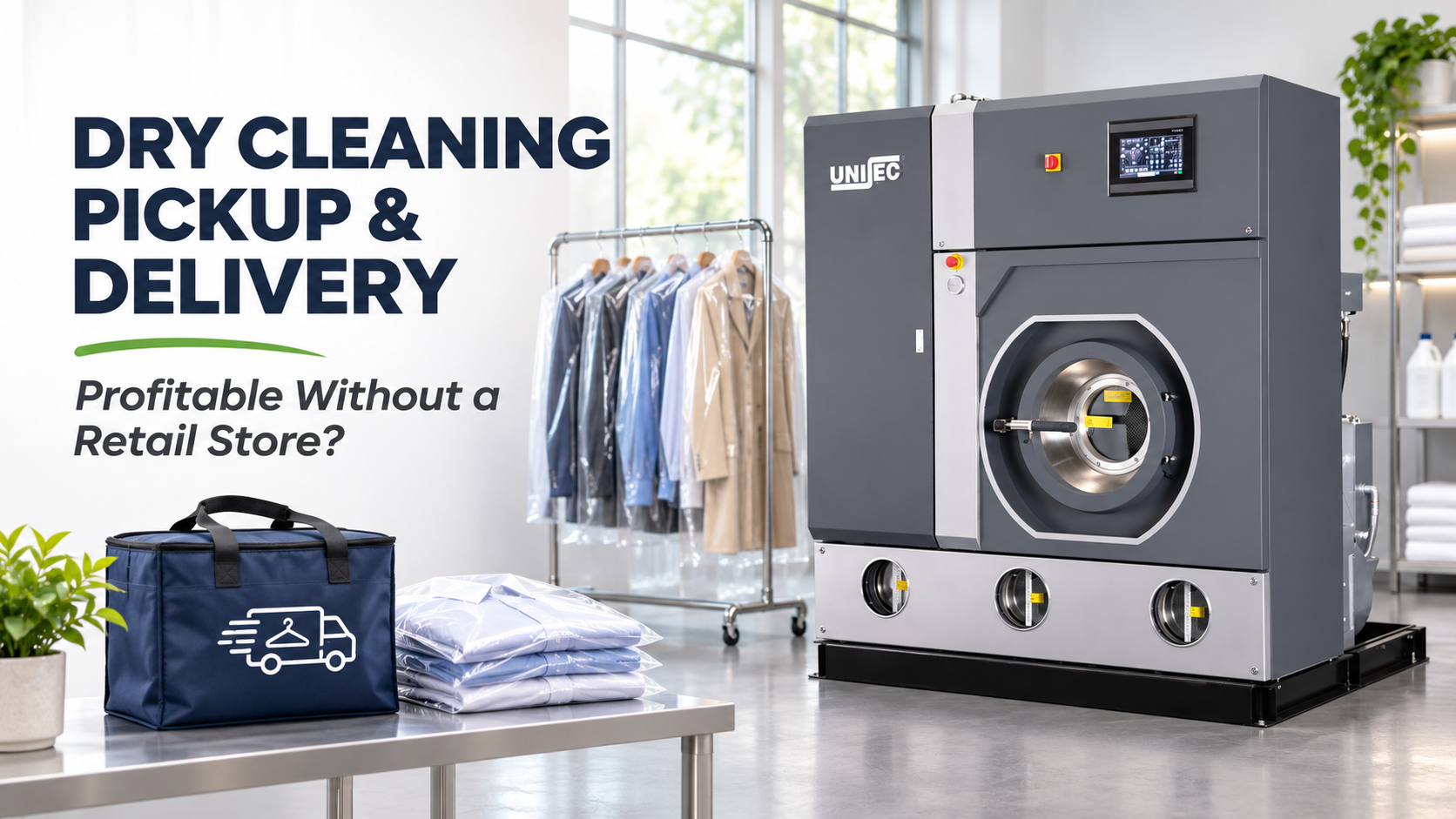
Starting a dry-cleaning business doesn't necessarily mean renting an expensive shop in a busy market.
Today, customers can schedule garment pickups through a phone call, WhatsApp or an online booking system. Their clothes are collected, professionally cleaned and delivered back to their doorstep.
For entrepreneurs, this creates an opportunity to operate without a customer-facing retail store. However, profitability depends on more than saving rent.
Delivery expenses, customer acquisition, garment processing and equipment investment still affect earnings. Even the decision to purchase a dry-cleaning machine should depend on actual order demand.
So, can this business model generate sustainable profits in India? Let's examine how it works, what it costs and where the real earning opportunities lie.
How Does a Dry Cleaning Pickup and Delivery Business Work?
A doorstep dry-cleaning service operates through a collection, processing and delivery system.
Customers schedule pickups, and the business collects their garments from homes, offices or residential communities.
Each garment is inspected, tagged and recorded before being sent for cleaning. After appropriate stain treatment, cleaning, finishing and quality inspection, the completed order is packaged and returned.
There are two main operating models:
-
Collection and delivery model: The business collects garments and uses an established professional processing partner.
-
Own processing facility: The business operates its own cleaning equipment from suitable commercial premises.
Both models can work without a retail storefront. However, owning professional machinery requires a properly planned processing facility, trained operators and suitable infrastructure.
How Much Does It Cost to Start a Dry Cleaning Delivery Business in India?
Removing a retail storefront can reduce expenses related to premium-location rent, interiors and front-desk staffing.
However, starting the business still requires working capital.
Important investment categories include:
|
Expense |
What It Covers |
|
Processing |
Outsourcing charges or professional cleaning equipment |
|
Transportation |
Pickup vehicles, fuel and delivery staff |
|
Technology |
Booking, billing and order tracking |
|
Marketing |
Local advertising, promotions and customer acquisition |
|
Packaging |
Garment covers, tags and delivery bags |
|
Operations |
Staff, utilities, administration and working capital |
A collection-only operation may need less initial equipment investment than a business operating its own plant.
For entrepreneurs planning in-house processing, the total budget should also cover machinery, site preparation, solvent systems, garment finishing and appropriate safety arrangements.
Is a Pickup and Delivery Dry Cleaning Business Actually Profitable?
A doorstep garment-care service can be profitable when order values consistently exceed processing, collection, delivery and overhead expenses.
Consider this hypothetical example:
|
Monthly Business Calculation |
Amount |
|
Daily customer orders |
15 |
|
Working days |
26 |
|
Total monthly orders |
390 |
|
Average order value |
₹450 |
|
Monthly gross revenue |
₹1,75,500 |
|
Variable cost per order |
₹230 |
|
Contribution before fixed expenses |
₹85,800 |
These figures are illustrative, not industry averages or guaranteed results.
The ₹85,800 contribution must still cover salaries, rent, marketing, administration, equipment financing and other fixed expenses.
If monthly fixed costs are ₹65,000, the business would generate approximately ₹20,800 before tax and any expenses not included in the assumptions.
This demonstrates why increasing orders alone is not enough. Delivery efficiency and average order value can significantly influence profitability.
Do You Need a Dry-Cleaning Machine to Start This Business?
Not necessarily.
A new entrepreneur can initially work with an established processing facility while focusing on customer acquisition and delivery operations.
This reduces equipment investment and allows the owner to evaluate local demand.
Purchasing a professional machine becomes more relevant when the business has sufficient processing volume, suitable premises and employees trained in garment care.
Operating your own facility can provide greater control over quality, scheduling and production, but also introduces maintenance, utility, solvent-handling and staffing responsibilities.
The purchasing decision should follow a realistic financial comparison rather than an assumption that owning machinery will always improve margins.
What Size Dry-Cleaning Machine Should a Growing Business Choose?
Machine capacity should be based on the weight and type of garments processed daily.
For example, 40 customer orders do not necessarily represent 40 machine loads. Orders may contain different garment quantities, fabrics and cleaning requirements.
Before selecting equipment, evaluate:
-
Average kilograms of garments received daily
-
Garment types and compatible cleaning processes
-
Available operating hours and batch sizes
-
Expected growth in customer orders
-
Installation, utility and service requirements
Professional equipment is available in different capacities and solvent configurations.
Choosing the right size helps avoid both underutilised machinery and processing delays during busy periods.
How Can You Get Your First 100 Customers Without a Retail Shop?
Without a walk-in storefront, local visibility becomes especially important.
Start by identifying residential communities, apartment complexes and office locations where customers may value convenient garment collection.
Offer clearly defined pickup schedules and transparent delivery commitments.
A Google Business Profile, where the business is eligible, can help customers discover the service in relevant local searches.
WhatsApp bookings, customer referrals and partnerships with residential communities can also generate enquiries.
Rather than advertising across an entire city immediately, concentrate on a manageable service area.
Reliable service and repeat orders are often more valuable than continuously acquiring customers who order only once.
What Minimum Order Value Makes Pickup and Delivery Profitable?
Delivery costs can quickly reduce earnings from small orders.
Consider two customers purchasing the same ₹200 service.
One lives in an apartment complex where several other orders are collected together. The other requires a separate trip across the city.
Although their order values are identical, the delivery costs may be very different.
Businesses should calculate:
Contribution per order = Customer payment − Processing, packaging and delivery costs
A minimum order value, scheduled pickup routes or a reasonable delivery fee can help protect margins.
The right threshold depends on local demand, transport expenses and the services customers purchase.
What Are the Biggest Challenges of Running Dry Cleaning Without a Store?
Customer convenience creates opportunities, but it also introduces operational responsibilities.
Common challenges include missed pickups, delivery delays, misplaced garments and disputes about pre-existing damage.
Every garment should be inspected and tagged before processing. Orders should be traceable through cleaning, finishing and dispatch.
Staff must also identify garments that require special treatment or cannot safely undergo a particular cleaning process.
Reliable communication matters because customers do not have a physical counter to visit when something goes wrong.
Consistent service quality is essential for building long-term trust.
What Licences and Infrastructure Are Required?
The requirements depend on whether the business only collects garments or operates its own processing facility.
A collection service may need applicable business registrations and local operating permissions.
An in-house plant may also require suitable premises, electrical infrastructure, ventilation, fire-safety arrangements and compliance with applicable environmental and solvent-handling regulations.
Requirements vary by location, equipment and cleaning technology.
Before installing professional machinery, verify the necessary permissions with the relevant local authorities and qualified technical professionals.
How Orgaearth Can Help You Start a Professional Dry Cleaning Business
Orgaearth Laundry Solutions supplies commercial garment-care equipment for businesses planning new processing facilities or expanding existing operations.
Its range includes hydrocarbon and multi-solvent systems for different garment types and production requirements.
Business owners can explore professional dry-cleaning machines from Orgaearth to compare available capacities and equipment configurations.
Orgaearth also assists with equipment selection, installation planning, technical guidance and after-sales support, helping entrepreneurs evaluate a setup suited to their processing requirements.
Conclusion: Can You Build a Profitable Dry Cleaning Business Without a Shop?
A pickup-and-delivery dry-cleaning business can operate without an expensive retail storefront, making it an option worth exploring for entrepreneurs in India.
However, profitability depends on steady customer demand, efficient delivery routes, realistic pricing and reliable garment processing.
Starting with a processing partner may help test demand before committing to equipment investment.
As orders increase, a dedicated processing facility may become commercially practical.
The most important step is to calculate the complete business costs before choosing how to operate.
Frequently Asked Questions
1. Can I start a dry cleaning business without a physical shop?
Yes. You can operate a pickup-and-delivery service without a customer-facing storefront by working with a professional processing partner or using a suitable commercial cleaning facility.
2. How much investment is required for a dry cleaning pickup and delivery business?
Investment depends on the operating model, delivery arrangements, processing costs, marketing and whether you purchase professional equipment. Prepare a detailed budget before launching.
3. Is a dry-cleaning machine necessary for a startup?
No. A collection-only business can outsource garment processing. A dedicated machine becomes relevant when establishing your own professional cleaning facility.
4. How many orders per day are needed to make a profit?
There is no universal number. Divide monthly fixed expenses by the average contribution earned per order to estimate the required order volume.
5. What capacity dry-cleaning machine is suitable for a small business?
The appropriate capacity depends on daily garment weight, batch sizes, fabric types and operating hours. A supplier can help evaluate equipment against expected demand.
6. Is pickup and delivery more profitable than a retail dry-cleaning shop?
It can have lower storefront costs, but delivery and customer-acquisition expenses may offset those savings. Compare complete operating costs before deciding.
7. How can a new business attract regular dry-cleaning customers?
Focus on residential communities, local online visibility, reliable scheduled pickups, transparent pricing, and customer referrals. Consistent quality encourages repeat orders.
Contact Us:
Orgaearth Laundry Solutions
Plot no. 774, Udyog Vihar, Phase 5, Gurugram, Haryana, India-122016
Email: marketing@orgaearth.com
Contact No. +91 7042912777

 English
 Arabic
 French
 Spanish
 Portuguese
 Deutsch
 Turkish
 Dutch
 Italiano
 Russian
 Romaian
 Portuguese (Brazil)