


From Clinic to Industry: A Practical Roadmap Into Medical Affairs.
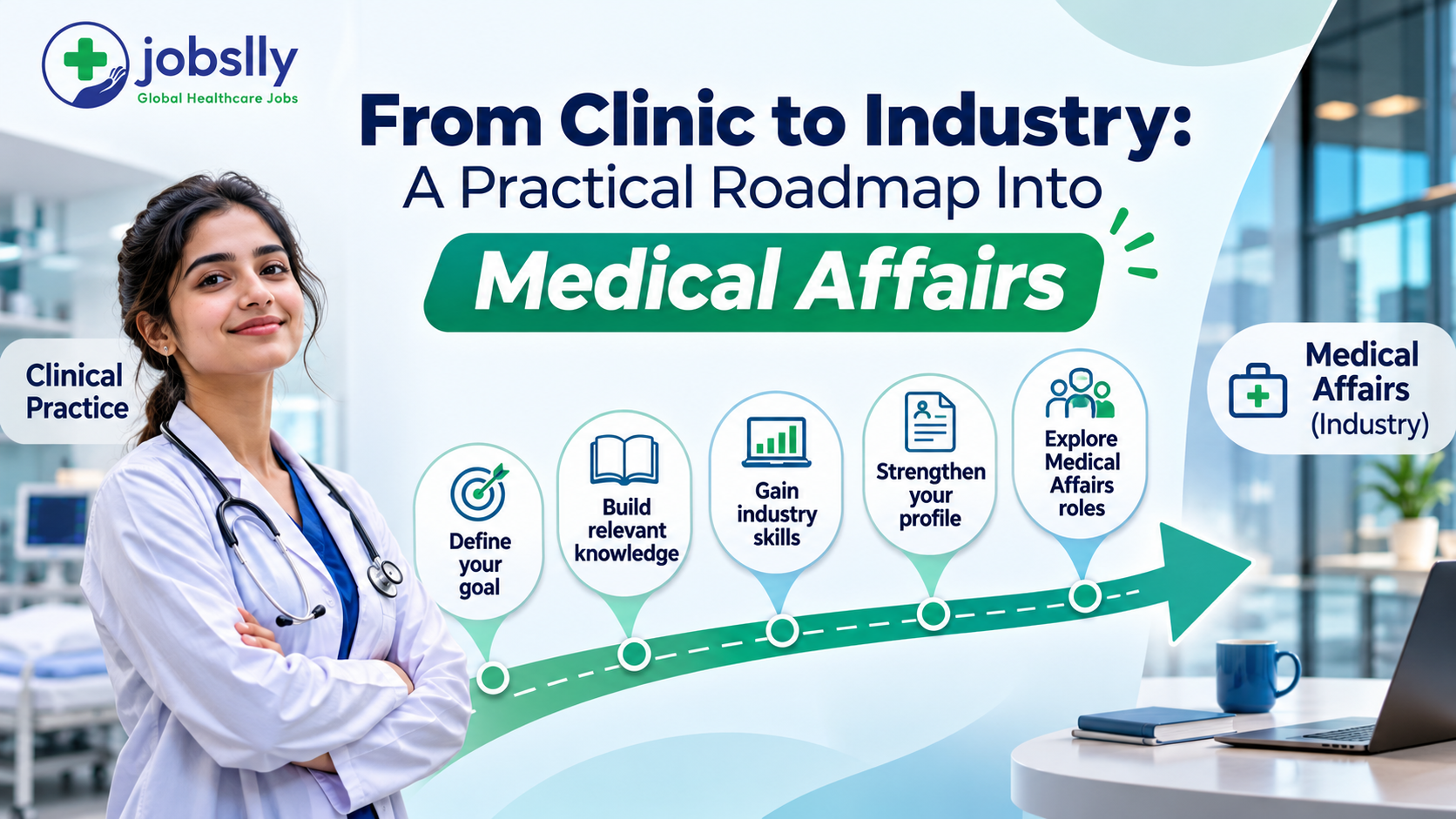
Plenty of doctors and pharmacists reach a point where clinical work or retail practice no longer feels like the only way to use their training. Medical Affairs often comes up in that conversation, and for good reason. It’s the part of a healthcare company that keeps science credible: translating evidence, answering medical questions, and making sure what’s said about a therapy is accurate and balanced. But “interested” and “hireable” are different things. This roadmap focuses on the second.
What Medical Affairs Really Involves
Medical Affairs sits between research, regulation and commercial teams. Day to day, that might mean reviewing literature, handling medical information queries, preparing scientific material or gathering insights from clinicians. Titles vary widely by company, so read each job description closely.
The Medical Science Liaison (MSL) role is the field-facing branch. Instead of promoting a product, an MSL exchanges scientific information with experts and brings real-world insights back to the organisation. It’s closer to a scientific conversation than a sales call.
Think Like a Compliance Professional
The biggest mindset shift from clinical life is learning where the lines are. In industry, what you say, how you document it and who you say it to all matter.
Get comfortable with Good Clinical Practice, the difference between scientific exchange and promotion, and the habit of escalating possible safety information. For India-specific work, read the CDSCO’s New Drugs and Clinical Trials Rules directly instead of relying on summaries. Interviewers notice candidates who can explain a rule in their own words.
Becoming Data-Literate
You don’t need to be a statistician, but you should be able to look at a trial result and ask sensible questions. What was the endpoint? Who was studied? What are the limitations? Real-world evidence adds another layer, because you must also judge where the data came from and how far to trust it.
Practise with published papers. Summarise one every week in plain language, as though explaining it to a colleague outside your specialty.
A Realistic 90-Day Starter Plan
Month one: build the foundation
Learn how the function is organised, read GCP guidance, and follow a few therapy areas closely.
Month two: create proof
Produce something concrete: a literature review, a short scientific presentation, or a mock medical plan for a therapy area you know well.
Month three: go to market
Refine your resume, tell your story to people already working in the field, and begin applying to well-matched roles rather than everything in sight.
A structured course can help, but a certificate alone proves little. What counts is whether you can explain what you built and learned.
Make Your Resume Show, Not Tell
Recruiters read countless lines like “excellent communicator.” Swap them for evidence. Instead of claiming strong communication, write that you presented trial findings to a non-specialist audience and answered questions using cited sources. Lead with a headline naming your target role, then back it with projects, specific responsibilities and relevant tools.
Where to Look for Roles
Search company career pages, professional networks and specialist recruiters, and try related titles such as Medical Advisor, Medical Information, Scientific Communications and Field Medical. A healthcare-focused board narrows the noise further, and Jobslly’s Medical Affairs listings are one place to compare MSL and specialist openings side by side.
Final Thoughts
Breaking into Medical Affairs is less about a single credential and more about visible proof: evidence you can read critically, communicate clearly and work within compliance boundaries. Start small, build something you can show, and keep your search targeted. Platforms like jobslly can help you track relevant openings while you keep sharpening your portfolio.
FAQs
1. Do I need pharma experience to enter Medical Affairs?
Not always. Some employers value backgrounds in medicine, pharmacy, research or medical writing, provided you can show how your skills transfer.
2. Is an MSL a sales role?
No. It centres on scientific exchange with experts, within strict compliance limits, rather than selling a product.
3. Can an MBBS graduate move into Medical Affairs?
Yes, depending on the employer and role. Pair your clinical background with evidence appraisal, communication and compliance knowledge.
4. Which skills matter most?
Literature review, data interpretation, scientific writing, presentation, stakeholder engagement and compliance awareness.
5. How much does the role pay?
It varies by seniority, employer, therapy area and location, so check current listings rather than relying on a single national figure.

 English
 Arabic
 French
 Spanish
 Portuguese
 Turkish
 Dutch
 Italiano
 Russian
 Romaian
 Portuguese (Brazil)
 Greek