


TekVerifii Face Recognition SDK for Enterprise Software Development
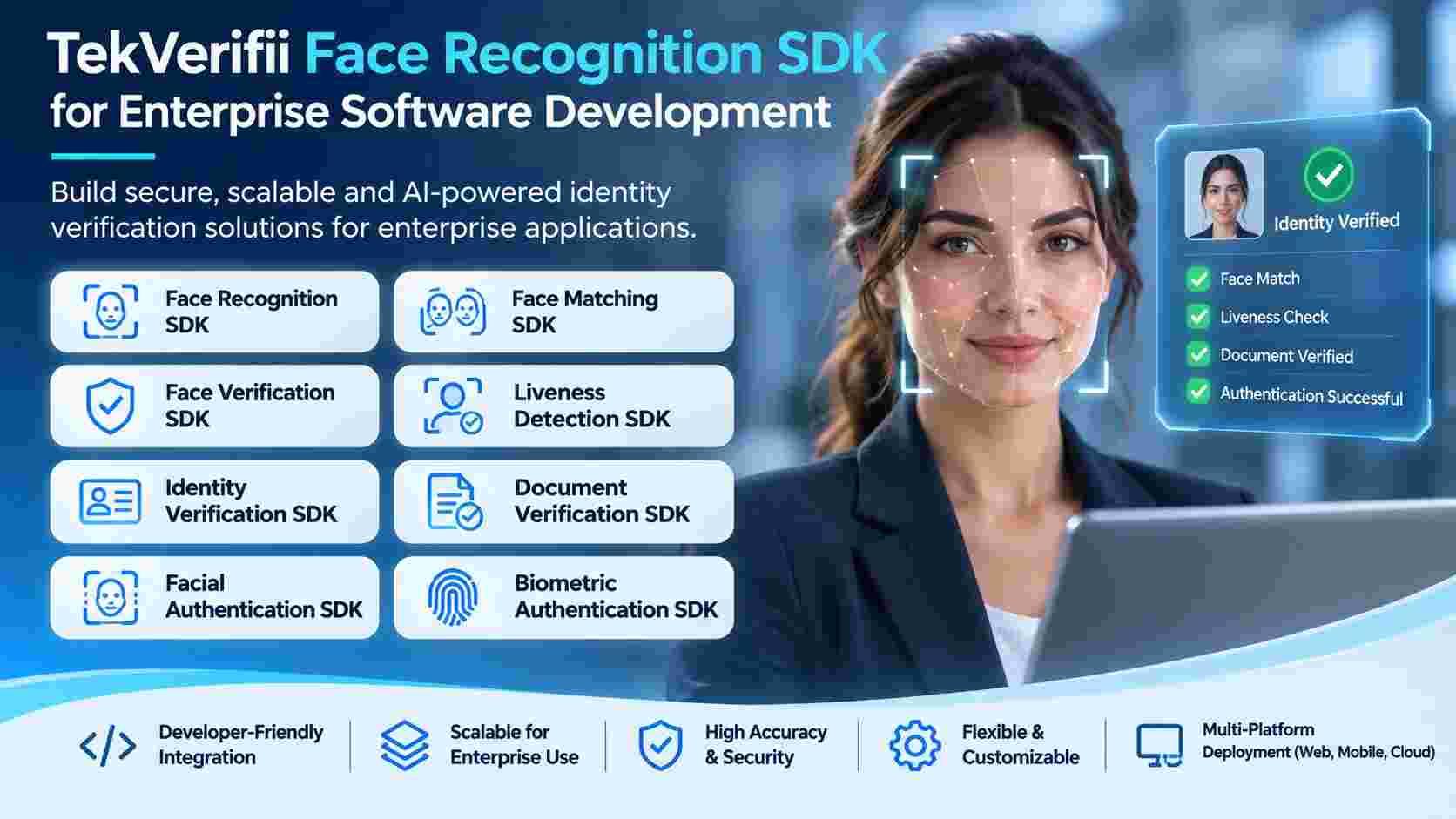
The TekVerifii Face Recognition SDK gives enterprise development teams a ready-made toolkit for adding trusted identity checks to the software they already build, from staff portals and customer apps to partner onboarding and secure entry. Instead of training models and maintaining biometric code, teams connect proven building blocks and spend their time on the business logic that makes their product different.
This guide shows where face technology fits in enterprise software, which components matter, how to plan the architecture and governance, and what to expect during rollout. It draws on the experience of Tektronix LLC, a security technology provider serving organisations across the UAE and the wider GCC region.
Why Enterprise Software Needs Trusted Identity
Enterprise applications now serve remote staff, outsourced contractors and customers who never visit a branch. In that world, knowing that the right person is behind the screen has become a core product requirement rather than a nice extra. A dependable Face Recognition SDK lets a software team treat the human face as one more secure input, alongside passwords and device checks, without becoming biometric specialists.
The Problem with Passwords Alone
Passwords are shared, reused, phished and forgotten. One-time codes can be intercepted, and badges can be lent to a colleague. Each weakness opens a door for fraud, and each reset request costs the help desk time and the user patience.
Where Identity Gaps Hurt Most
Gaps tend to appear at predictable moments: onboarding a new customer or employee, approving a high value payment, handing a shared device from one shift to the next, or granting a contractor temporary access. Strengthening those moments gives the biggest security return for the least extra effort.
Build or Buy: The Enterprise Decision
Every architecture review eventually asks whether to build biometric capability in house or adopt a specialist toolkit. The honest answer depends on the team, the timeline and the risk appetite.
The Hidden Cost of Building Alone
A homegrown solution needs data scientists, large and varied test sets, ongoing tuning, and constant defence against new spoofing methods. It also needs documentation, support and a plan for when the original engineers move on. Those costs are easy to underestimate during planning and painful to discover during production.
What a Ready Toolkit Changes
A mature toolkit moves the hardest work to a vendor that does it every day, so product teams can focus on user journeys, business rules and integration. Developers who want to see the available modules can explore the Tektronix developer toolkit before committing to a pilot.
The Components Enterprise Teams Actually Use
Strong identity flows are rarely built from one function. They combine several capabilities, each with a clear job, and the toolkit is designed so teams can adopt only the pieces they need.
Matching and Verification
The Face Matching SDK compares two faces and returns a similarity score. The Face Verification SDK turns that score into a decision for one claimed identity, with thresholds that a product owner can tune to balance convenience against risk.
Fake Resistance and Document Checks
The Liveness Detection SDK confirms that a real person is present rather than a printed photo, a screen replays or a mask. The Document Verification SDK reads identity documents and checks them for signs of tampering, so a live selfie can be compared with the portrait on the card.
Onboarding and Everyday Authentication
The Identity Verification SDK joins document, face and liveness steps into a single onboarding journey. After that, the Facial Authentication SDK handles the daily login or approval in a second or two. A wider Biometric Authentication SDK approach keeps the door open for adding further factors later, which protects the original investment as requirements grow.
Designing the Architecture
Good architecture decisions made early prevent expensive rework later. Three questions matter most: where the processing runs, how the toolkit connects to existing systems, and how the design behaves under load.
Where the Processing Runs
Enterprises usually choose between cloud services, private servers inside their own data centre, or processing on the user device. Regulated sectors often prefer private servers or device processing so that sensitive data stays under direct control, while consumer products may favour cloud for faster updates.
Connecting to Existing Systems
Identity checks must work with what is already there: identity providers, staff directories, customer databases, approval workflows and ticketing tools. Standard interfaces and clear documentation keep integration predictable, and a sandbox environment lets developers test without touching production data.
Performance and Scale
Load patterns are uneven. A bank sees spikes at salary time, an employer sees a rush at shift change, and a campaign can bring thousands of new customers in a single day. Teams should test peak volumes, response times and failure handling before launch, and they should plan sensible fullbacks such as a retry or a manual review queue.
Security, Privacy and Governance
Biometric data is personal data, so governance is part of the design rather than a final checkbox. In the UAE, the Personal Data Protection Law, Federal Decree Law No. 45 of 2021, sets the baseline, while the Telecommunications and Digital Government Regulatory Authority, Dubai Electronic Security Center and sector regulators add further expectations.
Privacy by Design
Good practice includes explicit consent, minimal retention, encrypted storage of face templates instead of raw photographs, strict access control for administrators and a plain alternative for users who cannot or prefer not to use their face. Alignment with ISO 27001 helps demonstrate that these habits are managed rather than occasional.
Testing Accuracy and Fairness
Teams should test with people of different ages, skin tones, lighting conditions and device types. Presentation attack testing aligned with ISO/IEC 30107 and independent benchmarks from the US National Institute of Standards and Technology provide reference points for judging quality and for explaining decisions to auditors.
Enterprise Use Cases
The same building blocks serve very different industries, which is why a toolkit is often more economical than separate custom projects.
Banking and Fintech
Remote account opening, payment approval and call centre checks benefit from face-based verification. Regulators such as the Central Bank of the UAE, the Dubai International Financial Centre and the Abu Dhabi Global Market expect strong customer identification, and face checks help meet that expectation while keeping journeys short.
Workforce and Secure Access
Attendance, shared workstation login, visitor and contractor entry and access to restricted rooms can all rely on the same identity engine, which reduces buddy punching and lost badge costs.
Government and Citizen Services
Public service portals can combine face checks with national digital identity such as UAE PASS to confirm citizens and residents without a visit to a counter.
Serving UAE Enterprises in Dubai and Abu Dhabi
Organisations choosing the TekVerifii Face Recognition SDK UAE package gain local support in their time zone, awareness of national rules and interfaces that suit users who work in both English and Arabic.
A TekVerifii Face Recognition SDK Dubai project often sits inside a fast moving fintech, free zone or retail product, where speed to market and a smooth mobile experience decide success.
A TekVerifii Face Recognition SDK Abu Dhabi project is more often tied to government, energy or healthcare programmes, where governance, documentation and formal approvals carry extra weight.
A Practical Path to Rollout
Define the Journey
Write down who is being identified, in which channel, and what happens when the check fails. A clear journey decides which components are needed and which thresholds are acceptable.
Prototype Quickly
Build a small working version in a sandbox, connect one real system and measure speed and success rate. Early evidence builds confidence with security, legal and business stakeholders. Teams ready to begin can talk to the Tektronix team about a pilot and agree success measures up front.
Test with Real Users
Invite a varied group to try the flow on their own phones and workstations, in bright and dim rooms. Real behaviour exposes small usability problems that lab testing misses.
Release in Stages
Launch to a limited group, watch the numbers, then widen access. Track approval rate, retry rate, fraud attempts caught and support tickets. Further product details are available on the TekVerifii product page.
Why Local Experience and Support Matter
Software projects succeed when the supplier stays involved after the first demo. Tektronix LLC supports UAE enterprises from evaluation and integration through testing and long-term support, and its team understands regional regulation, device diversity and bilingual user needs.
Conclusion
The TekVerifii Face Recognition SDK gives enterprise teams a dependable way to add trusted identity to their software, and a good Face Recognition SDK keeps that work simple. The Face Matching SDK and Face Verification SDK components decide who a person is, while the Liveness Detection SDK confirms that the person is really there. The Document Verification SDK and Identity Verification SDK make onboarding fast, and the Facial Authentication SDK and Biometric Authentication SDK protect every later login and approval. Teams planning a TekVerifii Face Recognition SDK UAE programme gain local support and clear guidance on national rules. From a TekVerifii Face Recognition SDK Dubai fintech launch to a TekVerifii Face Recognition SDK Abu Dhabi government service, now is the time to start building.
FAQs
How does a Face Verification SDK differ from face search?
Verification compares a person with one claimed identity, for example the account holder, which is fast and privacy friendly. Search compares a face against a large gallery, which is a different task with different risks.
Why is a Liveness Detection SDK important for enterprise apps?
Without a liveness check, a stolen photo or a replayed video can pass a face match. The check ensures a live person is present, which is essential for remote onboarding and payments.
Can a Document Verification SDK work with UAE identity documents?
It is designed to read common identity documents and check them for tampering. The exact list of supported documents should be confirmed with Tektronix for your use case.
When should a team choose a Biometric Authentication SDK approach?
Choose it when you expect to combine several checks, such as face, document and device signals, or when risk rules will change over time. It keeps the design flexible without a rewrite.
Is TekVerifii Face Recognition SDK Abu Dhabi support available for government projects?
Tektronix LLC works with organisations across the UAE, so teams in Abu Dhabi can discuss scope, documentation and approval needs directly with the Tektronix team.

 English
 Arabic
 French
 Portuguese
 Deutsch
 Turkish
 Dutch
 Italiano
 Russian
 Romaian
 Portuguese (Brazil)
 Greek