


MBA Courses Compared: How to Pick the Format That Fits Your Working Life
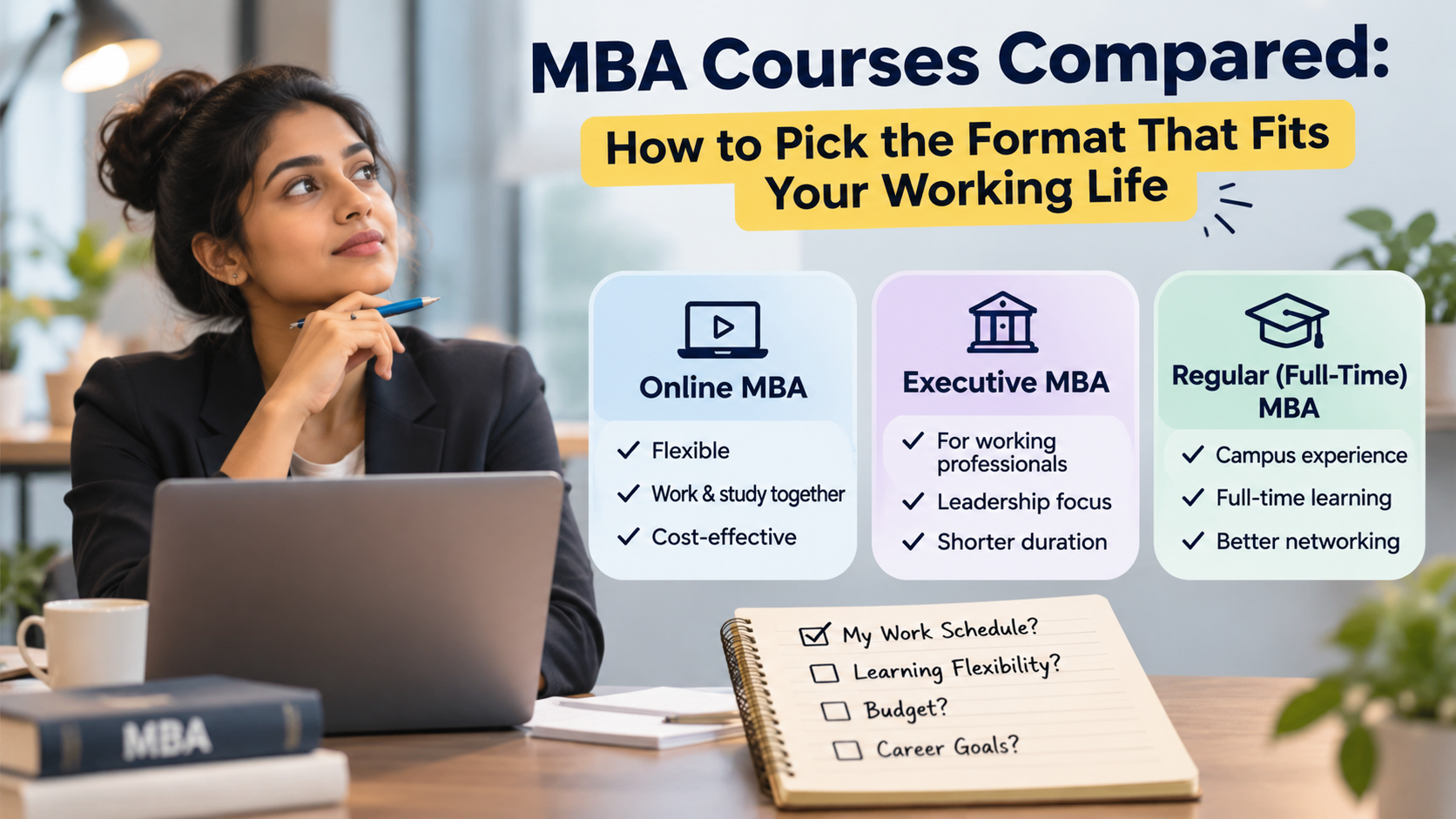
MBA Courses Compared: How to Pick the Format That Fits Your Working Life
You’re 29, three years into a job you’re decent at, and every colleague has an opinion about doing an MBA. The trouble is that the phrase MBA courses covers at least six different products, from a two-year campus programme to an online degree you finish alongside work, and most comparison pages rank colleges before they’ve helped you choose the format.
This guide is for working professionals who haven’t picked a college yet. I used current figures from portals and universities, and where they disagree, I’ll say so.
What Are the Main MBA Courses You Can Choose From in India?
Careers360 lists full-time, part-time, executive, online, distance and integrated formats, and other portals add a one-year MBA. Durations and entry rules differ by source, so treat this as a rough map rather than a rulebook.
|
Format |
Typical duration |
Usual entry requirement |
Who it tends to suit |
|
Full-time |
2 years |
Bachelor’s degree, often with 50% marks |
Career switchers and early-career graduates |
|
One-year |
About 1 year |
Graduation plus 3+ years of experience |
Experienced people who can pause work |
|
Executive |
1–2 years |
Graduation plus work experience |
Experienced professionals |
|
Part-time |
2–3 years |
Bachelor’s degree, often with 50% marks |
People who can attend evening or weekend classes |
|
Online |
Usually 2 years |
Bachelor’s degree |
People who need to keep earning |
|
Distance |
2–3 years |
Bachelor’s degree, requirements vary |
Self-paced learners who don’t need much interaction |
Online durations are quoted anywhere from one to four years on some portals, though two years is the standard answer. Integrated programmes, which run five years after Class 12, are a different track and aren’t aimed at working professionals.
Which Format Lets You Keep Your Job, and What Does It Cost You?
Part-time, executive, online and distance formats all let you stay employed, but each one costs you something different. Part-time and weekend formats keep you on a campus, so the real challenge is getting from the office to the classroom after a full day. Executive programmes assume experience, and many ask for three years or more. Online programmes usually ask only for a bachelor’s degree.
The difference between online and distance matters more than most people realise. Online programmes typically give you live and recorded sessions with real interaction, while distance programmes are largely self-paced with minimal interaction, according to Manipal. Of all the MBA courses that fit around a job, online is the only one that removes the commute entirely. It also asks the most of your self-discipline.
MBA or PGDM: Does the Label on the Certificate Matter?
An MBA is a degree from a UGC-recognised university. A PGDM is a diploma from an AICTE-approved autonomous institute. For most jobs, that difference barely registers. It starts to matter for PhD admissions and some government roles, where a PGDM may need an equivalence certificate from the AIU. In its own wording, AIU grants equivalence to certain two-year full-time PGDMs from AICTE-approved institutes with accredited programmes, and it isn’t automatic. So check the specific institute, not the category.
Several sources also say salary outcomes track the institute, the specialisation and your experience more than the degree-or-diploma label. Keep that in mind when a counsellor makes a big deal of the word “degree”. Whichever you choose, ask which one you’re being offered when you compare MBA courses across colleges.
How Do You Pick a Specialisation When You Already Have a Career?
Most colleges offer finance, marketing, HR, operations or analytics. Many MBA courses follow a similar shape: shared management fundamentals first, then specialisation, so you don’t have to decide on day one.
My advice for working professionals is simple. Pick the specialisation that either deepens what you already do or gives you the clearest bridge to what you want next. If you’re switching fields, choose the track where you can build proof, such as a project, a case study or a small portfolio, rather than just a new line on your CV.
What Should You Check Before You Pay for Any of These MBA Courses?
For online and distance formats, start with approval. One portal says an online MBA is equivalent to a regular MBA provided the university is UGC-DEB approved, and GradRight adds that AICTE approval matters for a management degree. Check the UGC-DEB portal for the current session rather than trusting a brochure.
Then look at the money. One portal lists online MBA fees from ₹40,000 to ₹3 lakh, while its averages for executive and one-year MBAs run to ₹15 lakh and ₹7 lakh. Those are portal averages, not quotes, so ask each college for the full fee schedule in writing. Finally, ask for outcomes of people who joined with your background, not the batch average. Comparing MBA courses on price alone is how people end up paying twice.
Where Online MBA Courses Fall Short (and Where They Don’t)
Online MBA courses suit people who can’t step away from a salary, because you keep earning while you study. They fall short if you’re counting on a campus network or on-campus recruiting, so ask what the online format offers in its place. They also fall short if you need someone to impose a routine on you. The format doesn’t take the work away. It takes the structure away.
If you know you work best with deadlines and classmates around you, a part-time campus format may serve you better.
So, Which of the MBA Courses Should You Actually Shortlist?
Pick the format first, then the college. Ask whether you can leave your job, what credential you’ll need later, and how much structure you need from others. Then compare approved options on outcomes and total cost, not brochure promises. Used that way, MBA courses stop looking like an endless list and start looking like a short, sensible decision. If you want somewhere to compare online options side by side, EazyGrad can help you shortlist and get your questions answered before you commit.
FAQs: Quick Answers on Choosing an MBA
Which of the MBA courses suits a working professional?
Part-time, executive, online and distance formats all allow you to keep working. Executive programmes typically ask for three years or more of experience, while online usually needs only a bachelor’s degree.
How long are MBA courses?
Two years is the standard answer for full-time and most online formats. Executive and one-year formats run about one to two years, and part-time stretches to two or three, though portals vary.
Is a PGDM the same as an MBA?
Not exactly. An MBA is a university degree and a PGDM is a diploma, but AICTE-approved, AIU-recognised PGDMs are treated as equivalent. Verify the specific institute.
Can I do an MBA without work experience?
Yes, for full-time and most online formats, usually with a bachelor’s degree and often around 50% marks. Executive and one-year programmes typically want three years or more of experience.
Is an online MBA valid?
It is when the university holds UGC-DEB approval for that programme. Check it on the official portal before you pay.

 English
 Arabic
 French
 Spanish
 Portuguese
 Turkish
 Dutch
 Italiano
 Russian
 Romaian
 Portuguese (Brazil)
 Greek