


Saudi Arabia Dairy Market Share, Trends, Analysis & Forecast 2026-2034
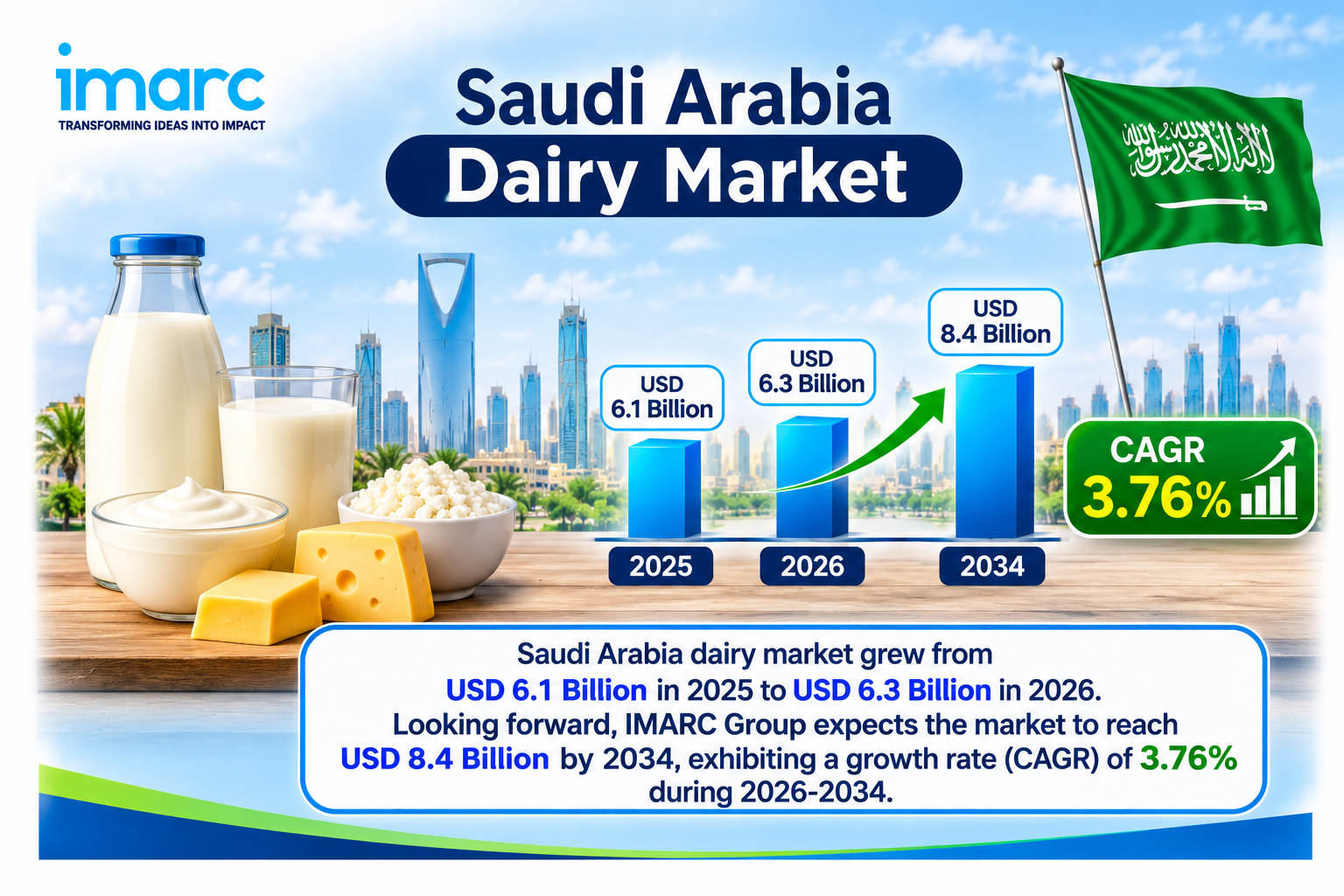
IMARC Group, a leading global market research and management consulting firm, has published its latest market intelligence report on the Saudi Arabia dairy market. The Saudi Arabia dairy market size increased from USD 6.1 Billion in 2025 to USD 6.3 Billion in 2026 and is projected to reach USD 8.4 Billion by 2034, exhibiting a CAGR of 3.76% during 2026-2034, driven by rising disposable incomes, evolving dietary habits, escalating health consciousness, and supportive government farm-modernization programs.
The market is building on steady structural momentum as the Kingdom's dairy sector moves from import reliance toward near-complete self-sufficiency, anchored by vertically integrated producers, expanding cold-chain networks, and a fast-digitalizing retail landscape. Premiumization, food-safety traceability technology, and e-commerce-led distribution are widening the addressable market across liquid milk, cheese, yoghurt, and value-added categories such as whey protein and lactose powder, while government-backed subsidies for farm equipment and livestock imports continue to underpin domestic production capacity. Large vertically integrated players such as Almarai Company anchor a supply base spanning farming, processing, and distribution, giving the market a foundation built for scale rather than a single growth catalyst.
Saudi Arabia Dairy Market at a Glance:
- Market Size (2025): USD 6.1 Billion
- Market Size (2026): USD 6.3 Billion
- Forecast Market Size (2034): USD 8.4 Billion
- CAGR (2026-2034): 3.76%
- Leading Product Segment (2025): Liquid Milk
- Leading Region (2025): Northern and Central Region
How AI and Smart Technologies Are Reshaping the Future of the Saudi Arabia Dairy Market
- AI-Driven Precision Dairy Farming: Large integrated operators are adopting sensor-based herd monitoring and predictive analytics to track animal health and optimize milk yield, improving feed efficiency and output consistency across the Kingdom's largest dairy farms.
- Automated Processing and Smart Packaging: Producers are deploying modified-atmosphere and vacuum packaging alongside automated filling lines to extend shelf life, cut food waste, and maintain quality as volumes scale to meet rising domestic and export demand.
- Blockchain-Enabled Supply Chain Traceability: Dairy companies are investing in blockchain platforms to track products from farm to shelf, strengthening food-safety assurance and transparency as consumers grow more attentive to product origin and quality.
Grab a sample PDF of this report: https://www.imarcgroup.com/saudi-arabia-dairy-market/requestsample
Saudi Arabia Dairy Market Trends and Drivers:
Government-backed support for farm modernization is a central pillar of supply-side growth, with subsidies covering roughly half the cost of irrigation engines and pumps, all shipping expenses including airfreight for imported livestock, and close to a third of the cost of dairy farm equipment. In a sign of further diversification, Saudi Arabia's Public Investment Fund set up a new venture in early 2024 to grow the Kingdom's camel dairy farming segment. Producers are also investing in workforce development, exemplified by Almarai's participation in the Ministry of Human Resources and Social Development's national training campaign, which is set to deliver tens of thousands of training opportunities to employees over several years.
Export-led growth is compounding this momentum: Saudi Arabia reported reaching full self-sufficiency in dairy products by mid-2024, and the broader food sector has benefited from billions of riyals in export-linked financing through the Saudi Industrial Development Fund and the Saudi Export-Import Bank. Industry leaders are translating this into job creation and skills development, with Almarai entering training and localization partnerships with vocational and logistics institutions to build out the domestic supply chain workforce, from farming through processing and distribution.
Technology investment is reinforcing both trends. International manufacturing groups are weighing new food-processing capacity inside the Kingdom, while packaging innovation, including modified-atmosphere and vacuum-sealed formats, is extending product shelf life and reducing waste. Partnerships between regional dairy groups and global packaging technology providers are accelerating sustainability upgrades across manufacturing facilities, supporting both quality and efficiency as the market scales.
Government Schemes and Vision 2030 Initiatives Driving Demand:
- Dairy Farm Modernization Subsidies: Government support covers a significant share of the cost of irrigation equipment, livestock import logistics, and farm machinery, directly lowering the capital burden for dairy producers expanding output.
- PIF Camel Dairy Initiative: The Public Investment Fund launched a dedicated venture in 2024 to develop the Kingdom's camel dairy farming industry as part of its broader economic diversification agenda.
- Food Export Financing Programs: The Saudi Industrial Development Fund and the Saudi Export-Import Bank have extended billions of riyals in loans and export assistance to food manufacturers, supporting dairy exports to GCC and other regional markets.
- Workforce Localization and Training Partnerships: Leading producers such as Almarai are partnering with vocational and logistics institutions on training and localization programs, building a domestic talent pipeline across farming, processing, and distribution.
Saudi Arabia Dairy Industry Segmentation:
The report has segmented the market into the following categories:
Breakup By Product Type:
- Liquid Milk
- Flavored Milk
- Cream
- Butter
- Cheese
- Yoghurt
- Ice Cream
- Anhydrous Milk Fat (AMF)
- Skimmed Milk Powder (SMP)
- Whole Milk Powder (WMP)
- Whey Protein
- Lactose Powder
- Curd
- Paneer
Liquid milk remains the backbone of the segment, underpinned by steady household demand for plain and flavored varieties as incomes rise and nutritional awareness grows, while flavored milk retains strong appeal among children and younger consumers. Cream continues to benefit from the expanding hospitality sector and growing adoption of Western-style cuisine, and butter remains a staple ingredient across both traditional and international cooking. Cheese consumption is climbing fastest among the processed categories, supported by urbanization, globalization, and the rising popularity of cheese-based dishes and snacks.
Breakup By Region:
- Northern and Central Region
- Western Region
- Eastern Region
- Southern Region
The Northern and Central Region, home to the capital Riyadh and other dense urban centers, carries the strongest demand given its large, urbanizing population. The Western Region, covering Jeddah, Mecca, and Medina, draws additional demand from religious tourism and cultural diversity tied to Hajj and Umrah pilgrim flows. The Eastern Region's industrial cities, including Dammam, Al Khobar, and Jubail, generate demand linked to economic prosperity and a diverse workforce, while the Southern Region, covering Abha, Jizan, and Najran, reflects more traditional dietary habits and a stronger agricultural base.
Competitive Landscape:
The report provides a comprehensive analysis of the competitive landscape in the Saudi Arabia dairy market with detailed profiles of all major companies, including:
- Almarai Company
- Al-Othman Holding Company
- Arla Foods amba
- Fonterra Co-operative Group Limited
- Saudia Dairy and Foodstuff Co.
- The National Agricultural Development Company
Market Concentration Analysis:
- Scale Leadership: Vertically integrated producers such as Almarai hold a dominant position across farming, processing, and distribution, setting the benchmark for scale in the sector
- Government-Backed Diversification: Public Investment Fund-led ventures, such as the dedicated camel dairy farming initiative, are expanding the competitive base beyond conventional cattle-dairy operators
- Export and Localization Partnerships: Collaboration agreements between leading producers and vocational, logistics, and export-financing institutions are reshaping competitive dynamics by strengthening domestic supply chain capability
What Does The Full Report Cover?
If you are tracking the Saudi Arabia dairy market for investment decisions, market entry planning, competitive benchmarking, or strategic advisory, IMARC Group's report gives you everything in one place:
- Complete market sizing in value terms with forecasts covering the full 2026-2034 projection period, alongside historical data from 2020-2025
- Quantified growth driver analysis across product type and regional markets
- Sub-segment breakdowns for all fourteen product categories, including liquid milk, cheese, yoghurt, milk powders, whey protein, and lactose powder
- Regional data across the Northern and Central, Western, Eastern, and Southern regions of Saudi Arabia
- Competitive profiles of leading global and national dairy companies with strategic landscape assessment
- Value chain analysis, Porter's five forces assessment, and investment and growth opportunity mapping
- Latest technology trends covering precision farming, smart packaging, blockchain traceability, and Vision 2030-driven export and self-sufficiency opportunities shaping market competition across the Kingdom
Recent News and Developments in Saudi Arabia Dairy Market
- March 2024: Almarai Company outlined its investment plan for 2024-2028 to reinforce its position as the Kingdom's largest vertically integrated dairy company, in line with Saudi Vision 2030 and the state's push to empower the private sector.
- March 2024: The Saudi Food Bank partnered with Kiri on a Ramadan iftaar initiative, pairing Kiri cheese with bread, juice, and fresh fruit as part of a fast-breaking meal program.
- January 2024: Saudia Dairy and Foodstuff Company (SADAFCO) opened a new distribution depot in Makkah.
Note: If you require specific details, data, or insights that are not currently included in the scope of this report, we are happy to accommodate your request. As part of our customization service, we will gather and provide the additional information you need, tailored to your specific requirements. Please let us know your exact needs, and we will ensure the report is updated accordingly to meet your expectations.
Key Questions This Report Answers
- What is the current Saudi Arabia dairy market size and what is its projected value?
- Which product type holds the largest share in the Saudi Arabia dairy market?
- What are the key drivers of Saudi Arabia dairy market growth?
- Which region dominates the Saudi Arabia dairy market and why?
- How are government subsidies, Vision 2030, and self-sufficiency goals reshaping production capacity and competitive strategy in the Saudi Arabia dairy industry?
- Who are the top companies in the Saudi Arabia dairy market and what are their competitive strategies?
- What are the investment and market entry opportunities across premium dairy, exports, and value-added product categories in Saudi Arabia?
About Us
IMARC Group is a global management consulting firm that helps the world's most ambitious changemakers to create a lasting impact. The company provides a comprehensive suite of market entry and expansion services. IMARC offerings include thorough market assessment, feasibility studies, company incorporation assistance, factory setup support, regulatory approvals and licensing navigation, branding, marketing and sales strategies, competitive landscape and benchmarking analyses, pricing and cost research, and procurement research.
Media and Sales Contact
IMARC Group
Email: sales@imarcgroup.com
United States: +1-201-971-6302
India: +91-120-433-0800
United Kingdom: +44-753-714-6104

 English
 Arabic
 French
 Spanish
 Portuguese
 Deutsch
 Turkish
 Italiano
 Russian
 Romaian
 Portuguese (Brazil)
 Greek