


How Shopify Integration Helps eCommerce Businesses Streamline Sales, Inventory, and Operations
Introduction
Running a successful Shopify store involves much more than managing products and processing customer orders. As an eCommerce business grows, managing inventory, fulfilment, accounting, and financial reporting across different platforms becomes increasingly complicated.
Many businesses use Shopify alongside separate inventory management systems, accounting software, warehouse applications, and ERP platforms. Although each tool serves an important purpose, disconnected systems can create operational challenges.
Missing updates, inconsistent stock quantities, manual data entry, and delayed reporting can affect productivity and business performance.
This is where Shopify integration becomes important. Connecting Shopify with other business applications helps companies streamline workflows, improve data consistency, and gain better visibility into their operations.
What Is Shopify Integration?
Shopify integration involves connecting an online store with other business applications so information can move between systems.
Depending on the applications involved, this may include synchronizing:
-
Customer information
-
Product details and variants
-
Inventory quantities
-
Sales orders
-
Payment and transaction information
-
Shipping and fulfilment updates
-
Financial and operational records
For growing businesses, these connections reduce the need to manage every application independently.
Why Do eCommerce Businesses Need Shopify Integration?
As online stores expand, manual processes become harder to maintain. Several challenges make integration increasingly valuable.
1. Inventory Management Across Multiple Channels
Businesses selling through multiple channels need accurate stock information to avoid overselling and unexpected shortages.
Connecting Shopify with an inventory management system helps synchronize stock information and provides better visibility into product availability.
2. Automated Order Processing
Manually transferring orders between different applications can slow down fulfilment.
Integration allows supported order information to move automatically between Shopify and connected ERP, warehouse, or inventory systems.
This reduces repetitive administrative work and helps teams process orders more efficiently.
3. Better Accounting and Financial Reporting
Sales information from Shopify is important for understanding business performance.
Connecting eCommerce data with accounting and financial systems can simplify reconciliation and improve visibility into revenue, expenses, and profitability.
4. Improved Customer Data Management
Customer information is often stored across eCommerce platforms, CRM applications, and other business systems.
Connecting these applications can help teams maintain more consistent customer records and improve communication between departments.
How Shopify Integration Improves Business Reporting
One major advantage of connecting Shopify with other business applications is the ability to analyze information across multiple systems.
Shopify provides valuable information about online sales, orders, and customer activity. However, businesses may need additional inventory, accounting, and fulfilment data to understand their overall performance.
For example, sales revenue alone does not explain product profitability. Businesses also need to consider purchasing costs, fulfilment expenses, inventory movement, and other operational factors.
Integrated reporting can help businesses:
-
Compare sales performance across products and channels.
-
Monitor inventory turnover and stock availability.
-
Understand product-level profitability.
-
Identify slow-moving inventory.
-
Compare sales information with financial records.
-
Monitor operational performance through centralized dashboards.
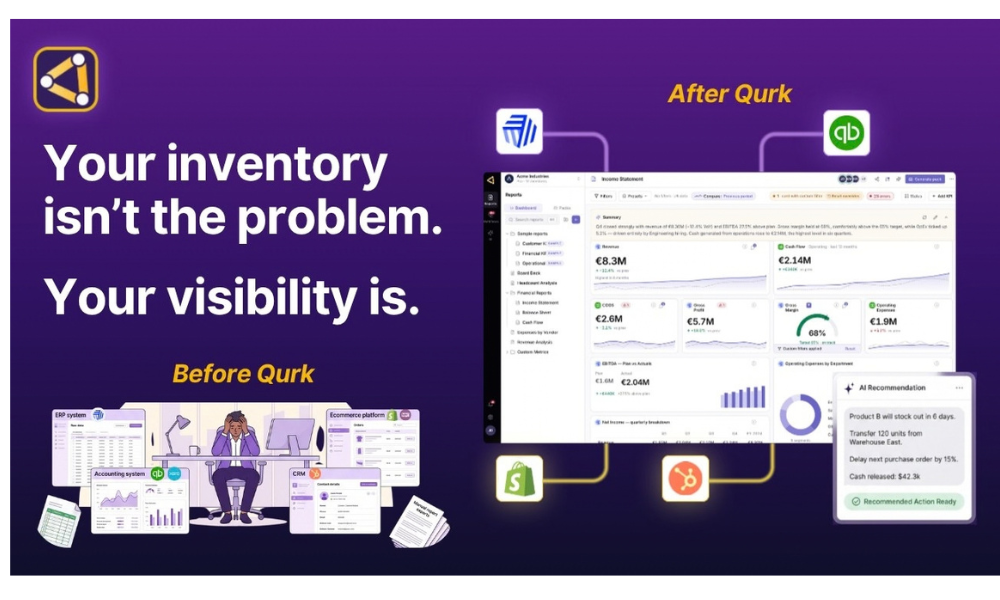
Businesses exploring ways to connect Shopify sales with inventory, accounting, and fulfilment data can consider Shopify integration with Qurk.
Qurk brings Shopify information together with connected business applications to support integrated reporting, workflow automation, and AI-powered business insights.
Common Applications to Connect With Shopify
The right integrations depend on the size and operational requirements of an eCommerce business.
Inventory Management Systems
Connecting Shopify with inventory software helps businesses synchronize stock quantities, product information, and order activity.
ERP Platforms
ERP integration can connect eCommerce operations with purchasing, inventory, finance, and other business processes.
Accounting Software
Accounting integrations help transfer relevant sales and transaction information, reducing repetitive financial administration.
Warehouse and Fulfilment Systems
Connecting Shopify with warehouse or third-party logistics platforms helps coordinate order processing, shipment updates, and inventory movements.
CRM Platforms
CRM integrations help businesses connect customer information and order activity with sales and customer relationship workflows.
Best Practices for Successful Shopify Integration
Implementing integrations requires careful planning to ensure information moves accurately between applications.
Understand Your Business Requirements
Identify which applications need to communicate and determine what information should be transferred.
Maintain Consistent Product Data
Use consistent SKUs, product identifiers, and variant information across connected systems.
Define Synchronization Rules
Determine how frequently information should be updated and which application should act as the primary source for each type of data.
Monitor Integration Performance
Regularly review failed updates, synchronization errors, and data discrepancies.
Plan for Future Growth
Choose integration solutions that can accommodate additional sales channels, products, warehouses, and business applications.
The Future of Connected eCommerce Operations
The future of eCommerce is increasingly connected.
As businesses adopt more specialized software, the ability to exchange information between applications will become even more important.
Automation and integrated reporting can help organizations reduce manual processes, identify operational problems earlier, and make better-informed decisions.
Rather than managing sales, inventory, accounting, and fulfilment separately, businesses can build a connected environment where each department works with more consistent information.
Conclusion
Shopify integration plays an important role in helping eCommerce businesses manage growing operational complexity.
By connecting Shopify with inventory management systems, ERP platforms, accounting applications, and fulfilment tools, businesses can improve synchronization, simplify workflows, and gain better visibility into their performance.
For companies looking to scale their online operations, investing in connected business systems can provide a stronger foundation for efficiency and sustainable growth.

 English
 Arabic
 Spanish
 Portuguese
 Deutsch
 Turkish
 Dutch
 Italiano
 Russian
 Romaian
 Portuguese (Brazil)
 Greek