


Green Bio-solvents Market Overview, Size, Trends & Forecast 2026-2034
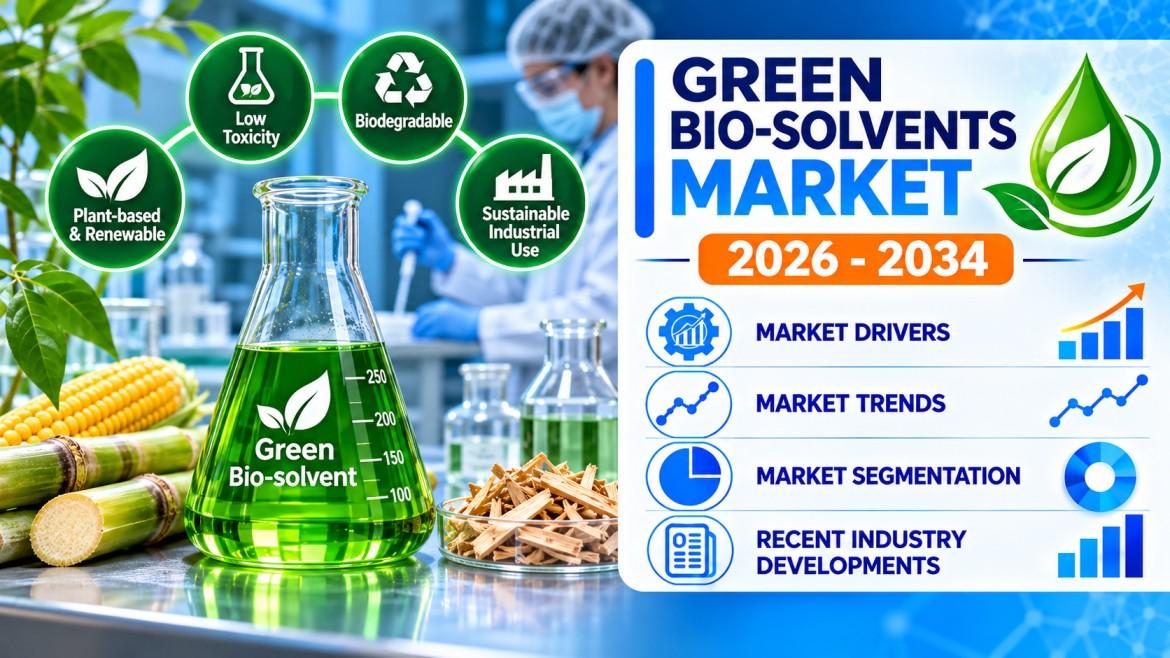
IMARC Group, a leading global market research and management consulting firm, has published its latest market intelligence report on the green and bio-solvents market. The global green and bio-solvents market size was valued at USD 14.8 Billion in 2025. Looking forward, IMARC Group estimates the market to reach USD 26.0 Billion by 2034, exhibiting a CAGR of 6.48% during 2026-2034, exhibiting a growth rate (CAGR) of 6.48% during 2026-2034, driven by rising environmental awareness, increasingly stringent government regulations aimed at cutting down volatile organic compound (VOC) emissions, expanding demand for sustainable alternatives across paints, coatings, and adhesives, and accelerating corporate decarbonization initiatives worldwide.
The market is experiencing strong growth momentum fueled by the structural transition from conventional petroleum-derived solvents toward non-toxic, biodegradable, and renewable alternatives. Conventional aromatic and chlorinated hydrocarbons, such as toluene, xylene, and methylene chloride, face escalating regulatory prohibitions due to their harmful environmental footprint, flammability hazards, and documented risks to occupational health. In response, chemical formulators across industrial manufacturing, automotive assembly, and consumer goods are reformulating their product lines with bio-derived solvents sourced from agricultural feedstocks including corn, sugarcane, soybeans, and citrus processing byproducts. Concurrently, advancements in industrial biotechnology, catalytic conversion, and green chemical refining are closing the performance and price parity gap, enabling bio-solvents to function as seamless drop-in replacements in high-volume commercial applications. The green and bio-based solvents market is growing as industries increasingly shift toward sustainable alternatives to conventional petroleum-based solvents. Rising environmental awareness, stricter regulations on volatile organic compound (VOC) emissions, and growing demand from paints and coatings, pharmaceuticals, adhesives, and cleaning products are driving market expansion.
How Circular Bio-Economy and Fermentation Innovations Are Reshaping the Green And Bio-solvents Market
- Utilization of Second-Generation Non-Food Agricultural Residues
- A critical technological advancement in bio-solvent production is the transition from first-generation edible crops to second-generation lignocellulosic biomass. Chemical manufacturers are utilizing agricultural wastes, including corn stover, sugarcane bagasse, wheat straw, and forestry waste, to produce bio-based alcohols, glycols, and esters. Through advanced enzymatic hydrolysis and genetically optimized microbial fermentation, biorefineries are unlocking fermentable sugars from waste streams without competing with the global food supply chain, significantly improving life-cycle carbon accounting for industrial users.
- High-Performance Drop-In Formulations Matching Kauri-Butanol Solvency
- A historical bottleneck for early green solvent adoption was inferior dissolution kinetics compared to legacy petrochemicals. Modern bio-solvent engineering has overcome this limitation by developing tailored molecular blends, such as lactate ester complexes and modified methyl soyates, that achieve Kauri-Butanol (KB) solvency values exceeding 90. These high-solvency profiles allow coatings manufacturers and industrial degreasers to dissolve stubborn synthetic resins, acrylics, and heavy greases with reduced application volumes, lower evaporation losses, and higher flash points that enhance worker safety on shop floors.
- Integration of Mass-Balance Certification and Low-Carbon Life Cycle Metrics
- Multinational chemical conglomerates are scaling biomass-balance supply chains certified under international standards such as ISCC PLUS (International Sustainability and Carbon Certification) and RSPO (Roundtable on Sustainable Palm Oil). By co-feeding renewable bio-feedstocks alongside fossil inputs in existing world-scale steam crackers and synthesis units, manufacturers are producing chemically identical bio-attributed solvents. This approach provides industrial customers with certified carbon footprint reductions of up to 50% to 70% without requiring costly changes to manufacturing equipment, regulatory registrations, or paint spray application lines.
Grab a sample PDF of this report: https://www.imarcgroup.com/green-bio-solvents-market/requestsample
Green And Bio-solvents Market Trends and Drivers
The global green and bio-solvents market is witnessing steady expansion, underpinned by rigorous environmental legislation and sustainable procurement mandates. In the European Union, the Registration, Evaluation, Authorisation and Restriction of Chemicals (REACH) regulation and the Industrial Emissions Directive (IED) enforce stringent caps on hazardous air pollutants (HAPs) and industrial solvent emissions. Solvents designated as Substances of Very High Concern (SVHC) face progressive phase-outs, compelling coatings, printing ink, and resin manufacturers to transition toward compliant bio-based alcohols, ethyl lactate, and bio-glycols. Similarly, in the United States, volatile organic compound limits established under the Clean Air Act, enforced at the state level by stringent agencies like California's South Coast Air Quality Management District (SCAQMD Rule 1113), have established near-zero VOC thresholds for architectural coatings and industrial adhesives, accelerating the shift toward bio-solvents.
Federal sustainability programs are also catalyzing demand through institutional purchasing power. In the United States, the USDA BioPreferred Program provides statutory procurement preferences for federal agencies and military installations to purchase certified bio-based degreasers, hydraulic fluids, and cleaning solvents containing high percentages of renewable biological carbon. In Asia, China's 14th Five-Year Plan for Green Chemical Manufacturing and national blue-sky air quality defense campaigns mandate significant VOC emission cuts across coastal industrial parks, prompting major paint manufacturers and automotive refinishing shops across Guangdong, Jiangsu, and Shandong provinces to transition to waterborne and bio-solvent formulations.
Corporate ESG mandates and life cycle assessment (LCA) benchmarks across consumer-facing industries are creating sustainable pull-through demand. Global automobile manufacturers, packaging converters, and consumer electronics brands are actively auditing Scope 3 supply chain emissions, rewarding tier-one suppliers that substitute fossil solvents with renewable chemistry. Because solvents represent a major contributor to embedded embodied carbon in surface coatings and cleaning solutions, replacing one metric ton of fossil toluene or butyl acetate with bio-based alternatives can mitigate over 1.5 to 2.0 metric tons of net carbon dioxide equivalents, directly assisting industrial brands in achieving net-zero operational commitments.
Ask an analyst for customized report: https://www.imarcgroup.com/request?type=report&id=2950&flag=E
Green And Bio-solvents Industry Segmentation
The report has segmented the market into the following categories:
Breakup By Type:
- Bio-Alcohols (Bio-Ethanol, Bio-Butanol, Bio-Methanol)
- Lactate Esters (Ethyl Lactate, Methyl Lactate)
- Methyl Soyate Solvents
- Bio-Glycols and Diols
- D-Limonene and Citrus Solvents
- Others
Bio-alcohols represent the largest product type segment, accounting for a dominant share of global volume consumption. Bio-ethanol, bio-butanol, and bio-methanol serve as foundational chemical intermediates and general-purpose solvent carriers across pharmaceuticals, personal care formulations, and waterborne paints due to their high miscibility, low odor, and well-established large-scale fermentation refining capacity. Lactate esters, notably ethyl lactate produced via the esterification of bio-based lactic acid with ethanol, represent one of the fastest-growing categories due to their exceptional 100% biodegradability, low vapor pressure, and non-carcinogenic safety profile in precision electronics degreasing and pharmaceutical processing. Methyl soyate, derived from soybean oil fatty acid methyl esters (FAME), commands significant volume in heavy-duty industrial degreasing, asphalt cleaning, and printing press cleanup where high flash points and low volatility are required. Bio-glycols and bio-diols, including bio-based 1,3-propanediol (PDO) and bio-propylene glycol, serve as key moisturizing carriers, coupling agents, and polyurethane resin building blocks.
Breakup By Application:
- Paints and Coatings
- Industrial and Domestic Cleaners
- Adhesives and Sealants
- Printing Inks
- Pharmaceuticals
- Cosmetics and Personal Care
- Others
Paints and coatings constitute the largest application segment, consuming more than 40% of total green and bio-solvent output. Solvents play an essential role in dissolving resin binders, controlling liquid viscosity, and regulating film-forming evaporation rates during architectural painting, automotive OEM finishing, and industrial equipment coating. Stringent VOC reduction standards have accelerated the adoption of bio-based ester and alcohol solvents in high-solids and waterborne coating formulations. Industrial and domestic cleaning represents the second-largest commercial outlet, fueled by rising institutional demand for non-flammable, non-toxic surface disinfectants, floor cleaners, and automated parts washers in schools, healthcare facilities, and food processing plants. The pharmaceutical and personal care segments represent high-value margins, utilizing ultra-pure, USP-grade bio-ethanol, bio-propanediol, and lactate esters as safe solvent vehicles for oral drug delivery, botanical extraction, perfume stabilization, and skin-friendly cosmetic emulsions.
Breakup By Region:
- North America (United States, Canada)
- Europe (Germany, France, United Kingdom, Italy, Spain, Others)
- Asia-Pacific (China, Japan, India, South Korea, Australia, Others)
- Latin America (Brazil, Mexico, Others)
- Middle East and Africa
North America dominates the global green and bio-solvents market, holding a leading share of over 36.7%. The region's leadership is anchored by abundant domestic agricultural feedstocks (corn, soy, and agricultural biomass), advanced biorefining and chemical infrastructure, aggressive corporate sustainability initiatives, and rigorous VOC limits enforced across California and federal jurisdictions. Europe represents the second-largest regional market, characterized by comprehensive regulatory oversight under the EU Green Deal and circular bio-economy investment programs in Germany, France, and the Benelux region. Asia-Pacific is projected to exhibit the highest growth velocity, catalyzed by expanding industrial manufacturing clusters, surging automotive production, booming residential construction, and progressive environmental legislation targeting air pollution in China, India, and Southeast Asia. Latin America, led by Brazil's world-leading sugarcane and bio-ethanol processing ecosystem, serves as a major low-cost feedstock hub and expanding consumer base for bio-based chemical intermediates.
Competitive Landscape
The report provides a comprehensive analysis of the competitive landscape in the green and bio-solvents market with detailed profiles of all major companies, including:
- Archer Daniels Midland Company (ADM)
- BASF SE
- Cargill Incorporated
- Circa Group
- Corbion N.V.
- Dow Inc.
- Eastman Chemical Company
- Florachem Corporation
- GFBiochemicals
- Huntsman Corporation
- LyondellBasell Industries Holdings B.V.
- Solvay S.A. (Syensqo)
- Vertec BioSolvents Inc. (Shrieve Chemical)
According to granular market intelligence presented in IMARC's full market report, premier chemical corporations and specialized green technology innovators are focusing on joint development ventures with agricultural processors, backward-integrating raw feedstock refining, and expanding drop-in biomass-balance product lines to capture long-term supply contracts with global coatings and consumer product conglomerates.
What Does The Full Report Cover?
If you are tracking the green and bio-solvents market for raw material procurement, green chemical portfolio expansion, regulatory compliance planning, or competitive benchmarking, IMARC Group's report provides comprehensive intelligence:
- Complete market sizing and multi-year revenue evaluations across all defined segments
- Detailed assessment of market drivers, raw material price volatility, VOC regulatory timelines, and decarbonization benchmarks
- Comprehensive sub-segment breakdowns across bio-solvent types, feedstock sources, end-use industries, and geographic territories
- Country-level market data for the United States, Canada, Germany, France, the United Kingdom, Italy, Spain, China, Japan, India, South Korea, and Brazil
- In-depth competitive profiling of leading global companies detailing manufacturing footprints, bio-content certifications, and strategic partnerships
- Strategic intelligence on circular refining economics, enzymatic processing breakthroughs, drop-in petrochemical replacements, and mass-balance supply networks
Recent News and Developments in Green And Bio-solvents Market
- February 2026: Shrieve Chemical Company completed the acquisition of Vertec BioSolvents LLC, integrating proprietary bio-based solvent technologies into its international distribution network to expand sustainable offerings for coatings, industrial cleaning, and agricultural chemical markets.
- February 2025: Gevo completed the acquisition of an advanced ethanol production and carbon-capture facility in North Dakota, expanding production capacity for low-carbon bio-alcohols that serve as fundamental building blocks for sustainable solvents and specialty chemical derivatives.
- September 2024: Solvay and Novamont introduced specialized green solvent formulations for architectural coatings, engineered to drastically minimize volatile organic compound emissions while providing drop-in compatibility with legacy industrial blending equipment.
- February 2024: Covestro inaugurated an industrial-scale bio-based aniline pilot facility at its Leverkusen site, demonstrating the technical feasibility of replacing petroleum feedstocks with plant biomass for downstream chemical intermediate synthesis.
Note: If you require specific details, data, or insights that are not currently included in the scope of this report, we are happy to accommodate your request. As part of our customization service, we will gather and provide the additional information you need, tailored to your specific requirements. Please let us know your exact needs, and we will ensure the report is updated accordingly to meet your expectations.
Key Questions This Report Answers
- What is the current global green and bio-solvents market size and what is its projected value?
- Which product type segment holds the largest share in the global green and bio-solvents market?
- What are the primary regulatory and environmental drivers accelerating bio-solvent adoption?
- Which region dominates the global green and bio-solvents market and why?
- How are second-generation agricultural residues and bio-catalysis reshaping the economics of green solvent manufacturing?
- Who are the leading companies in the global green and bio-solvents market and what are their strategic priorities?
- What are the high-growth commercial opportunities across paints and coatings, industrial cleaners, and pharmaceutical extraction?
About Us
IMARC Group is a global management consulting firm that helps the world's most ambitious changemakers to create a lasting impact. The company provides a comprehensive suite of market entry and expansion services. IMARC offerings include thorough market assessment, feasibility studies, company incorporation assistance, factory setup support, regulatory approvals and licensing navigation, branding, marketing and sales strategies, competitive landscape and benchmarking analyses, pricing and cost research, and procurement research.
Media and Sales Contact
IMARC Group
Email: sales@imarcgroup.com
United States: +1-201-971-6302
India: +91-120-433-0800
United Kingdom: +44-753-714-6104

 English
 Arabic
 Spanish
 Portuguese
 Deutsch
 Turkish
 Dutch
 Italiano
 Russian
 Romaian
 Portuguese (Brazil)
 Greek