


How Transformers Process Sequential Data Efficiently
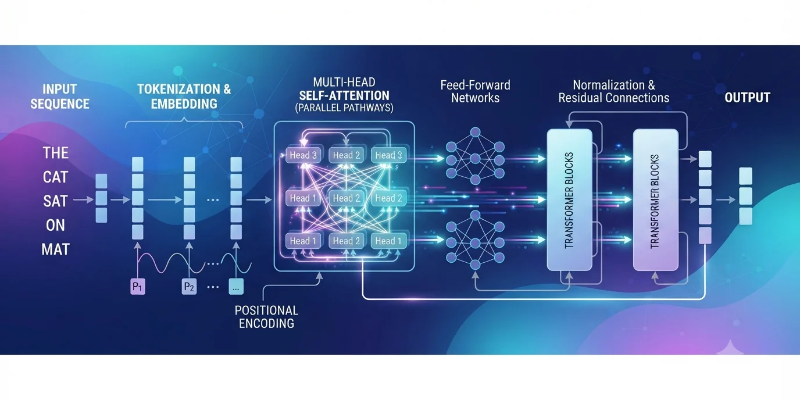
Transformers have changed the way artificial intelligence (AI) processes and understands sequential data. They are widely used in natural language processing, machine translation, text generation, and many other AI applications. Unlike traditional neural networks, Transformers can process multiple words at the same time instead of handling them one by one. This makes them faster and more efficient when working with large amounts of information.
Understanding how Transformers work is an important step for anyone interested in modern AI technologies. If you want to build a strong foundation in generative AI and explore its practical applications, consider enrolling in Gen AI Courses in Pondicherry at FITA Academy to develop your knowledge and technical skills.
What Are Transformers in Artificial Intelligence?
Transformers are deep learning models designed to understand relationships between different parts of sequential data. They were originally developed to improve how computers process human language. Today, they are used in chatbots, virtual assistants, recommendation systems, and large language models.
Traditional models often process information in a fixed order. Transformers use a mechanism called self-attention to identify connections between different words or data elements. This allows them to understand the context of information more effectively.
For example, when reading a sentence, a Transformer can identify how one word relates to other words, even when they appear far apart.
How Transformers Process Sequential Data
Transformers follow several important steps to process sequential information. Each step helps the model understand the input and generate meaningful output.
1. Tokenization
The first step is tokenization. Here, the input text is divided into smaller units called tokens. A token can be a complete word, part of a word, or even a punctuation mark.
For example, a sentence is separated into individual tokens before being passed to the model. This makes the information easier for the Transformer to process.
2. Embedding
After tokenization, each token is converted into a numerical representation called an embedding. Computers understand numbers rather than human language, so embeddings help transform words into meaningful numerical data.
These representations capture useful information about words and their relationships.
3. Positional Encoding
Since Transformers process multiple tokens simultaneously, they need a way to understand word order. Positional encoding solves this problem by adding information about each token's position.
For example, the sentences "The dog chased the cat" and "The cat chased the dog" contain similar words but have different meanings. Positional information helps the model understand these differences.
The Role of the Self-Attention Mechanism
Self-attention is one of the most important features of the Transformer architecture. It helps the model identify which words are important when understanding a particular word.
For example, consider the sentence, "The student placed the book on the table because it was heavy." The model uses attention to understand which words are connected and determine what "it" refers to.
Self-attention calculates the importance of different tokens by comparing their relationships. This allows the model to focus on relevant information rather than treating every word equally.
How Multi-Head Attention Improves Efficiency
Multi-head attention allows Transformers to examine different relationships within the same input simultaneously.
Each attention head focuses on a different type of relationship. One head might identify grammatical connections, while another may focus on meaning or nearby words.
By combining these different perspectives, Transformers develop a better understanding of the input.
This approach improves the model's ability to recognize complex patterns and process information effectively.
Why Transformers Are Faster Than Traditional Models
One major advantage of Transformers is parallel processing. Traditional recurrent neural networks process sequential data step by step, which can increase processing time.
Transformers can process multiple tokens simultaneously during training. This makes better use of modern hardware, especially graphics processing units (GPUs).
They also handle long-range relationships more effectively because they can directly connect different tokens within a sequence. If you want to understand these concepts in greater depth and develop practical AI knowledge, take an Artificial Intelligence Course in Pondicherry to explore machine learning, deep learning, and modern AI technologies.
Real-World Applications of Transformers
Transformers support several technologies that people use every day.
-
Chatbots: They help conversational AI systems understand questions and generate relevant responses.
-
Machine Translation: They convert text from one language into another while maintaining context.
-
Text Summarization: They identify important information and create shorter versions of lengthy documents.
-
Content Generation: They generate articles, descriptions, emails, and other written content.
-
Speech Recognition: They help AI systems understand and process spoken language.
These applications demonstrate how Transformers improve the ability of machines to understand and generate human language. If you want to understand the fundamental concepts behind these technologies, explore the Artificial Intelligence Course Syllabus to learn about machine learning, neural networks, deep learning, and Transformer architecture.
Transformers have made sequential data processing faster and more effective through parallel computation, positional encoding, and self-attention. Their ability to understand relationships between different elements makes them valuable in modern artificial intelligence.
As AI technology continues to develop, Transformers will remain an important part of language processing, content generation, and intelligent automation. Understanding their working principles can help beginners build a strong foundation in the growing field of artificial intelligence.

 English
 Arabic
 French
 Spanish
 Portuguese
 Deutsch
 Turkish
 Dutch
 Italiano
 Russian
 Romaian
 Portuguese (Brazil)