


Significant Figures in Addition and Subtraction-A Complete Guide

Accuracy is essential in mathematics, chemistry, physics, and many other scientific fields. When working with measurements, it is important to understand not only how to calculate an answer but also how to express it correctly. This is where significant figures become useful.
Significant figures represent the meaningful digits in a measured or calculated value. They help communicate the precision of a measurement and prevent results from appearing more accurate than the original data allows.
Addition and subtraction follow a special rule for significant figures. Unlike multiplication and division, where the number of significant digits determines the final precision, addition and subtraction depend on the number of decimal places.
Understanding this difference can help students, researchers, and professionals avoid common calculation errors. Whether you are completing a chemistry assignment, solving a physics problem, or checking measurements for a laboratory experiment, knowing how to apply these rules is essential.
This guide explains how significant figures work in addition and subtraction, provides practical examples, and shows how a Sig Figs Calculator can help verify your results.
What Are Significant Figures?
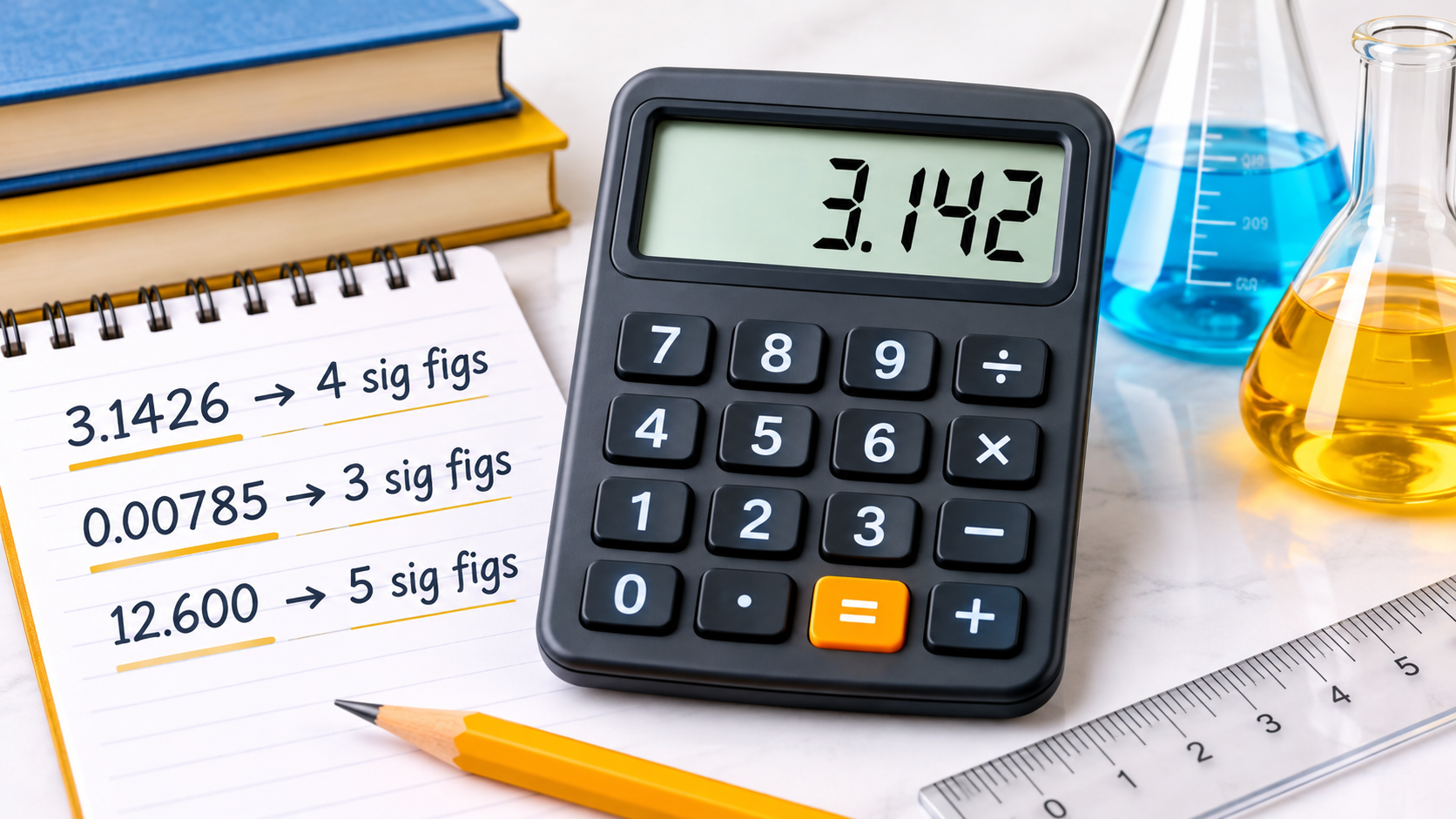
Significant figures are the digits in a number that contribute to its precision. They include all certain digits in a measurement and one estimated digit when appropriate.
For example, consider the measurement 24.6 cm. It contains three significant figures: 2, 4, and 6.
The number 24.6 communicates more precision than 25 because it includes an additional digit. In scientific measurements, this difference matters.
Identifying Significant Figures
The following rules help determine which digits are significant:
-
All nonzero digits are significant. For example, 456 contains three significant figures.
-
Zeros between nonzero digits are significant. For example, 4007 contains four significant figures.
-
Leading zeros are not significant. For example, 0.0062 contains two significant figures.
-
Trailing zeros after a decimal point are significant. For example, 5.200 contains four significant figures.
-
Trailing zeros in whole numbers without a decimal point can be ambiguous. Scientific notation can clarify the intended precision.
Understanding these rules is the first step toward performing accurate calculations.
The Main Rule for Addition and Subtraction
When adding or subtracting measured values, the final answer should have the same number of decimal places as the measurement with the fewest decimal places.
This rule is different from the multiplication and division rule, which focuses on the number of significant figures.
For example, suppose you add 12.45 and 3.2.
The first value has two decimal places, while the second has one. Therefore, the final answer should have one decimal place.
The calculation is:
12.45 + 3.2 = 15.65
Rounding the result to one decimal place gives:
15.7
The final answer is 15.7 because the least precise measurement, 3.2, is recorded only to the tenths place.
Why Decimal Places Matter
When measurements are added or subtracted, their precision depends on the place value of the least precise measurement.
Imagine measuring two pieces of wood. One is 15.4 cm long, and the other is 8 cm long.
The first measurement is recorded to the nearest tenth of a centimetre. The second is recorded only to the nearest whole centimetre.
Adding the values gives 23.4 cm. However, the original measurements do not support reporting the total to the nearest tenth.
The appropriate result is 23 cm.
This approach prevents false precision and keeps the calculated answer consistent with the original measurements.
How to Add Numbers Using Significant Figures
Adding values with different decimal places is straightforward when you follow a consistent process.
Step 1: Write the Numbers Clearly
Arrange the numbers so that their decimal points line up. This makes it easier to identify the least precise decimal place.
Step 2: Perform the Addition
Calculate the total using the normal rules of addition. Do not round individual measurements before completing the calculation unless the problem specifically requires it.
Step 3: Identify the Fewest Decimal Places
Check the original numbers and find the measurement with the fewest decimal places.
Step 4: Round the Final Answer
Round the result to the decimal place identified in the previous step.
Example 1: Adding Measurements
Calculate:
18.36 + 4.2 + 7.125
First, add the numbers:
18.36 + 4.2 + 7.125 = 29.685
Now examine the decimal places:
-
18.36 has two decimal places.
-
4.2 has one decimal place.
-
7.125 has three decimal places.
The measurement 4.2 has the fewest decimal places.
Therefore, round 29.685 to one decimal place.
Final answer: 29.7
Example 2: Adding Whole Numbers and Decimals
Calculate:
125 + 16.8 + 3.45
The total is:
125 + 16.8 + 3.45 = 145.25
The number 125 has no decimal places, so the result must be rounded to the nearest whole number.
Final answer: 145
The original measurements determine the precision of the answer, not the number of digits produced by the calculator.
How to Subtract Numbers Using Significant Figures
Subtraction follows exactly the same decimal-place rule as addition.
The final answer must be rounded to the fewest decimal places present in the original measurements.
Example 1: Subtracting Two Measurements
Calculate:
45.78 − 12.3
First, perform the subtraction:
45.78 − 12.3 = 33.48
The number 12.3 has one decimal place, while 45.78 has two.
Round 33.48 to one decimal place.
Final answer: 33.5
Example 2: Subtracting Measurements with Different Precision
Calculate:
102.5 − 98.27
The difference is:
102.5 − 98.27 = 4.23
The first measurement has one decimal place, so the final answer must also have one decimal place.
Final answer: 4.2
This example demonstrates why the number of digits in the final answer does not determine its precision. The result has two significant figures, but the important consideration is that it has one decimal place.
Example 3: Subtracting Values Near Zero
Calculate:
5.006 − 4.98
The calculation gives:
5.006 − 4.98 = 0.026
The number 4.98 has two decimal places. Therefore, the answer must be rounded to the hundredths place.
Final answer: 0.03
The leading zeros in 0.03 are not significant. Only the digit 3 counts as a significant figure.
This example also shows why rounding rules should be applied carefully. The result may look very different from the unrounded value, but it follows the required precision rule.
Significant Figures in Addition and Subtraction with Scientific Notation
Scientific notation is commonly used in chemistry, physics, and engineering to express very large or very small numbers.
A number in scientific notation is written as a coefficient multiplied by a power of ten.
For example:
3.45 × 10⁴ = 34,500
When adding or subtracting numbers in scientific notation, it is usually easiest to express them using the same power of ten before performing the calculation.
Example: Addition in Scientific Notation
Calculate:
2.35 × 10³ + 4.2 × 10²
First, express both numbers using the same power of ten:
2.35 × 10³ + 0.42 × 10³
Add the coefficients:
(2.35 + 0.42) × 10³ = 2.77 × 10³
The original values have different decimal precision when expressed with the same exponent. The second coefficient has two decimal places, while the first has two as well.
Therefore, the result remains:
2.77 × 10³
Scientific notation makes it easier to see the significant digits and the place value of each measurement.
Common Mistakes to Avoid
Even students who understand the basic rule can make mistakes when working with significant figures.
Confusing Decimal Places with Significant Figures
This is one of the most common errors.
For addition and subtraction, the final answer depends on decimal places, not the total number of significant figures.
For example:
12.34 + 1.2 = 13.54
The correct result is 13.5, not 13.54.
Rounding Too Early
Avoid rounding intermediate results unnecessarily.
If a calculation involves several steps, keep the unrounded values until the final step. Early rounding can introduce small errors that affect the final answer.
Ignoring Whole Numbers
Whole numbers without decimal points may still have limited precision.
For example, if a measurement is recorded as 250 cm, its intended precision may be unclear. Scientific notation can help communicate whether the value has two or three significant figures.
Using the Wrong Rounding Rule
When rounding to a specified decimal place, examine the digit immediately to the right of the last retained digit.
If that digit is 5 or greater, increase the retained digit by one. If it is less than 5, leave the retained digit unchanged.
For example:
-
12.46 rounded to one decimal place becomes 12.5.
-
12.43 rounded to one decimal place becomes 12.4.
Using a Sig Figs Calculator for Addition and Subtraction
A Sig Figs Calculator can help check calculations and reduce rounding errors, particularly when working with several measurements.
However, it is important to understand what the calculator is doing. A standard calculator may display many digits without considering the precision of the original measurements.
A significant figure calculator can help you verify whether the final result follows the correct rounding rule.
For addition and subtraction, the important information is the number of decimal places in each original measurement.
For example, enter the values 15.67 and 2.4 into a calculator.
The unrounded result is 18.07.
Since 2.4 has only one decimal place, the correct result is 18.1.
A calculator can verify the arithmetic, but you should still understand why the final answer is rounded to that precision.
This is especially useful for students preparing laboratory reports, completing chemistry exercises, or checking physics calculations.
FAQs About Significant Figures in Addition and Subtraction
1. What is the rule for significant figures in addition?
The final answer must have the same number of decimal places as the original measurement with the fewest decimal places.
2. Is the rule for subtraction the same as addition?
Yes. Both addition and subtraction use the decimal-place rule rather than the total number of significant figures.
3. Why do addition and multiplication use different rules?
Addition and subtraction depend on the place value of the least precise measurement. Multiplication and division depend on the total number of significant figures in the original values.
4. Should I round intermediate calculations?
Generally, no. Keep extra digits during intermediate steps and round the final answer only when the calculation is complete.
5. Can a significant figure calculator help with addition?
Yes. A significant figure calculator can help verify the arithmetic and determine whether the final answer has the correct precision. However, understanding the decimal-place rule remains important.
6. How do I handle zeros in the final answer?
Leading zeros are not significant, but they may be necessary to show the correct decimal place. For example, 0.03 has one significant figure, while 0.030 has two.
Conclusion
Significant figures are an essential part of accurate scientific calculations. When adding or subtracting measurements, the final answer must be rounded to the same decimal place as the measurement with the fewest decimal places.
The most important point is to distinguish between decimal places and significant figures. Addition and subtraction use decimal places, while multiplication and division use the total number of significant figures.
By arranging numbers correctly, performing the calculation, identifying the least precise measurement, and rounding only at the appropriate stage, you can produce reliable results.
Practice with different measurements and use a significant figure calculator to check your work when needed. With consistent practice, these rules become easier to apply in chemistry, physics, mathematics, and everyday measurement problems.

 English
 Arabic
 French
 Spanish
 Deutsch
 Turkish
 Dutch
 Italiano
 Russian
 Romaian
 Portuguese (Brazil)
 Greek