


Does an Andrology Room Setup Company Provide Stainless Steel Laboratory Furniture?
Introduction
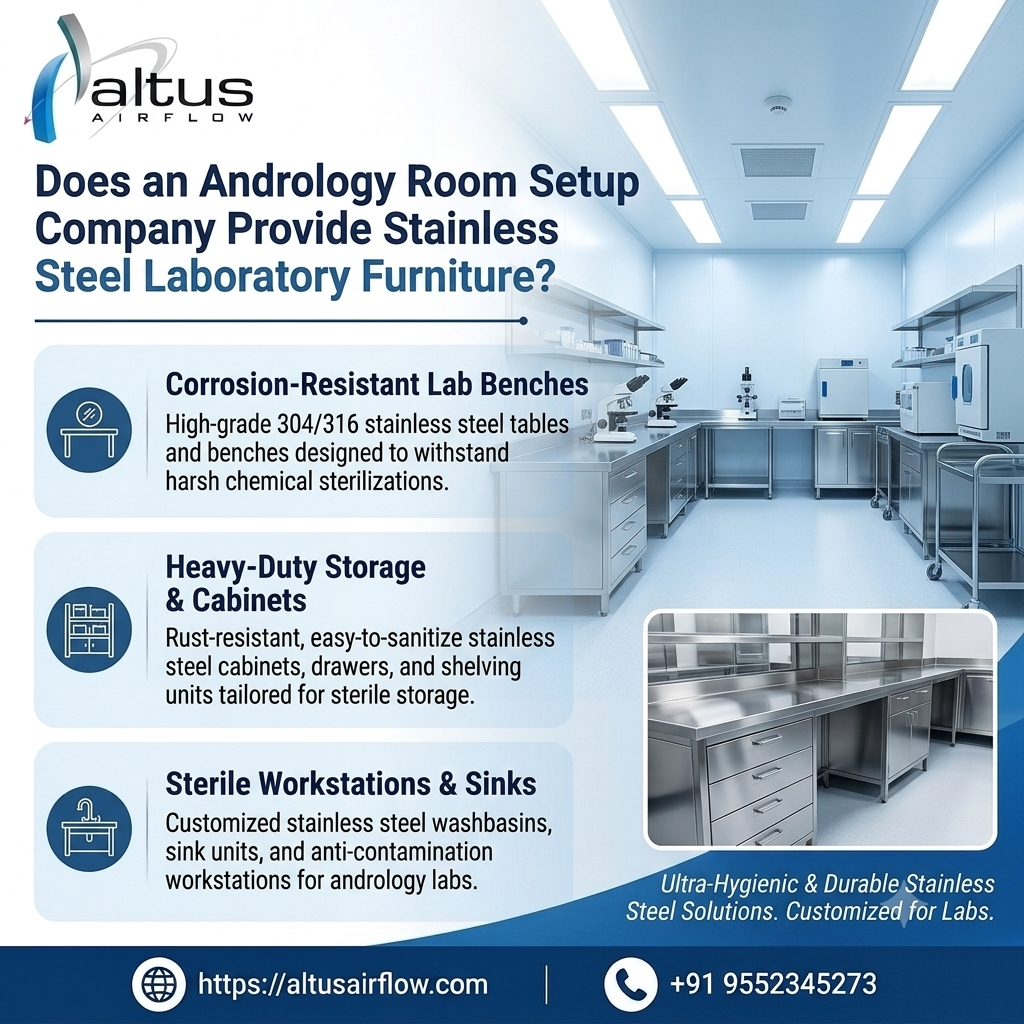
Altus Airflow understands the importance of creating hygienic, organized, and functional laboratory environments for fertility centres and healthcare facilities. An Andrology Room Setup Company may provide stainless steel laboratory furniture as part of its laboratory infrastructure solutions, depending on the project scope and client requirements. Stainless steel furniture is widely preferred in laboratory environments because of its durability, corrosion resistance, smooth surfaces, and ease of cleaning.
Selecting appropriate laboratory furniture helps improve workspace organization, support daily diagnostic activities, and maintain suitable hygiene conditions. From workbenches and storage cabinets to sinks and equipment tables, every furniture component should be planned according to laboratory workflows.
1. Understanding the Role of Stainless Steel Furniture in Andrology Laboratories
An andrology laboratory performs important diagnostic activities related to male reproductive health. These activities may include semen analysis, sperm morphology assessment, sample preparation, microscopic examination, and other laboratory procedures.
Such environments require furniture that supports cleanliness, organized workflows, and convenient access to laboratory equipment.
Stainless steel furniture offers several advantages for these applications:
-
Durability: Stainless steel furniture can withstand regular laboratory use and repeated cleaning.
-
Corrosion resistance: Appropriate stainless steel grades provide resistance to moisture and many commonly used cleaning agents.
-
Easy maintenance: Smooth surfaces make routine cleaning and disinfection easier.
-
Structural strength: Stainless steel workbenches can support laboratory equipment and accessories.
-
Hygienic design: Properly finished surfaces minimize unnecessary gaps where dirt and residues may accumulate.
Furniture selection should always consider the specific laboratory activities, cleaning protocols, and equipment requirements.
2. Types of Stainless Steel Laboratory Furniture Available
A laboratory infrastructure provider may offer different stainless steel furniture options depending on the available space and operational requirements.
Some commonly used furniture components include:
Stainless Steel Laboratory Workbenches
Workbenches provide dedicated surfaces for sample preparation, documentation, and routine laboratory activities.
They should have adequate working space, stable construction, and smooth surfaces. Their dimensions should be selected according to the laboratory layout and equipment requirements.
Stainless Steel Storage Cabinets
Storage cabinets help organize laboratory consumables, accessories, and approved supplies.
They can be designed with shelves, drawers, and separate compartments to support convenient inventory management.
Stainless Steel Equipment Tables
Equipment tables provide stable platforms for microscopes, laboratory instruments, and other diagnostic devices.
Their design should consider equipment weight, dimensions, vibration sensitivity, and electrical requirements.
Stainless Steel Laboratory Sinks
Laboratory sinks support cleaning activities and general laboratory utility requirements.
Their placement should be planned to prevent interference with designated sample preparation and examination areas.
Stainless Steel Trolleys
Trolleys help transport laboratory supplies and equipment between designated workstations.
They should have suitable dimensions, smooth surfaces, and easily maneuverable wheels.
3. Why Stainless Steel Is Preferred for Andrology Laboratory Furniture
Material selection is an important part of laboratory planning. Stainless steel is commonly used because it offers a combination of strength, durability, and maintenance convenience.
The following characteristics make it suitable for many laboratory applications.
Corrosion resistance: Stainless steel grades such as 304 and 316 offer different levels of corrosion resistance. The appropriate grade should be selected according to the chemicals, moisture exposure, and cleaning products used in the laboratory.
Non-porous surface: Properly finished stainless steel provides a smooth surface that does not readily absorb liquids.
Cleaning compatibility: Stainless steel can generally withstand routine cleaning when suitable grades and compatible cleaning agents are selected.
Long-term durability: Its structural strength makes it useful for workbenches, cabinets, and equipment-supporting furniture.
Professional appearance: Stainless steel provides a clean and organized appearance that complements modern laboratory interiors.
However, stainless steel furniture alone does not guarantee a sterile laboratory. Appropriate cleaning, disinfection, sample handling, and infection prevention procedures remain essential.
4. How Furniture Selection Supports Laboratory Workflow
A well-designed andrology laboratory should allow technicians to complete routine activities without unnecessary movement or interruptions.
Furniture placement plays an important role in achieving this objective.
For example, workbenches should be positioned according to the sequence of laboratory activities. Equipment tables should provide convenient access to microscopes and other diagnostic instruments.
Storage cabinets should be located where authorized staff can retrieve supplies without disturbing ongoing procedures.
A functional layout may include:
-
Sample receiving and identification areas.
-
Dedicated sample preparation workstations.
-
Microscopic examination stations.
-
Equipment storage arrangements.
-
Documentation and reporting workspaces.
-
Cleaning and utility areas.
The furniture arrangement should also provide sufficient space for staff movement and equipment maintenance.
Proper planning helps reduce workspace congestion and makes everyday laboratory operations more convenient.
5. Customization of Stainless Steel Laboratory Furniture
Every andrology laboratory has different dimensions, equipment requirements, and operational workflows. Therefore, customized furniture can be useful when developing a new laboratory or renovating an existing facility.
A professional Andrology Room Setup Company should be able to discuss furniture requirements as part of the overall laboratory planning process, subject to its product and service scope.
Customization may include:
Workbench dimensions: Furniture can be planned according to available floor space and workstation requirements.
Storage configurations: Cabinets can include drawers, adjustable shelves, and compartments for different laboratory materials.
Equipment provisions: Workstations can be designed around the dimensions and utility requirements of specified laboratory instruments.
Utility integration: Furniture planning may consider electrical points, data connections, and plumbing provisions where required.
Surface finishing: Different finishes can be evaluated according to cleaning requirements and the intended laboratory application.
Customized solutions help ensure that furniture fits the laboratory rather than forcing technicians to adapt their workflows to unsuitable arrangements.
6. Important Factors to Consider When Selecting Stainless Steel Furniture
Hospitals and fertility centres should evaluate several factors before purchasing laboratory furniture.
Stainless Steel Grade
The grade of stainless steel affects corrosion resistance, durability, and suitability for different environments.
Grade 304 is commonly used for general laboratory furniture, while grade 316 may be considered where greater resistance to certain corrosive conditions is required.
The final selection should depend on the intended application.
Surface Finish
Furniture should have smooth, properly finished surfaces without unnecessary sharp edges or difficult-to-clean joints.
A suitable finish supports routine cleaning and maintenance.
Load-Bearing Capacity
Workbenches and equipment tables should support the weight of the instruments placed on them.
Manufacturers should provide relevant load-bearing specifications.
Dimensions and Ergonomics
Workstation height, depth, and accessibility should be considered to support comfortable working conditions.
Furniture should allow technicians to perform routine tasks without unnecessary bending or reaching.
Maintenance Requirements
Hospitals should understand the cleaning procedures, compatible disinfectants, and maintenance recommendations for each furniture component.
These factors help decision-makers select furniture that supports long-term laboratory functionality.
7. Integration of Furniture with Laboratory Infrastructure
Laboratory furniture should not be selected independently of the overall room design.
Its positioning and construction must be coordinated with ventilation, lighting, electrical systems, plumbing, and other infrastructure components.
Important integration considerations include:
-
HVAC coordination: Furniture placement should not obstruct ventilation outlets or interfere with designed airflow patterns.
-
Electrical planning: Workstations should have suitable electrical provisions for the intended equipment.
-
Lighting arrangements: Laboratory benches should receive appropriate task lighting.
-
Plumbing connections: Sinks and other utility furniture should be coordinated with approved plumbing layouts.
-
Wall and floor finishes: Furniture dimensions should complement the room's modular construction and cleaning requirements.
This coordination is particularly important in laboratories where space is limited and multiple diagnostic activities take place.
Proper integration helps avoid unnecessary modifications after furniture installation.
8. Maintaining Hygiene and Cleaning Stainless Steel Furniture
Although stainless steel is easy to maintain, regular cleaning is necessary to preserve its condition and support laboratory hygiene.
Laboratory personnel should follow documented cleaning and disinfection procedures.
Recommended maintenance practices include:
-
Remove visible dust and laboratory residues using approved cleaning methods.
-
Use cleaning agents compatible with the selected stainless steel grade.
-
Follow the disinfectant manufacturer's recommended concentration and contact time.
-
Avoid abrasive materials that may damage the surface finish.
-
Clean frequently touched areas according to the laboratory schedule.
-
Inspect joints, corners, handles, and cabinet interiors.
-
Report scratches, corrosion, or structural damage for timely repair.
Chloride-containing cleaning products should be used cautiously because inappropriate exposure can cause pitting or corrosion.
Staff should also ensure that cleaning chemicals do not come into contact with biological samples or interfere with laboratory procedures.
9. Stainless Steel Furniture and Equipment Safety
Laboratory furniture must provide stable and safe support for sensitive diagnostic instruments.
For example, microscopes and analytical devices require appropriately designed work surfaces.
Important safety considerations include:
Structural stability: Tables and workbenches should remain stable during routine operations.
Rounded edges: Properly finished edges help reduce accidental injuries.
Cable management: Electrical cables should be organized to prevent tripping hazards and accidental disconnections.
Equipment positioning: Instruments should be placed according to manufacturer recommendations.
Weight distribution: Heavy equipment should be positioned on furniture with suitable load-bearing capacity.
Accessibility: Storage drawers and cabinets should allow convenient access without obstructing movement.
Furniture safety should be reviewed during the design and installation stages.
10. Role of Professional Installation and Project Coordination
Even high-quality furniture may create operational difficulties if it is installed incorrectly.
Professional installation helps ensure that furniture is positioned according to approved laboratory drawings and utility requirements.
The installation process generally involves:
-
Measuring the available laboratory space.
-
Reviewing furniture specifications.
-
Preparing the installation layout.
-
Coordinating electrical and plumbing provisions.
-
Manufacturing or procuring approved furniture.
-
Transporting components to the site.
-
Installing and aligning furniture.
-
Inspecting joints, fittings, and structural stability.
-
Completing final handover inspections.
Hospitals should clarify whether furniture supply, manufacturing, installation, and maintenance are included in the selected provider's quotation.
Clear project coordination also helps ensure that furniture installation does not interfere with other laboratory construction activities.
11. What Should Hospitals Ask Before Purchasing Laboratory Furniture?
Before finalizing a furniture supplier, hospitals and fertility centres should ask relevant technical and commercial questions.
These questions help clarify product quality, customization options, and service responsibilities.
Some useful questions include:
-
Which stainless steel grades are available?
-
Are material specifications and quality documents provided?
-
Can furniture dimensions be customized?
-
What is the load-bearing capacity of workbenches?
-
Are cabinets available with adjustable shelves?
-
Which cleaning agents are compatible with the furniture?
-
Does the quotation include installation?
-
Are warranty and maintenance services available?
-
Can furniture be integrated with the laboratory's electrical and plumbing requirements?
-
Can previous laboratory furniture projects be reviewed?
Hospitals should compare suppliers based on product quality, technical specifications, installation expertise, and overall project value rather than considering price alone.
12. Benefits of Choosing an Integrated Laboratory Setup Solution
Planning furniture alongside the rest of the laboratory infrastructure offers several advantages.
Instead of selecting workbenches, storage cabinets, and equipment tables independently, hospitals can coordinate these components with the complete room layout.
An integrated approach can help achieve:
-
Better utilization of available space.
-
Convenient workstation positioning.
-
Improved storage organization.
-
Easier cleaning and maintenance.
-
Proper coordination of utilities.
-
Reduced installation conflicts.
-
Consistent laboratory interiors.
A coordinated setup also makes it easier to accommodate future equipment requirements and operational changes.
The final furniture arrangement should always reflect the laboratory's clinical activities, equipment specifications, and approved hygiene procedures.
Conclusion
Stainless steel laboratory furniture is a valuable component of modern andrology laboratory infrastructure. Workbenches, storage cabinets, equipment tables, sinks, and trolleys help create organized workspaces that support daily diagnostic activities. Selecting suitable materials, customized dimensions, appropriate surface finishes, and professional installation services is essential for maintaining functionality and hygiene.
Altus Airflow focuses on developing well-planned healthcare and laboratory infrastructure solutions that support efficient operations and practical workspace design. By choosing an experienced Andrology Room Setup Company and evaluating furniture specifications carefully, fertility centres can establish durable, organized, and easy-to-maintain laboratory environments.
Frequently Asked Questions (FAQs)
1. Does an Andrology Room Setup Company provide stainless steel laboratory furniture?
An Andrology Room Setup Company may provide stainless steel workbenches, storage cabinets, equipment tables, sinks, and other laboratory furniture depending on its project scope.
2. Why is stainless steel preferred for laboratory furniture?
Stainless steel is preferred because of its durability, corrosion resistance, smooth surfaces, and convenient cleaning requirements.
3. Which stainless steel grade is suitable for andrology laboratory furniture?
Grades 304 and 316 are commonly considered, depending on the laboratory environment and chemical exposure.
4. Can stainless steel laboratory furniture be customized?
Yes. Workbenches, cabinets, and equipment tables can be customized according to laboratory dimensions and operational requirements.
5. Is stainless steel furniture easy to maintain?
Yes. Properly finished stainless steel furniture is generally easy to clean using compatible cleaning agents and approved procedures.
Read Our Previous Blog ---------------> How does an Andrology Room Design Company design utility and service systems?

 English
 Arabic
 French
 Spanish
 Portuguese
 Deutsch
 Turkish
 Italiano
 Russian
 Romaian
 Portuguese (Brazil)
 Greek