


What Is the Ideal Lighting Intensity in a Modular Cardiac Operation Theatre?
Introduction
Altus Airflow understands that proper lighting plays an important role in creating a safe and efficient cardiac surgical environment. A Modular Cardiac Operation Theatre requires carefully planned illumination to help surgeons examine delicate tissues, identify anatomical structures, and perform complex procedures with precision. The ideal lighting intensity depends on surgical requirements, operating field visibility, and the surrounding environment. Selecting appropriate surgical lights, colour temperatures, and brightness controls helps maintain visual comfort while supporting the demanding requirements of cardiac operations.
Lighting design should also consider glare reduction, shadow management, uniform illumination, and adjustable brightness. Combining surgical lights with balanced ambient and peripheral lighting creates a comfortable working environment for surgeons, anaesthesiologists, and other medical professionals.
1. Understanding Lighting Intensity in Cardiac Operating Theatres
Lighting intensity refers to the amount of light falling on a particular surface. It is measured in lux (lx), which represents lumens per square metre. In an operating theatre, lighting must provide sufficient visibility without creating excessive brightness or visual discomfort.
Cardiac surgeries involve detailed procedures where surgeons examine blood vessels, heart tissues, and other delicate anatomical structures. Inadequate illumination can make it difficult to distinguish tissue variations, while excessive brightness may cause glare and reduce visual contrast.
A properly designed lighting arrangement should provide different illumination levels for different areas:
-
Surgical field lighting: Provides concentrated illumination directly over the patient and surgical site.
-
Peripheral lighting: Illuminates the area surrounding the operating table.
-
General lighting: Maintains visibility throughout the operating room.
-
Task lighting: Supports specific activities such as equipment preparation and documentation.
These lighting layers work together to create a balanced visual environment.
2. What Is the Recommended Surgical Lighting Intensity?
The ideal surgical lighting intensity depends on the type of surgical luminaire, its operating distance, and the requirements of the procedure.
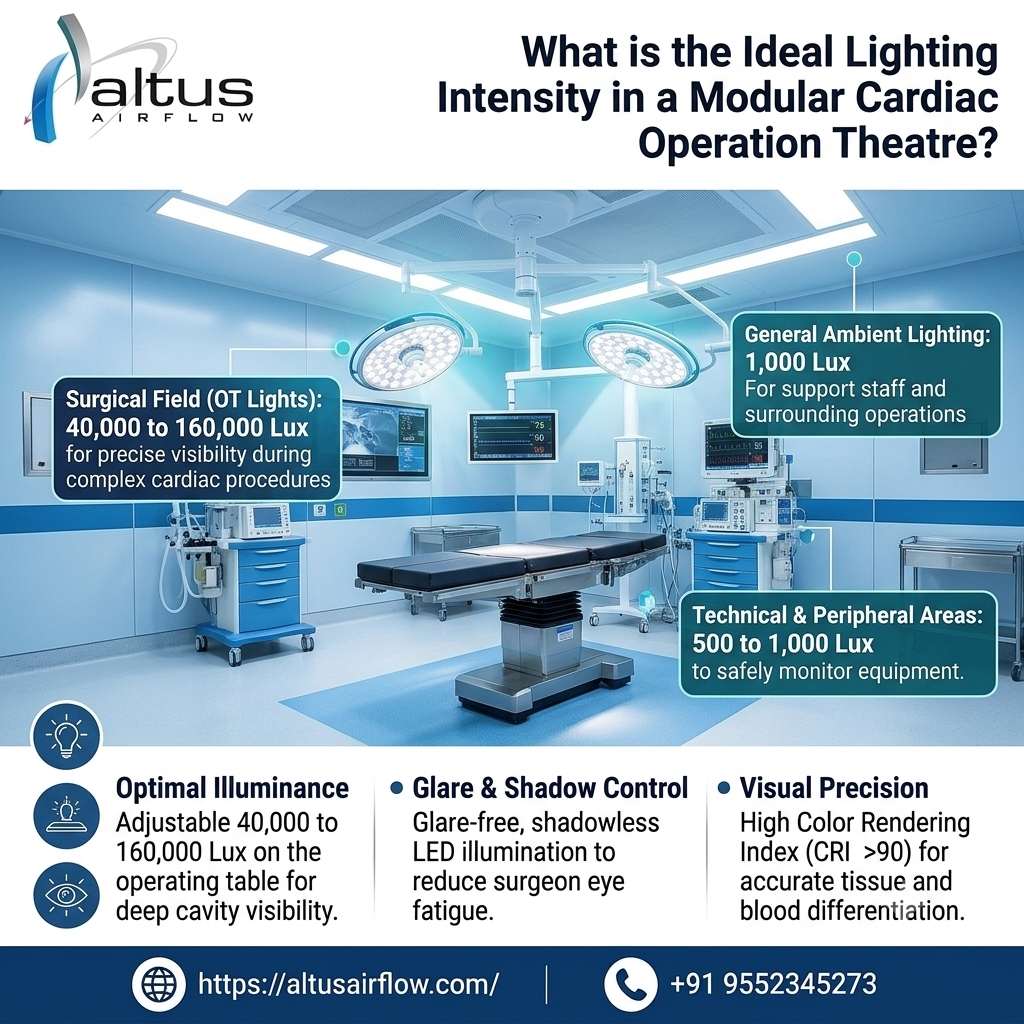
According to IEC 60601-2-41:2021, surgical luminaires must provide central illuminance exceeding 40,000 lux at maximum irradiance settings, while maximum central illuminance must not exceed 160,000 lux under the specified measurement conditions.
This range supports the illumination requirements of different surgical procedures. However, the maximum available intensity does not mean that every cardiac procedure should always use the highest brightness setting. Surgeons and clinical teams should adjust illumination according to the surgical field, depth of the operating cavity, tissue visibility, and individual preferences.
The following values provide general references for planning different lighting zones:
| Lighting area | General reference intensity |
|---|---|
| Surgical field | 40,000–160,000 lux |
| General operating theatre lighting | Around 1,000 lux |
| Peripheral operating area | Around 2,000 lux as a design target |
| Equipment preparation areas | According to specific task requirements |
These figures should be treated as planning references rather than universal settings. Final lighting levels must be established through applicable standards, project specifications, clinical requirements, and professional lighting assessments.
3. Why Is Proper Lighting Important During Cardiac Surgery?
Cardiac surgery requires accuracy, concentration, and continuous visual assessment. Surgeons must observe small anatomical structures while working with specialised instruments and medical equipment.
Appropriate lighting supports these activities in several ways.
Improved Tissue Visibility
Sufficient illumination helps surgeons distinguish different tissue structures and identify small anatomical details. This is particularly important during procedures involving coronary arteries, heart valves, and blood vessels.
Better Surgical Precision
Consistent lighting helps medical professionals maintain visual control over the operating field. It supports accurate instrument positioning and reduces difficulties caused by poorly illuminated areas.
Reduced Visual Fatigue
Surgeons may spend several hours performing complex procedures. Balanced illumination and suitable brightness controls help reduce unnecessary eye strain.
Improved Team Coordination
Anaesthesiologists, nurses, technicians, and surgeons all need appropriate visibility. Well-planned lighting supports communication and coordination between different members of the surgical team.
Greater Procedural Efficiency
When the surgical field is adequately illuminated, medical professionals can observe the operating area comfortably and concentrate on their responsibilities.
4. Role of LED Surgical Lights in Modern Cardiac OTs
LED surgical lights have become an important component of modern operating theatre infrastructure. They provide controlled illumination and offer several practical advantages over conventional lighting technologies.
Some important benefits include:
Energy efficiency: LED technology generally consumes less electrical power than conventional surgical lighting systems, supporting efficient energy management.
Long operating life: Quality LED fixtures are designed for extended operation, reducing the frequency of lamp replacement.
Reduced heat generation: Modern LED surgical lights can help limit unnecessary heat around the operating field when appropriately selected and installed.
Adjustable illumination: Many surgical lighting systems offer multiple brightness settings, allowing surgeons to adjust the light according to procedural requirements.
Colour accuracy: High-quality LED systems provide suitable colour rendering, helping medical professionals distinguish tissues and observe changes in their appearance.
The selection of LED fixtures should consider illumination performance, colour rendering, heat management, electrical safety, and compatibility with the operating room design.
5. Importance of Colour Temperature and Colour Rendering
Lighting intensity alone cannot determine the quality of surgical illumination. Colour temperature and colour rendering are equally important factors.
Colour temperature is measured in Kelvin (K) and describes the visual appearance of light. Surgical lighting systems commonly provide adjustable or selected colour temperatures within manufacturer-specified ranges.
A suitable colour temperature helps create comfortable working conditions while supporting the visibility of different tissues and surgical materials.
Colour rendering describes how accurately a light source displays colours compared with a reference source. A high colour rendering index (CRI) is particularly useful in cardiac procedures because surgeons need to observe subtle differences in tissue colour.
When selecting surgical lights, hospitals should consider:
-
Appropriate colour temperature for the intended procedures.
-
High colour rendering performance.
-
Consistent colour appearance across multiple light heads.
-
Adjustable settings where clinically useful.
-
Compatibility between surgical and general lighting systems.
These considerations help create an effective visual environment for medical professionals.
6. How Does Peripheral Lighting Improve the Surgical Environment?
One common lighting challenge in operating theatres is the difference in brightness between the surgical field and the surrounding room.
For example, surgical lights may produce tens of thousands of lux at the operating site, while general room lighting may remain considerably lower. Moving the eyes repeatedly between these areas can create visual adaptation difficulties.
Peripheral lighting helps reduce this contrast.
It illuminates the area around the operating table and creates a gradual transition between the surgical field and the rest of the room. Lighting design references commonly identify approximately 2,000 lux as a useful peripheral lighting target, although the final value depends on the project and applicable requirements.
Benefits include:
-
Improved visual adaptation.
-
Reduced discomfort caused by sudden brightness differences.
-
Better visibility for assisting medical professionals.
-
Improved awareness of equipment and surrounding activities.
-
More balanced illumination across the operating room.
A carefully coordinated lighting system should avoid creating excessively bright or dark areas.
7. Shadow Management and Uniform Light Distribution
Shadows can interfere with surgical visibility when surgeons, nurses, or equipment obstruct the light source.
Cardiac procedures frequently involve multiple professionals working around the operating table. Their movements can create shadows over the surgical field if the lighting arrangement is inadequate.
Modern surgical lighting systems address this challenge through multiple light sources and carefully designed optical arrangements.
Important considerations include:
Multiple light heads: Multiple lighting units help provide illumination from different directions.
Shadow dilution: Properly designed fixtures help maintain useful illumination when one or more light paths are obstructed.
Depth of illumination: Surgical lights should provide adequate illumination within deeper operating cavities.
Uniform distribution: The illuminated field should maintain suitable brightness without significant dark areas or distracting hotspots.
Flexible positioning: Adjustable arms and light heads allow surgical teams to position the lights according to procedural needs.
These features are particularly useful in complex cardiac operations where visibility must be maintained despite frequent movement around the operating table.
8. Factors to Consider When Planning OT Lighting Installation
Lighting installation should be considered during the early planning stages of an operating theatre project. The arrangement of surgical lights must coordinate with the ceiling structure, medical equipment, ventilation systems, and clinical workflow.
Several factors require attention.
Ceiling Configuration
The ceiling should support the weight and movement requirements of surgical light suspension systems. Structural provisions must be planned before installation.
Medical Equipment Positioning
Surgical lights should not interfere with medical pendants, monitors, anaesthesia equipment, or other ceiling-mounted installations.
Ventilation Coordination
Lighting fixtures and their mounting arrangements should be coordinated with airflow distribution systems. The placement of equipment must not unnecessarily obstruct designed airflow patterns.
Electrical Infrastructure
Surgical lights require reliable electrical connections and suitable backup power arrangements. Emergency electrical provisions should be incorporated according to applicable healthcare and electrical safety requirements.
Maintenance Accessibility
Lighting systems should allow inspection, cleaning, servicing, and replacement of components without creating unnecessary disruption to clinical operations.
Hygiene Requirements
Fixtures and surrounding surfaces should be suitable for routine cleaning and disinfection. Sealed designs and appropriate materials can help reduce areas where dust and contaminants may accumulate.
9. Role of Dimming Controls and Emergency Lighting
Modern operating theatres require flexibility because lighting requirements can change throughout a procedure.
Dimming controls allow medical professionals to adjust the illumination level according to their activities. For example, surgeons may require concentrated surgical illumination during an operation, while certain imaging-related activities may require reduced general lighting.
Lighting controls should be easy to operate and should not interfere with clinical activities.
Emergency lighting is equally important. A sudden electrical interruption must not leave the surgical field without adequate illumination.
Hospitals should consider:
-
Reliable emergency power arrangements.
-
Suitable backup provisions for surgical lights.
-
Appropriate electrical circuit separation.
-
Fail-safe lighting performance.
-
Regular testing of backup systems.
-
Clear maintenance and inspection procedures.
The design should follow applicable medical electrical equipment standards and hospital emergency power requirements.
10. Testing and Maintenance of Surgical Lighting Systems
Installing high-quality surgical lights is only one part of achieving reliable performance. Regular testing and maintenance help ensure that the system continues to provide the required illumination.
During commissioning, technical teams should verify the performance of the lighting installation.
Important testing activities include:
-
Illuminance measurement: Measure the light intensity at the operating field and other designated locations.
-
Uniformity assessment: Check whether the illuminated area provides consistent visibility.
-
Shadow performance: Evaluate how illumination changes when objects obstruct the light.
-
Colour performance: Verify colour rendering and colour temperature against manufacturer specifications.
-
Positioning assessment: Confirm that light heads can be adjusted without interfering with other equipment.
-
Electrical safety checks: Inspect electrical connections and emergency power arrangements.
-
Functional testing: Check dimming controls, movement mechanisms, and backup performance.
Maintenance should include cleaning, inspection, adjustment, and replacement of components according to manufacturer recommendations.
Proper documentation of commissioning results and periodic inspections also helps hospitals maintain consistent lighting performance.
11. How Does Modular Design Support Better Lighting Integration?
A modular approach makes it easier to coordinate lighting systems with other operating theatre components.
Instead of treating surgical lighting as an isolated installation, the entire room can be planned as an integrated clinical environment.
A well-coordinated design considers:
-
Surgical light mounting arrangements.
-
Ceiling panel configurations.
-
Medical gas pendants.
-
Air handling and filtration systems.
-
Electrical distribution.
-
Equipment placement.
-
Cleaning and maintenance access.
This coordination helps reduce installation conflicts and supports efficient use of available operating room space.
In a well-designed Modular Cardiac Operation Theatre, lighting provisions are considered alongside ventilation, electrical infrastructure, and medical equipment requirements. This integrated approach helps create an organised surgical environment that can accommodate the specific needs of cardiac procedures.
12. Common Lighting Mistakes Hospitals Should Avoid
Even advanced lighting equipment may not deliver the expected results when the overall design is inadequate.
Hospitals should avoid several common mistakes:
-
Selecting surgical lights based only on maximum lux output.
-
Ignoring peripheral and ambient illumination.
-
Overlooking shadow management.
-
Installing lights without coordinating ceiling-mounted equipment.
-
Choosing fixtures with unsuitable colour rendering.
-
Neglecting emergency power requirements.
-
Ignoring cleaning and maintenance accessibility.
-
Failing to conduct illumination testing after installation.
Lighting decisions should involve hospital planners, clinical professionals, electrical consultants, and specialised operating theatre infrastructure teams.
Conclusion
Ideal lighting intensity in a cardiac operating theatre is not determined by brightness alone. It depends on maintaining the right balance between surgical field illumination, peripheral lighting, colour accuracy, shadow control, and visual comfort. Surgical lights designed within the applicable 40,000–160,000 lux central illuminance range provide flexibility for different procedures, while properly planned ambient lighting supports the entire surgical team.
A carefully designed operating theatre should integrate lighting with ventilation, ceiling systems, electrical infrastructure, and medical equipment to achieve a reliable surgical environment.
Altus Airflow focuses on specialised modular healthcare infrastructure, helping hospitals plan functional and well-coordinated operating theatre environments. With attention to technical requirements, equipment integration, and installation quality, Altus Airflow supports the development of modern cardiac operating facilities.
Frequently Asked Questions (FAQs)
1. What is the ideal lighting intensity in a cardiac operating theatre?
A Modular Cardiac Operation Theatre should have surgical lights providing central illuminance between 40,000 and 160,000 lux, with adjustable brightness according to surgical requirements.
2. Why is lighting important during cardiac surgery?
It improves tissue visibility, supports surgical precision, and helps reduce visual fatigue.
3. What type of lighting is preferred for cardiac operating theatres?
LED surgical lights are commonly preferred because of their energy efficiency, adjustable illumination, and colour rendering capabilities.
4. What is the role of peripheral lighting in an operating theatre?
Peripheral lighting reduces brightness differences between the surgical field and surrounding areas, supporting visual comfort.
5. Does surgical lighting require adjustable brightness?
Yes. Adjustable brightness allows surgeons to select suitable illumination levels for different surgical activities.
Read Our Previous Blog --------------->What are the long-term benefits of partnering with a Modular IVF Lab Turnkey Project Company?

 English
 Arabic
 French
 Spanish
 Portuguese
 Deutsch
 Dutch
 Italiano
 Russian
 Romaian
 Portuguese (Brazil)
 Greek