


Understanding Temperature and Top-K Sampling in LLMs
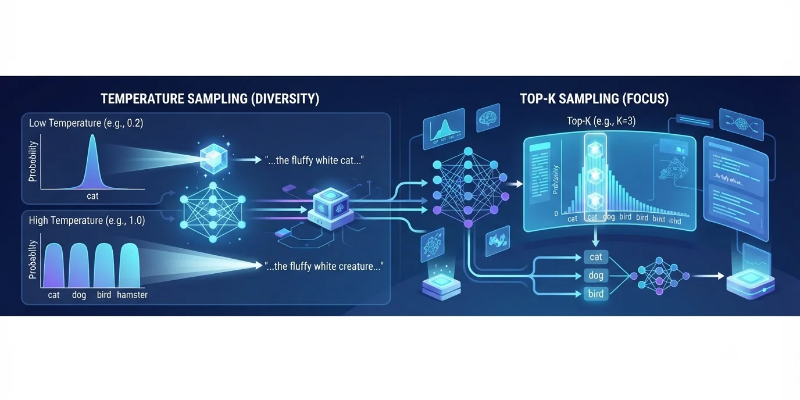
Large Language Models (LLMs) produce text that resembles human writing by anticipating the next token according to the conversation's context. However, the way these models select the next token can significantly affect the quality, creativity, and accuracy of their responses. Two important techniques that control this process are temperature and Top-K sampling. Understanding these concepts helps beginners learn how AI models generate different responses to the same prompt. If you want to build a strong foundation in generative AI and understand how language models work, consider enrolling in a Generative AI Course in Delhi at FITA Academy to develop practical knowledge and technical skills.
What is Temperature in Large Language Models?
Temperature is a variable that influences the unpredictability of the responses produced by a large language model. It influences how the model selects the next token from the available possibilities. A cooler temperature results in more consistent predictions from the model, whereas a warmer temperature introduces greater variability in its responses.
For example, when temperature is set to a low value, the model usually selects tokens with higher probabilities. This makes its responses more consistent and focused. When the temperature is increased, the model becomes more flexible and may generate unexpected or creative answers.
How Does Temperature Affect AI-Generated Responses?
Temperature plays a crucial role in regulating both the creativity and the uniformity of the content generated by AI.
Low Temperature: A low temperature value makes the model more deterministic. It is useful for tasks that require clear, consistent, and fact-focused responses, such as answering technical questions or summarizing information.
High Temperature: A high temperature value increases randomness in token selection. It allows the model to explore less likely words and expressions, making it useful for creative writing, brainstorming, and generating different ideas.
Moderate Temperature: A moderate temperature provides a balance between consistency and creativity. It works well for general conversations, explanations, and everyday content generation.
What is Top-K Sampling in LLMs?
Top-K sampling is a text generation technique that limits the number of possible tokens the model can select from. Instead of considering every available token, the model selects only the K most probable tokens and chooses the next token from this smaller group.
For example, if the Top-K value is set to 5, the model considers only the five tokens with the highest predicted probabilities. This reduces the possibility of selecting highly unlikely tokens and helps control the quality of generated responses. A smaller K value generally produces more focused and predictable outputs. A larger K value gives the model more choices, allowing greater variation in its responses.
How Temperature and Top-K Sampling Work Together
Temperature and Top-K sampling are often used together to control how an LLM generates text. While temperature adjusts the probability distribution of possible tokens, Top-K sampling limits the selection to a fixed number of high-probability options. For example, a model using low temperature and a small Top-K value will generally generate focused and predictable responses. In contrast, high temperature combined with a larger Top-K value can produce more varied and creative outputs.
These parameters serve different purposes, but they complement each other during the text generation process. Understanding their interaction is useful when configuring language models for different applications.
To understand these concepts in greater depth, it is important to learn about token prediction, probability distributions, model training, and text generation. Exploring an Artificial Intelligence Course Syllabus can help you identify these essential topics and understand how they connect with other fundamental AI concepts. This knowledge can provide a structured learning path for developing practical skills in artificial intelligence and generative AI.
Key Differences Between Temperature and Top-K Sampling
Although both techniques influence text generation, their functions are different.
-
Temperature controls the randomness of token selection by adjusting the probability distribution.
-
Top-K Sampling limits the number of candidate tokens available for selection.
-
Temperature influences how strongly the model prefers high-probability tokens.
-
Top-K Sampling removes tokens outside the selected group of K most probable options.
If you want to strengthen your understanding of these concepts and explore other essential AI technologies, take time to discover AI Courses in Delhi and build practical knowledge for working with modern artificial intelligence applications.
Real-World Applications of Temperature and Top-K Sampling
Temperature and Top-K sampling are useful in several generative AI applications. Chatbots can use lower temperature settings to provide consistent answers to user questions. Content generation tools can use higher temperature settings to produce creative writing and fresh ideas.
These techniques are also useful in AI-powered assistants, conversational systems, automated content creation, and language generation platforms. Programmers have the opportunity to try out various configurations to achieve an appropriate equilibrium among creativity, consistency, and the quality of responses.
Temperature and Top-K sampling are important techniques that influence how Large Language Models generate text. Temperature controls the randomness of token selection, while Top-K sampling restricts the available token choices. Understanding both concepts helps beginners gain a clearer picture of LLM text generation and how generative AI responses can be customized for different tasks.

 English
 Arabic
 French
 Spanish
 Portuguese
 Deutsch
 Turkish
 Italiano
 Russian
 Romaian
 Portuguese (Brazil)
 Greek