


How Do Modular Cardiac OT Setup Services Ensure Regulatory Compliance?
Introduction
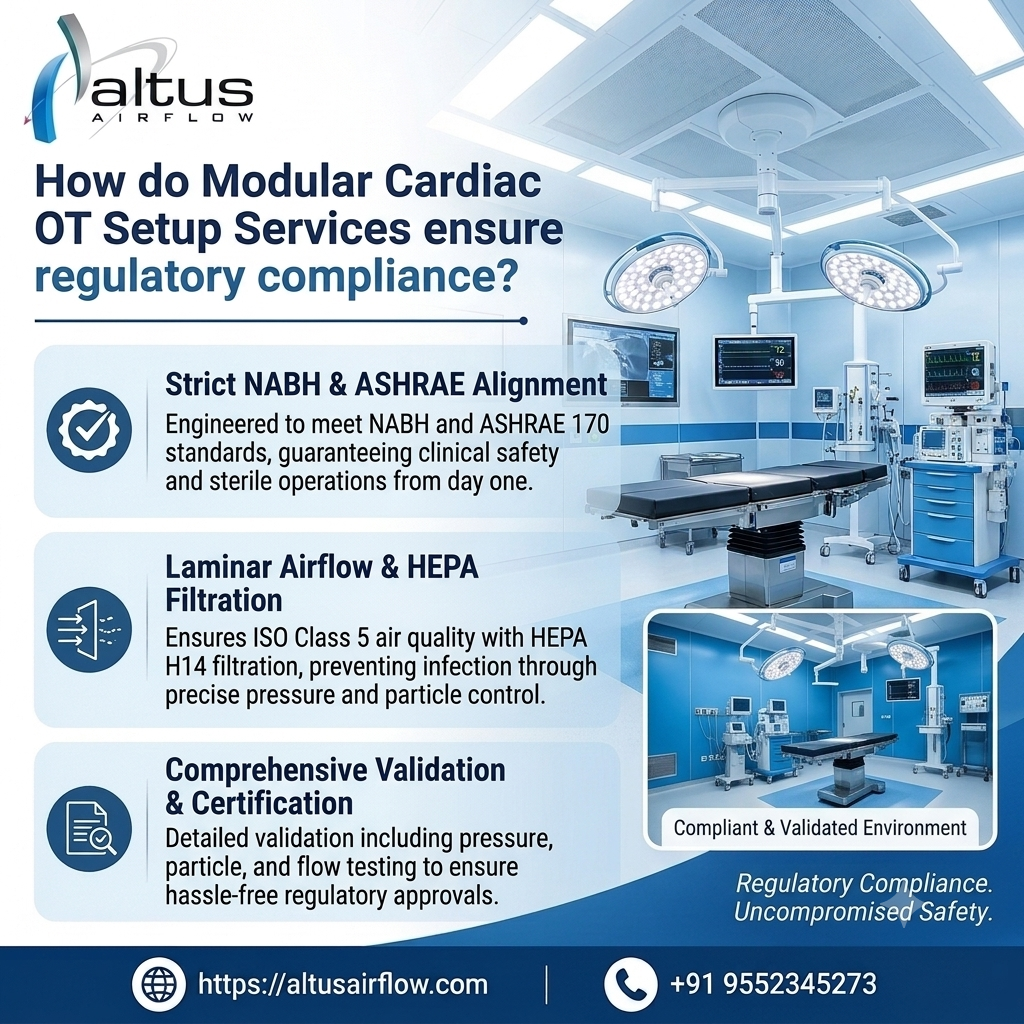
Altus Airflow understands that regulatory compliance is essential when developing specialised cardiac operating theatres. Modular Cardiac OT Setup Services help hospitals establish operating environments that meet applicable healthcare, engineering, electrical safety, ventilation, and infection control requirements. From modular construction and HVAC integration to HEPA filtration, medical gas systems, and electrical installations, every component must follow relevant technical guidelines. Proper planning, documentation, testing, and coordination with qualified professionals help hospitals develop safe, functional, and regulation-compliant surgical facilities.
Compliance should be considered throughout the project rather than addressed only after installation. Coordinated engineering and clinical planning help ensure that the operating theatre meets its intended requirements before clinical operations begin.
1. Understanding Regulatory Requirements for Cardiac Operating Theatres
Cardiac operating theatres require specialised infrastructure because they support complex surgical procedures and advanced medical equipment. Hospitals must identify the regulatory requirements applicable to the facility before beginning the design and installation process.
These requirements may cover:
-
Healthcare facility infrastructure.
-
Infection prevention and control.
-
Ventilation and air filtration.
-
Electrical safety.
-
Medical gas installations.
-
Fire protection and emergency preparedness.
-
Structural and building safety.
-
Medical equipment installation.
-
Environmental monitoring and maintenance.
In India, hospitals may need to consider applicable National Building Code provisions, Bureau of Indian Standards (BIS) requirements, National Accreditation Board for Hospitals and Healthcare Providers (NABH) standards, and relevant state and local regulations.
The exact requirements depend on the hospital's location, facility classification, equipment, and intended clinical activities.
A detailed compliance assessment helps identify applicable standards before the project moves into the construction stage.
2. Following Healthcare Accreditation Standards
Healthcare accreditation standards provide a framework for evaluating the quality, safety, and operational readiness of hospital infrastructure.
NABH accreditation requirements are particularly relevant for hospitals seeking to establish structured healthcare quality and patient safety systems.
Operating theatre planning should consider requirements related to:
Patient safety: The operating environment should support safe surgical practices, appropriate equipment placement, and emergency preparedness.
Infection control: Interior finishes, ventilation arrangements, cleaning procedures, and environmental controls should support the hospital's infection prevention programme.
Facility management: Electrical systems, HVAC equipment, medical gas installations, and other infrastructure should be properly maintained.
Documentation: Hospitals should maintain records of equipment inspections, maintenance activities, testing, and corrective actions.
Staff safety: Appropriate safety measures should protect surgeons, nurses, technicians, and other healthcare professionals.
Accreditation requirements should be translated into practical engineering specifications during the planning stage. This helps ensure that the infrastructure supports the hospital's operational policies.
3. Ensuring HVAC and Ventilation Compliance
Ventilation is one of the most important engineering considerations in cardiac operating theatres. A properly designed HVAC system helps maintain suitable temperature, humidity, air cleanliness, and pressure relationships.
Regulatory compliance requires the ventilation design to follow applicable healthcare engineering standards and project-specific environmental requirements.
Important considerations include:
-
Appropriate air changes according to the applicable design criteria.
-
Suitable HEPA filtration where specified.
-
Controlled airflow distribution.
-
Appropriate temperature and humidity regulation.
-
Required pressure relationships between different spaces.
-
Proper return and exhaust air arrangements.
-
Accessible HVAC maintenance provisions.
The ventilation design should be supported by engineering calculations and technical documentation.
Commissioning activities should include airflow measurements, pressure differential verification, filter integrity testing, and environmental performance checks as applicable.
These activities help establish whether the installed ventilation system performs according to the approved design.
4. Maintaining HEPA Filtration and Air Quality Standards
High-efficiency particulate air filters are widely used in specialised operating theatre ventilation systems to control airborne particles.
However, selecting a suitable filter does not automatically guarantee regulatory compliance. The complete filtration arrangement must be properly designed, installed, sealed, tested, and maintained.
Hospitals should evaluate the following aspects:
Filter classification: Confirm that the selected filter meets the required efficiency classification and applicable technical specifications.
Installation quality: Ensure that filter housings and connections are properly sealed to minimise bypass leakage.
Integrity testing: Conduct appropriate filter leakage and integrity tests during commissioning and periodic verification.
Differential pressure monitoring: Monitor pressure differences across filters to identify loading and possible performance issues.
Replacement schedules: Establish maintenance intervals according to manufacturer recommendations and actual operating conditions.
Documentation: Maintain filter specifications, installation records, inspection reports, and test certificates.
A documented filtration maintenance programme supports consistent environmental performance and helps hospitals demonstrate compliance during technical inspections.
5. Complying with Modular Construction and Interior Requirements
Modular operating theatre construction involves specialised wall panels, ceilings, flooring, doors, and service integration systems.
These components must be selected according to healthcare hygiene requirements, structural specifications, and applicable building regulations.
Important compliance considerations include:
Wall panels: Surfaces should be smooth, durable, non-porous, and compatible with approved cleaning and disinfection procedures.
Flooring: Flooring should provide suitable durability, cleanability, and slip resistance. Electrical conductivity requirements should be evaluated where applicable.
Ceiling systems: Ceiling panels should support the required structural loads and accommodate surgical lights, medical pendants, and ventilation equipment.
Doors: Door assemblies should support the required room sealing, accessibility, and operational requirements.
Sealing arrangements: Joints and service penetrations should be properly sealed to maintain the intended room integrity.
Material documentation: Product specifications and relevant test certificates should be available for review.
Hospitals should also verify that modular components are installed according to approved drawings and manufacturer instructions.
6. Ensuring Electrical Safety and Emergency Power Compliance
Cardiac operating theatres depend on continuous electrical supply for medical equipment, surgical lighting, monitoring systems, and essential environmental controls.
Electrical installations must therefore follow applicable medical location requirements and electrical safety standards.
In India, relevant BIS standards and the applicable National Electrical Code provisions should be considered during electrical planning.
IEC 60364-7-710 is an important international reference for electrical installations in medical locations.
Important electrical safety provisions include:
-
Appropriate electrical distribution panels.
-
Dedicated circuits for critical medical equipment.
-
Suitable earthing and equipotential bonding.
-
Electrical isolation arrangements where required.
-
Insulation monitoring systems where applicable.
-
UPS backup for designated critical loads.
-
Emergency generator integration.
-
Appropriate circuit protection.
-
Emergency lighting provisions.
Hospitals should conduct electrical safety inspections and functional testing before commissioning.
The electrical design must also consider the classification of the medical location and the requirements of the equipment being installed.
7. Following Medical Gas Installation Standards
Medical gas systems are essential components of cardiac operating theatre infrastructure. They support anaesthesia delivery, respiratory care, and other clinical activities.
Medical gas installations should be planned and executed according to applicable standards, hospital requirements, and manufacturer specifications.
Common considerations include:
Gas pipeline arrangements: Pipelines should be designed for the intended medical gases and connected to appropriate supply systems.
Terminal units: Gas outlets should be correctly identified, positioned, and compatible with the intended medical equipment.
Pipeline identification: Appropriate colour coding, labelling, and identification should be provided according to applicable requirements.
Pressure monitoring: Suitable monitoring arrangements should help identify abnormal pressure conditions.
Alarm systems: Medical gas alarms should notify authorised personnel about supply failures and abnormal operating conditions.
Testing and verification: Pipeline cleanliness, pressure integrity, cross-connection prevention, and gas identity should be verified before clinical use.
Medical gas systems should be installed and tested by qualified professionals. Proper commissioning documentation is important for demonstrating installation quality and operational readiness.
8. Integrating Fire Safety and Emergency Preparedness
Fire safety is another important part of regulatory compliance in healthcare infrastructure.
Operating theatres contain electrical equipment, medical gases, specialised installations, and other components that require coordinated fire protection planning.
Hospitals should evaluate applicable fire safety requirements under local regulations and relevant building codes.
Important provisions may include:
-
Appropriate fire detection systems.
-
Suitable fire alarm arrangements.
-
Emergency exits and evacuation routes.
-
Emergency lighting and signage.
-
Fire-resistant construction elements where required.
-
Suitable firefighting equipment.
-
Electrical fault protection.
-
Emergency response procedures.
Fire safety planning should also consider the operation of ventilation systems during emergency situations.
Hospitals should coordinate fire protection arrangements with architects, electrical consultants, HVAC engineers, and fire safety professionals.
Regular inspection and emergency preparedness exercises help verify that the installed systems and hospital procedures remain effective.
9. Maintaining Radiation Safety Compliance
Some cardiac operating theatres use imaging equipment such as mobile C-arms or other fluoroscopy systems.
When ionising radiation equipment is installed or operated, hospitals must consider the applicable radiation protection requirements.
In India, the Atomic Energy Regulatory Board (AERB) regulates radiation safety aspects associated with diagnostic X-ray equipment.
Relevant compliance considerations may include:
Equipment approval: Ensure that imaging equipment meets applicable regulatory requirements.
Room planning: Evaluate shielding requirements and radiation protection provisions according to the equipment and installation design.
Radiation monitoring: Provide suitable radiation monitoring arrangements where required.
Staff protection: Ensure that personnel follow radiation protection procedures and use appropriate protective equipment.
Documentation: Maintain relevant equipment, quality assurance, and radiation safety records.
The radiation safety design should be evaluated by qualified professionals before installing imaging equipment.
Not every cardiac operating theatre requires identical radiation protection provisions. Requirements depend on the equipment and intended use.
10. Documentation and Regulatory Inspection Preparation
Documentation is essential for demonstrating that the operating theatre has been designed, installed, and tested according to applicable requirements.
Hospitals should maintain a structured compliance file throughout the project.
Important documents may include:
-
Approved architectural and engineering drawings.
-
HVAC design calculations.
-
HEPA filter specifications and test reports.
-
Airflow and pressure testing reports.
-
Electrical safety certificates.
-
UPS and generator testing records.
-
Medical gas installation and commissioning reports.
-
Fire safety documentation.
-
Material specifications and product certifications.
-
Equipment installation records.
-
Operation and maintenance manuals.
-
Preventive maintenance schedules.
These documents help hospital management, technical teams, accreditation assessors, and regulatory authorities review the infrastructure.
A document management process should also identify responsible personnel and ensure that records are updated whenever modifications or maintenance activities are performed.
11. Testing, Commissioning, and Final Compliance Verification
Before a cardiac operating theatre begins clinical operations, all installed systems should undergo appropriate testing and commissioning.
Commissioning verifies whether the infrastructure performs according to the approved technical design and applicable requirements.
A typical verification process includes:
-
Structural inspection: Check modular wall, ceiling, flooring, and door installations.
-
HVAC testing: Verify airflow, air changes, temperature, humidity, and pressure conditions.
-
HEPA verification: Conduct appropriate filter integrity and installation checks.
-
Electrical testing: Inspect earthing, electrical protection, UPS, and emergency power arrangements.
-
Medical gas testing: Verify pipeline integrity, gas identification, terminal units, and alarms.
-
Fire safety verification: Check detection, alarm, emergency lighting, and other applicable provisions.
-
Equipment testing: Confirm the safe installation and operation of medical equipment.
-
Documentation review: Ensure that test reports and commissioning records are complete.
The hospital should review outstanding observations and corrective actions before approving the facility for clinical use.
Commissioning should be conducted by appropriately qualified specialists, with results documented for future reference.
12. How Integrated Project Coordination Supports Compliance?
Regulatory compliance involves several engineering disciplines. Problems can arise when architectural, electrical, HVAC, medical gas, and equipment installations are planned independently.
A coordinated project approach helps reduce these issues.
Modular Cardiac OT Setup Services support compliance by bringing different infrastructure requirements together during project planning and execution.
Coordination may involve:
-
Architects for room layouts and building integration.
-
HVAC consultants for ventilation and filtration.
-
Electrical engineers for medical power distribution.
-
Medical gas specialists for pipeline systems.
-
Fire safety consultants for emergency protection.
-
Equipment suppliers for installation requirements.
-
Hospital clinical teams for workflow and safety considerations.
This integrated approach helps identify potential conflicts before installation and supports better documentation, testing, and project handover.
However, regulatory approval and ongoing compliance remain the responsibility of the hospital and the relevant authorised professionals and authorities. The installation partner supports the process through appropriate design coordination, technical execution, and documentation.
Conclusion
Regulatory compliance in cardiac operating theatres requires a coordinated approach to ventilation, filtration, modular construction, electrical safety, medical gas installations, fire protection, and equipment integration. Hospitals should identify applicable standards during the planning stage and verify every critical system through proper testing, commissioning, and documentation.
Modular Cardiac OT Setup Services help coordinate these technical requirements and support the development of safe, functional, and well-organised surgical environments.
Altus Airflow focuses on specialised modular healthcare infrastructure, helping hospitals coordinate operating theatre construction, ventilation, filtration, and essential engineering systems. With attention to technical specifications, project documentation, and installation quality, Altus Airflow supports hospitals in developing modern cardiac surgical facilities.
Frequently Asked Questions (FAQs)
1. How do Modular Cardiac OT Setup Services ensure regulatory compliance?
Modular Cardiac OT Setup Services support compliance through coordinated planning, HVAC design, HEPA filtration, electrical safety, medical gas integration, testing, and commissioning.
2. Which standards are relevant to cardiac operating theatre construction in India?
Applicable NABH requirements, BIS standards, National Building Code provisions, and relevant local regulations may apply.
3. Why is HVAC compliance important in cardiac operating theatres?
It helps maintain suitable airflow, filtration, temperature, humidity, and pressure conditions.
4. Are HEPA filter testing and documentation necessary?
Yes. Appropriate integrity testing and documentation help verify filtration system performance.
5. How is electrical safety maintained in modular cardiac OTs?
Through suitable earthing, electrical protection, emergency power, isolation arrangements, and medical electrical safety testing.
Read Our Previous Blog ---------------> Can a Modular Cardiac OT Turnkey Project Company integrate smart OT technologies?

 English
 Arabic
 Spanish
 Portuguese
 Deutsch
 Turkish
 Dutch
 Italiano
 Russian
 Romaian
 Portuguese (Brazil)
 Greek