


How Much Do Ecommerce Management Services Cost? Starter, Growth, and Enterprise Models Explained
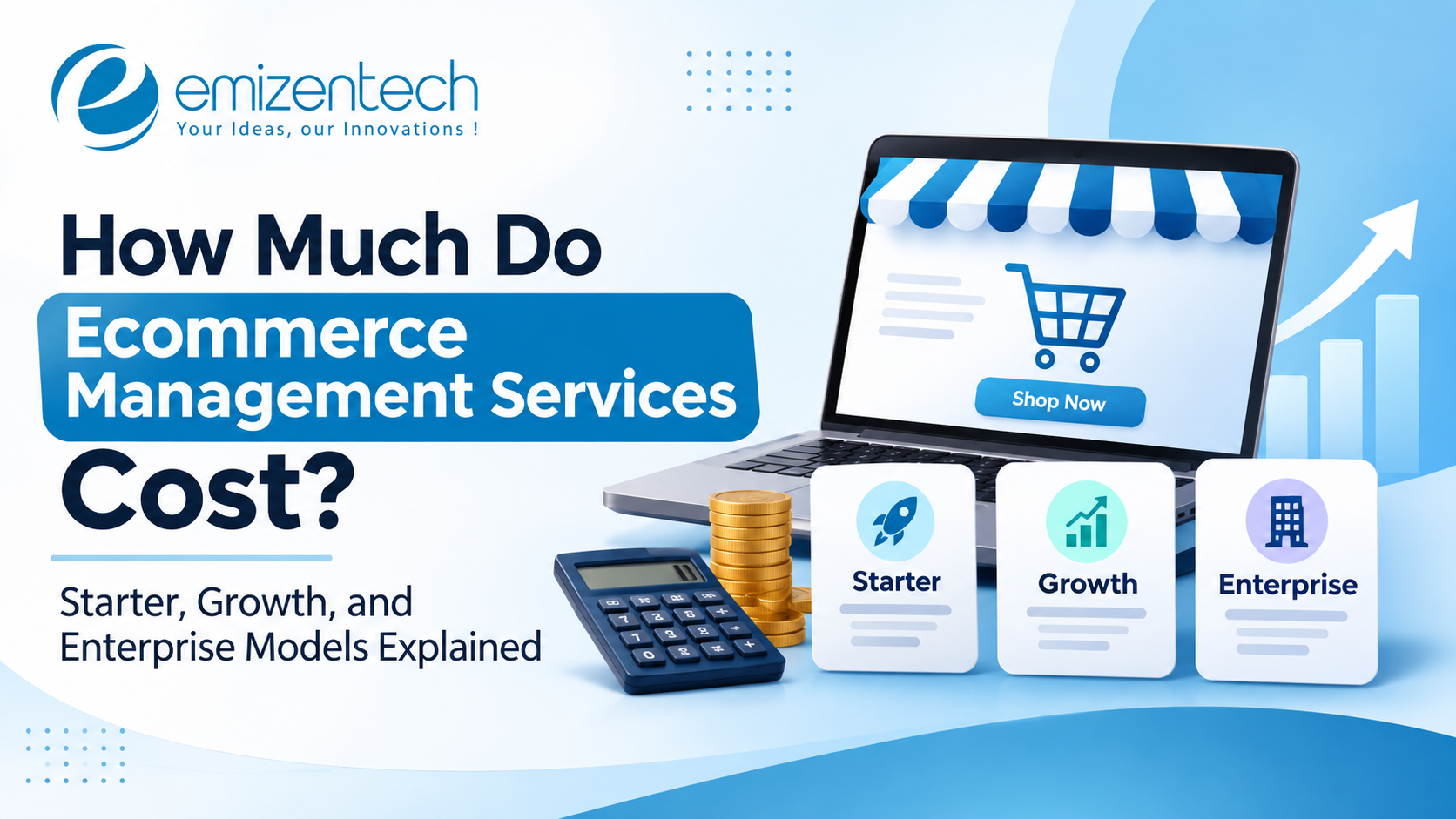
Managing an ecommerce store involves more than listing products and processing orders. Businesses must handle inventory, customer queries, website maintenance, marketing activities, and order fulfillment while keeping operations running smoothly. As these responsibilities increase, managing everything internally can become expensive and time-consuming.
The cost of ecommerce management services depends on the size of the store, operational complexity, required services, and level of ongoing support. Understanding different pricing models helps businesses choose a management plan that fits their current requirements and future growth.
What Determines Ecommerce Management Services Cost?
Ecommerce management costs are influenced by several factors. A small store with a limited product catalog will generally require fewer resources than a large operation managing multiple sales channels and high order volumes.
Here are the main factors that influence pricing:
- Store Size and Product Catalog: Managing a small number of products requires less effort than maintaining thousands of product listings, descriptions, images, and pricing updates.
- Order Volume: Higher order volumes increase the workload associated with order processing, tracking, returns, and fulfillment coordination.
- Inventory Management: Businesses with multiple warehouses, suppliers, or product categories may require more advanced inventory monitoring.
- Marketing Requirements: SEO, paid advertising, email campaigns, and promotional activities can increase the overall management cost.
- Platform and Integrations: Managing connected systems, payment gateways, CRM platforms, and inventory tools adds technical responsibilities.
- Support Requirements: Dedicated assistance, extended support hours, and regular performance monitoring can influence monthly pricing.
Evaluating these factors helps businesses understand what they are paying for instead of comparing service packages based only on their monthly fees.
Ecommerce Management Cost by Business Model
Ecommerce management requirements change as businesses expand. A startup may need basic store maintenance, while an established retailer may require coordinated operations across multiple channels.
The following models explain how management requirements differ at each stage.
Starter Model: Costs for Small Ecommerce Stores
The Starter model is suitable for startups, small retailers, and businesses operating with limited product catalogs. At this stage, the primary objective is to maintain essential store operations without investing heavily in a dedicated internal team.
Typical services include:
- Basic website maintenance and product updates.
- Order processing and tracking.
- Inventory updates and monitoring.
- Basic customer query management.
- Routine website checks.
Pricing generally depends on the number of products, frequency of updates, and ecommerce support support hours included in the package. Businesses with straightforward operations can often manage their stores through a limited monthly service arrangement.
Growth Model: Costs for Expanding Online Stores
The Growth model is designed for businesses experiencing increasing sales, expanding product catalogs, or entering additional sales channels. As operations become more demanding, basic store maintenance is no longer sufficient.
Management services at this level may include:
- Multi-channel store management.
- Marketing campaign coordination.
- Advanced inventory and order management.
- Product catalog optimization.
- Sales performance monitoring and reporting.
- Customer support coordination.
Costs increase because these activities require more time, specialized expertise, and coordination between different business functions. Businesses should evaluate whether their management package supports their expansion plans without creating unnecessary operational expenses.
Enterprise Model: Costs for Large Ecommerce Operations
Enterprise management is intended for large retailers, established ecommerce brands, and businesses handling complex operations. These stores often require advanced technical support, multiple integrations, and coordinated management across different markets.
Common services include:
- Multi-store and multi-region management.
- Advanced platform and system administration.
- Custom integrations and workflow automation.
- Dedicated account and technical support.
- Advanced reporting and performance monitoring.
- Coordination of complex inventory and order operations.
Enterprise pricing is usually customized according to business requirements. The number of storefronts, integration complexity, operational scale, and support expectations all influence the final cost.
What Services Are Usually Included in Ecommerce Management Packages?
Not every ecommerce management package covers the same responsibilities. Some focus on routine store operations, while others include technical maintenance, marketing, and performance optimization.
Before selecting a package, businesses should understand which activities are included.
- Store Maintenance: Covers website updates, bug fixes, functionality checks, and routine technical maintenance.
- Product Catalog Management: Includes adding products, updating descriptions, managing images, and maintaining accurate product information.
- Order and Inventory Management: Involves monitoring stock levels, processing orders, coordinating fulfillment, and handling returns.
- Customer Support: Covers customer queries, order-related concerns, and assistance throughout the purchasing process.
- Marketing Management: May include SEO, email marketing, promotional campaigns, and paid advertising coordination.
- Performance Reporting: Provides insights into sales, website activity, customer behavior, and operational performance.
Some packages include all these services, while others charge separately for specialized activities. Businesses should review the service agreement carefully to identify exclusions and additional charges.
How to Choose the Right Ecommerce Management Plan
Selecting a management plan based only on price can create problems later. A cheaper package may exclude important services, while an expensive package may include features that a business does not currently need.
Consider these factors before making a decision:
1. Identify Your Operational Requirements
List the activities that require regular assistance, including product updates, order processing, inventory monitoring, and website maintenance. This helps establish the actual scope of work.
2. Compare Service Scope and Pricing
Review what each package includes and identify additional charges for marketing, technical support, integrations, or other specialized services.
3. Check Scalability
Choose a service arrangement that can accommodate increasing orders, additional products, and new sales channels without requiring frequent changes.
4. Evaluate Support Availability
Understand the available support hours, communication channels, response times, and process for handling urgent technical issues.
5. Review Reporting and Performance Tracking
Regular reports help businesses evaluate store performance, identify operational issues, and understand whether management activities are delivering value.
A suitable plan should address current business needs while leaving room for future expansion.
Conclusion
Ecommerce management costs depend on how much support a business needs and how complex its operations have become. Starter models suit businesses managing basic store activities, Growth models support expanding operations, and Enterprise models address large-scale management requirements.
Before selecting a service package, businesses should compare the included activities, pricing structure, support availability, and scalability. EmizenTech brings experience in ecommerce development and technology solutions, helping businesses build and manage ecommerce operations with technical capabilities aligned with their business requirements.
FAQs
1. How much do ecommerce store management services cost per month?
Monthly costs depend on store size, service requirements, order volume, and management complexity. Basic packages generally cost less than growth-oriented or enterprise arrangements.
2. What is included in ecommerce store management services?
Common services include website maintenance, product catalog updates, inventory management, order processing, customer support, marketing coordination, and performance reporting.
3. Is outsourcing ecommerce management more affordable than hiring an in-house team?
Outsourcing can reduce recruitment, training, and employee-related expenses. However, the actual cost depends on the services required and the outsourcing agreement.
4. Can small businesses afford ecommerce management services?
Yes. Small businesses can choose limited service packages covering essential activities such as product updates, order management, and routine website maintenance.
5. Do ecommerce management costs increase as a store grows?
Costs can increase as product catalogs, order volumes, integrations, and support requirements expand. However, the actual increase depends on the management model and service agreement.

 English
 Arabic
 French
 Spanish
 Portuguese
 Deutsch
 Turkish
 Dutch
 Italiano
 Russian
 Portuguese (Brazil)
 Greek