


Industrial Lamination Machine India | Cold Laminator
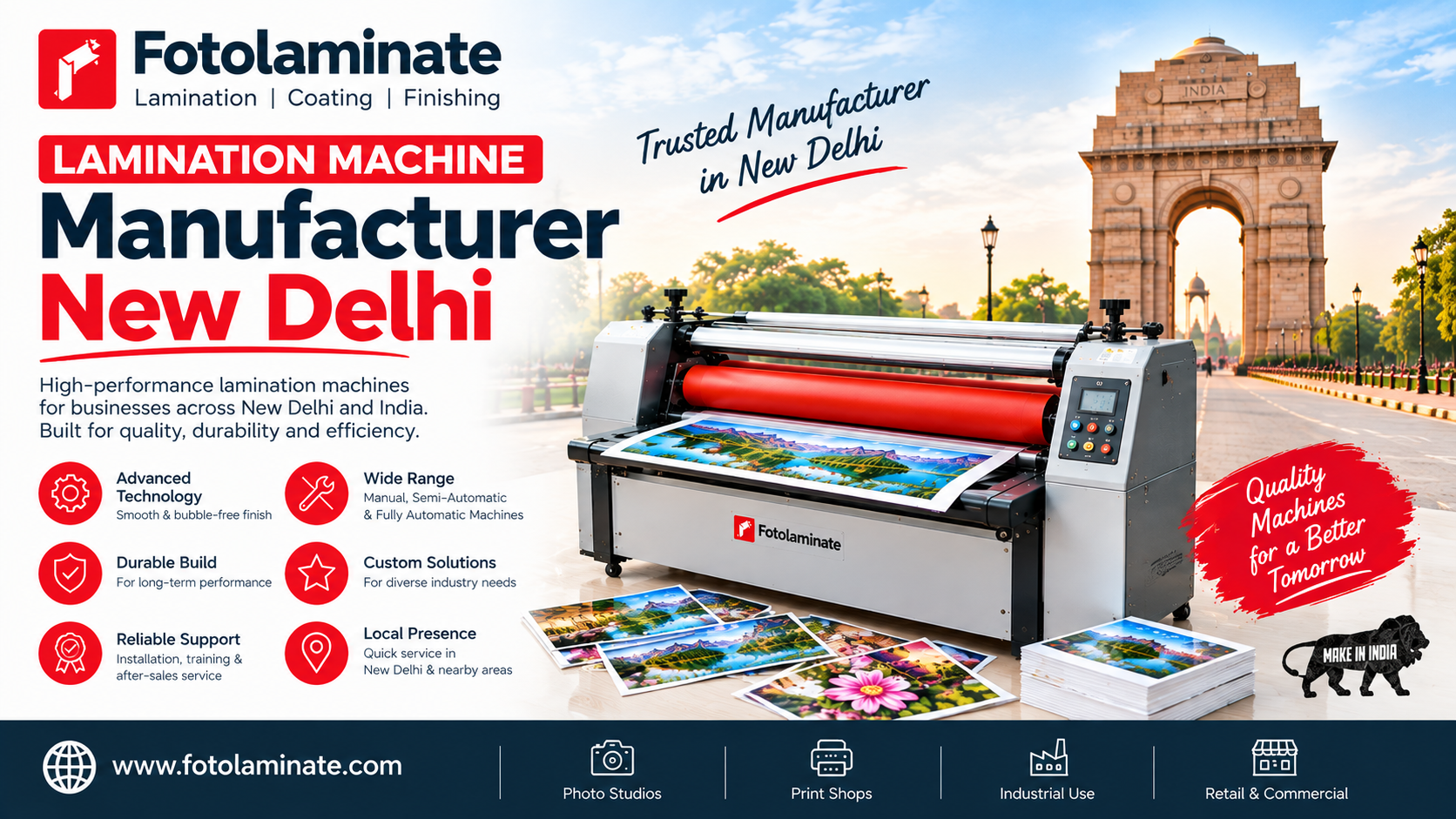
Lamination plays an important role in commercial printing, photo finishing, signage production and several industrial applications. Businesses use lamination equipment to protect printed surfaces, improve their appearance and create finished products that are easier to handle.
When searching for an industrial lamination machine India, buyers should first identify the type of material they process and the production capacity they need. A cold laminating machine can be a practical choice for photographs, vinyl graphics, posters and other printed materials that require film application without heat-based bonding.
What Is an Industrial Lamination Machine?
An industrial lamination machine is equipment designed to join or apply a protective layer to a material as part of a production or finishing process. Its construction and operating system depend on the application.
In the printing and photo-finishing industry, industrial laminators are commonly used to apply protective films to printed surfaces. Larger machines may support wider materials, continuous feeding or higher production volumes.
Industrial lamination equipment can serve different industries, including:
-
Commercial printing: Finishing posters, brochures and promotional graphics.
-
Photo finishing: Protecting photographs and album prints.
-
Signage production: Laminating vinyl graphics and display materials.
-
Packaging: Applying films to suitable printed sheets and packaging materials.
-
Specialised manufacturing: Bonding layers in applications such as electronics, composites and other industrial products.
The machine required for a printing business is not necessarily suitable for electronics or composite manufacturing. Buyers should select equipment according to the actual lamination process.
Understanding a Cold Laminating Machine
A cold laminating machine applies pressure-sensitive adhesive film to a surface using rollers. Unlike thermal lamination, it does not rely on heat to activate the adhesive.
The operator feeds the print and film through the rollers. Pressure helps the adhesive film bond to the material, creating a protective or decorative surface.
Cold lamination is commonly used for:
-
Photographs and photo album prints.
-
Posters and advertising graphics.
-
Vinyl prints and signage.
-
Canvas and display graphics.
-
Selected heat-sensitive printed materials.
The quality of the result depends on the adhesive film, substrate condition, roller pressure and feeding technique. Dust, incorrect alignment and uneven pressure can cause bubbles or wrinkles.
Types of Cold Laminating Machines
Businesses can choose from several machine configurations depending on their production requirements.
1. Manual Cold Laminating Machine
Manual machines use an operator-controlled feeding and roller mechanism. They can suit smaller photo studios, printing shops and businesses with moderate workloads.
Their relatively simple operating arrangement can make them useful where automation is not essential.
2. Semi-Automatic Cold Laminating Machine
Semi-automatic models automate selected operations, such as roller movement or feeding, depending on the configuration. They can reduce manual effort while allowing operators to control parts of the process.
These machines may suit growing print businesses that handle regular lamination jobs.
3. Fully Automatic Cold Laminating Machine
Fully automatic machines offer a higher level of operational automation. Depending on the model, they may include powered feeding, adjustable speed and pressure-control systems.
They are worth considering for commercial units where production volume and operator efficiency are important.
4. Flatbed Cold Laminating Machine
Flatbed machines are designed for suitable sheet-based and larger-format applications. Their working width, roller gap and feeding arrangement should be checked against the materials being processed.
How to Choose an Industrial Lamination Machine India
Selecting an industrial lamination machine India requires more than comparing the purchase price. A machine should match your production volume, material dimensions and finishing requirements.
Consider the following factors before making a decision:
| Selection factor | Why it matters |
|---|---|
| Working width | Determines the maximum print or material width |
| Roller quality | Affects pressure distribution and finishing consistency |
| Automation | Influences operator involvement and production workflow |
| Speed control | Helps manage different materials and jobs |
| Roller gap | Determines suitable material thickness |
| Film compatibility | Ensures the machine works with the required laminating film |
| Service support | Helps reduce downtime and maintenance difficulties |
For example, a photo studio handling smaller prints may prefer a compact manual machine. A commercial signage business processing wide vinyl graphics may need a wider, motorised laminator.
Benefits of Using a Cold Laminating Machine
Cold lamination offers practical advantages for businesses working with different printed materials.
-
No heat-based bonding: Useful for compatible materials that may be sensitive to heat.
-
Versatile applications: Suitable for photographs, posters, vinyl and selected display prints.
-
Protective finish: Helps protect printed surfaces from routine handling and environmental exposure.
-
Different machine sizes: Available in configurations for small studios and larger printing operations.
-
Flexible film choices: Depending on compatibility, businesses can use films with different finishes.
However, cold lamination is not the right solution for every material. Always check the adhesive film and machine manufacturer's recommendations.
Industrial Lamination Machine India: Manufacturer and Model Considerations
When comparing manufacturers in India, examine their experience with the type of equipment you need. Ask for product specifications, machine demonstrations, maintenance guidance and details about available configurations.
Foto Laminate, operating as M/S Mela Ram & Sons, manufactures photo-finishing and printing equipment under the Codalam brand in New Delhi. Its product range includes cold lamination machines, flatbed laminators, thermal laminators, UV coating equipment and other photo-finishing machinery. <Cite refs={["turn971384search0","turn971384search4"]}/>
For businesses interested in cold lamination, available Codalam configurations include different machine widths and automation options. Buyers should compare individual models rather than assuming that all machines in a product range have identical features.
The wider Indian market also includes manual and industrial cold laminators from several manufacturers and suppliers. Product listings show differences in working width, roller arrangement, thickness capacity and operating mechanism. <Cite refs={["turn971384search0","turn971384search4","turn971384search12"]}/>
Before placing an order, request a demonstration using your regular print material and confirm the machine's supported film specifications.
Maintenance Tips for Better Machine Performance
Regular maintenance can help maintain consistent finishing quality and reduce avoidable production interruptions.
-
Clean rollers and remove dust or adhesive residue as recommended.
-
Check film alignment before feeding material.
-
Keep prints flat and free from dust.
-
Use suitable pressure and speed settings.
-
Inspect rollers for visible wear or damage.
-
Follow the manufacturer's instructions for servicing and replacement parts.
Operators should also avoid forcing material through the machine if it is not feeding correctly.
10 Frequently Asked Questions
1. What is an industrial lamination machine used for?
It is used to apply or bond layers to materials in production and finishing processes, including commercial printing, signage and specialised manufacturing.
2. What is a cold laminating machine?
It is a machine that applies pressure-sensitive adhesive film to a surface using rollers without heat-based adhesive activation.
3. Is cold lamination suitable for photographs?
Yes. Cold lamination is commonly used for photographs and album prints when compatible film and suitable machine settings are used.
4. What is the difference between cold and thermal lamination?
Cold lamination uses pressure-sensitive adhesive film, whereas thermal lamination uses heat and pressure with compatible thermal film.
5. Which cold laminating machine is suitable for a printing business?
The choice depends on print width, production volume, material type and required automation. Manual, semi-automatic and fully automatic options are available.
6. Can a cold laminating machine be used for vinyl?
Many machines support suitable vinyl graphics. Confirm the recommended film, media thickness and working width before use.
7. What features should I check before purchasing an industrial laminator?
Check working width, roller construction, pressure adjustment, speed control, roller gap, film compatibility and service support.
8. Does a larger laminating machine always provide better results?
No. A wider machine is useful for larger materials, but finishing quality also depends on roller condition, pressure, film and operator technique.
9. How can I reduce bubbles during cold lamination?
Clean the print and rollers, align the film correctly, use suitable pressure and feed the material smoothly.
10. How do I select a reliable machine manufacturer in India?
Compare manufacturing experience, available models, technical documentation, product demonstrations, spare parts and after-sales support.
Conclusion
Choosing an industrial lamination machine India starts with understanding the materials, production volume and finishing process involved. For photo studios, signage businesses and commercial printing units, a suitable cold laminating machine can provide a practical way to apply protective film without heat-based bonding.
Compare machine configurations, check important specifications and request a working demonstration before purchasing. Selecting equipment that matches your actual workload can help maintain consistent output and support long-term business operations.

 English
 Arabic
 French
 Spanish
 Portuguese
 Deutsch
 Turkish
 Dutch
 Italiano
 Romaian
 Portuguese (Brazil)
 Greek