


Interoperability and Digitalization Fuel Growth in the Global Smart Home Devices Market
Smart Home Devices Market Surges as AI, IoT and Connected Living Transform Residential Automation
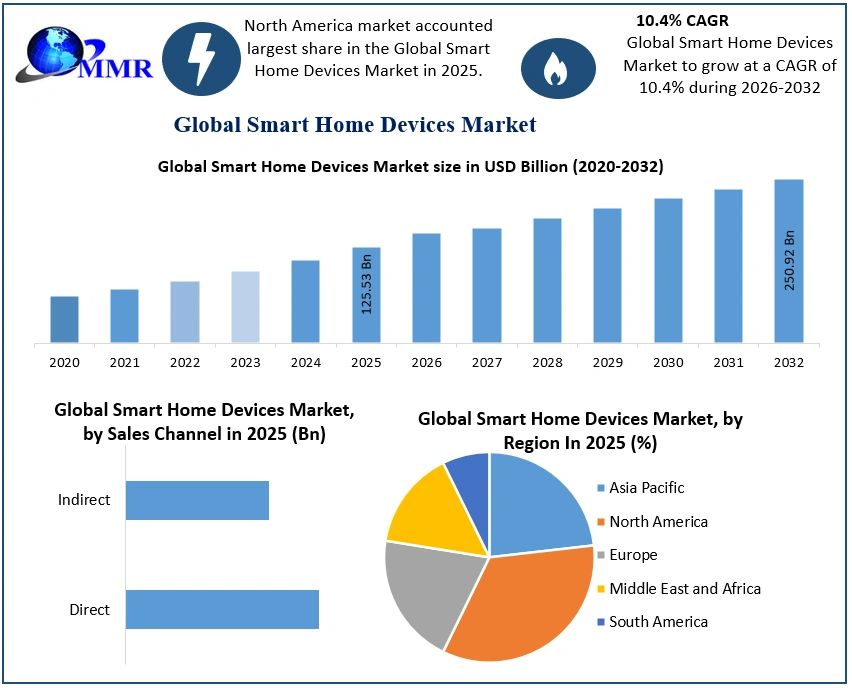
The Smart Home Devices Market is rapidly evolving as households increasingly adopt connected technologies for security, energy management, convenience, entertainment, and automated control. According to Maximize Market Research, the market was valued at USD 113.71 billion in 2024 and is projected to reach approximately USD 250.93 billion by 2032, expanding at a CAGR of 10.4% from 2025 to 2032. The market is benefiting from rising internet penetration, smartphone adoption, IoT connectivity, artificial intelligence, voice-assisted technologies, and growing consumer demand for energy-efficient homes. Smart devices are increasingly shifting from standalone products toward integrated ecosystems capable of communicating, learning user preferences, and automating household functions. Growing concerns over home security, rising energy costs, demand for remote monitoring, and the adoption of connected appliances are creating additional momentum. Opportunities are emerging through AI-powered automation, predictive security, edge computing, smart energy management, Matter-enabled interoperability, and subscription-based connected-home services. As consumers increasingly expect devices from different manufacturers to work together seamlessly, interoperability and cybersecurity are also becoming important competitive differentiators.
* Download the Full Market Report: https://www.maximizemarketresearch.com/request-sample/145908/
U.S. Market Trends and Investment
The United States remains a leading smart-home market because of high technology adoption, strong purchasing power, widespread broadband and smartphone penetration, and established ecosystems from major technology companies. During 2025, the U.S. market increasingly shifted toward AI-enabled and interoperable smart-home platforms. Amazon expanded its Alexa strategy through Alexa+, a generative-AI assistant designed to provide more conversational and personalized interactions across connected devices, while its Alexa Fund broadened investment toward AI-enabled hardware, smart agents, and emerging AI architectures. Google also expanded its Home APIs and Matter ecosystem, announcing in May 2025 that developers could access more than 750 million devices, with Gemini intelligence enabling more natural device control, automated routines, and AI-powered camera experiences. Schneider Electric further strengthened the U.S. market with its 2025 Square D QO Smart Panel Smart Power Manager, designed to help homeowners manage increasing electricity demand associated with heat pumps, induction cooking, and EV charging without costly electrical-service upgrades.
Market Segmentation
By Product Type, Security & Access Control held the largest market share of the Smart Home Devices Market. Increasing demand for connected surveillance cameras, smart locks, access-control systems, alarms, and AI-enabled security solutions is supporting the segment's leadership. Consumers are increasingly seeking real-time monitoring and remote control through smartphones and connected platforms, while AI-based analytics are enabling more predictive security capabilities. By Sales Channel, Indirect sales held the largest share, supported by retailers, wholesalers, cellular carriers, value-added resellers, and e-commerce platforms that provide consumers with broader access to smart-home products. By Software & Services, Behavioral solutions represented the leading segment, reflecting the growing importance of systems that analyze user behavior and household activity to provide personalized automation and energy-management functions.
Smart Home Devices Market, Key Players:
1. Honeywell (US)
2. Siemens (Germany)
3. Johnson Controls (Ireland)
4. Schneider Electric (France)
5. ASSA ABLOY (Sweden)
6. Amazon (US)
7. Apple (US)
8. ADT (US)
9. ABB (Switzerland)
10. Robert Bosch (Germany
11. Sony (Japan)
12. Samsung Electronics (South Korea)
13. Crestron Electronics (US)
14. Legrand (France)
15. Others
Competitive Analysis
The MMR report identifies Honeywell, Siemens, Johnson Controls, Schneider Electric, and ASSA ABLOY among the key companies in the global Smart Home Devices Market. The publicly available MMR information does not disclose individual company market-share percentages, so specific shares have not been assigned. Honeywell strengthened its smart-building technology portfolio in June 2025 with Honeywell Connected Solutions, an AI-powered platform integrating building software, systems, and devices into a unified interface. Siemens introduced Building X developments in 2025, emphasizing an open, cloud-based and interoperable architecture designed to integrate building systems and support decarbonization. Johnson Controls continued advancing its OpenBlue ecosystem, with AI capabilities supporting energy optimization, predictive maintenance, indoor-air-quality monitoring, and increasingly autonomous building management. Schneider Electric expanded its residential smart-home portfolio in 2025 with Wiser automation, smart switches, indoor-air-quality monitoring, and energy-management capabilities. ASSA ABLOY continued investing in electromechanical and digital access solutions, including smart-home-integrated locks and mobile-based access technologies; the company also completed 23 acquisitions during 2025 while continuing product-development investment.
Regional Analysis
North America held the largest regional share of the Smart Home Devices Market, supported by high IoT penetration, strong consumer adoption, advanced digital infrastructure, and established smart-home ecosystems. The United States is the principal contributor, with demand driven by smart security, energy management, voice assistants, connected appliances, and home automation. China represents a major growth opportunity due to rapid urbanization, expanding connected-device manufacturing, and smart-city development. Japan benefits from advanced electronics capabilities, aging-home modernization requirements, and strong consumer acceptance of connected technologies. Germany and France are supported by energy-efficiency objectives, building digitalization, and increasing interest in intelligent energy management, while the United Kingdom benefits from smart-meter deployment, connected heating, security technologies, and growing demand for energy-efficient homes. Siemens' 2025 Infrastructure Transition Monitor found that 55% of surveyed organizations planned to increase investment in smart-building technologies, highlighting the broader shift toward intelligent and energy-efficient built environments.
Related Reports:
Tumble Dryer Market https://www.maximizemarketresearch.com/market-report/tumble-dryer-market/146660/
Global Virtual Data Room (VDR) Market https://www.maximizemarketresearch.com/market-report/global-virtual-data-room-vdr-market/109744/
Sports Protective Gear Market https://www.maximizemarketresearch.com/market-report/sports-protective-gear-market/148740/
Conclusion
The Smart Home Devices Market is positioned for strong long-term expansion as AI, IoT, cloud computing, edge intelligence, and interoperability transform connected living. The most significant opportunities are likely to emerge from AI-powered security, predictive home automation, smart energy management, connected HVAC, Matter-enabled devices, privacy-focused edge processing, and subscription-based services. In my view, the transition from isolated connected gadgets to intelligent ecosystems will be the market's most important growth catalyst. Companies capable of combining seamless interoperability, cybersecurity, energy efficiency, personalization, and simple user experiences will be best positioned to capture the next phase of smart-home adoption. With the market projected to more than double from USD 113.71 billion in 2024 to approximately USD 250.93 billion by 2032, investment in AI-enabled and energy-intelligent connected-home solutions presents substantial opportunities across developed and emerging markets.
About Maximize Market Research
Maximize Market Research Pvt. Ltd. (MMR) is a global market research and consulting firm known for delivering accurate, actionable, and data-driven insights. Our expertise spans diverse industries — including medical devices, pharmaceuticals, technology, automotive, electronics, chemicals, personal care, and consumer goods. We provide services such as market-validated forecasts, competitive intelligence, strategic consulting, and industry impact analysis, helping businesses navigate market complexities and achieve sustainable growth.
Contact Maximize Market Research
MAXIMIZE MARKET RESEARCH PVT. LTD.
2nd Floor, Naval IT Park Phase 3,
Pune-Bangalore Highway, Narhe,
Pune, Maharashtra 411041, India.
📞 +91 9607365656
📧 sales@maximizemarketresearch.com

 English
 Arabic
 French
 Portuguese
 Deutsch
 Turkish
 Dutch
Dutch
 Italiano
 Russian
 Romaian
 Portuguese (Brazil)
 Greek
Greek