


Non-Human Primate Research: Rethinking Ethics, Evidence, and Biospecimen Quality
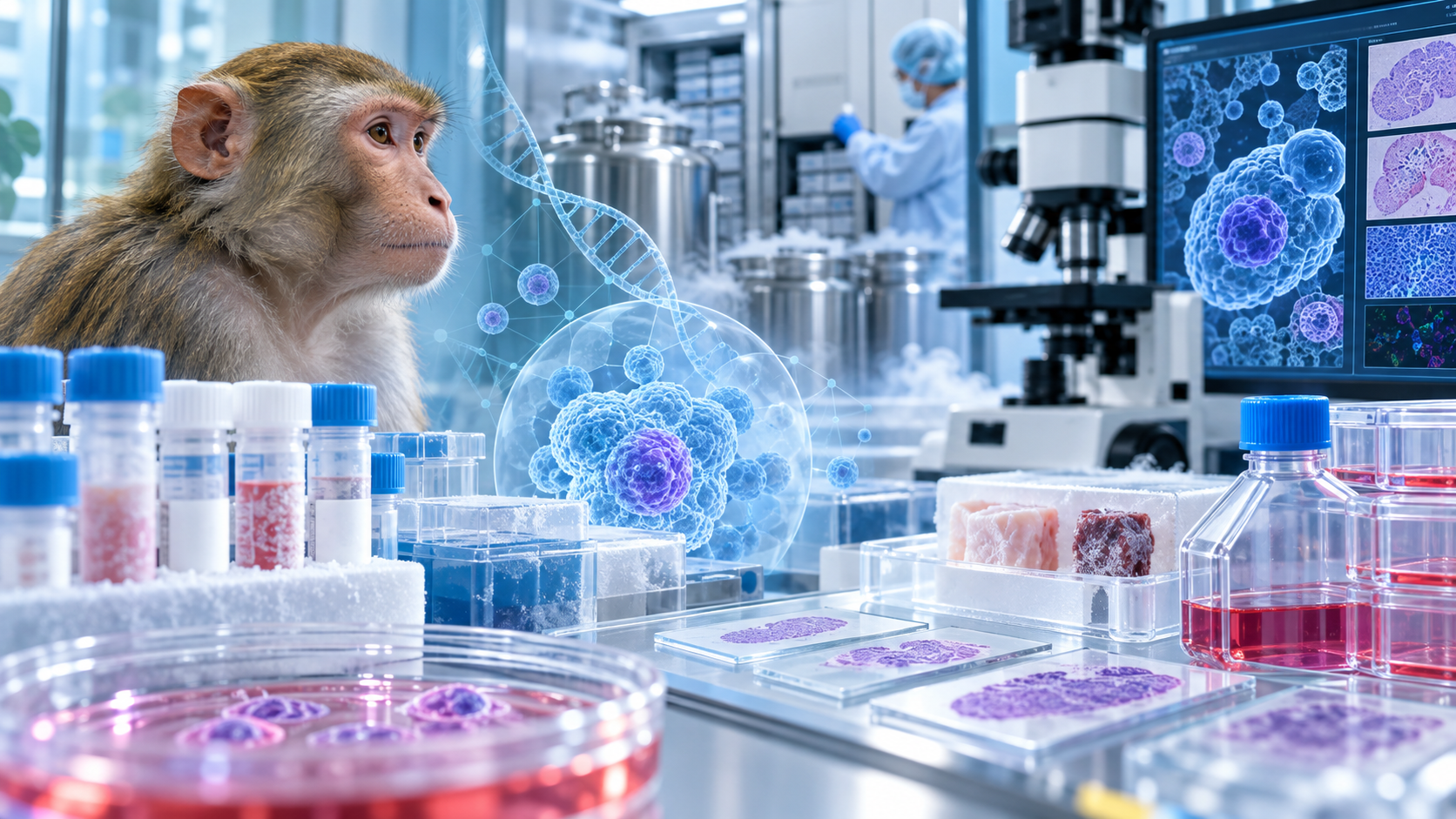
Can a primate experiment be ethically justified when its research question could be answered using existing specimens? This question challenges researchers to consider not only what a study might discover, but whether additional animal use is necessary. Non-human primates have complex social and behavioral needs that are difficult to accommodate in laboratory environments, making careful scientific justification particularly important.
Biobanking offers a practical way to improve the value obtained from animal-derived materials. The National Institute on Aging's Nonhuman Primate Tissue Bank, for example, supports replacement, reduction, and refinement—the 3Rs—by maximizing the use of existing samples. However, banked tissues remain animal-derived, and their availability does not automatically establish their suitability for every experiment.
The priority should therefore be to match the research question with the most appropriate material, verify its quality, and establish what its results can—and cannot—demonstrate. For non-human primate (NHP) research, ethical responsibility and experimental rigor belong within the same development strategy.
Start with the Biological Question, Not the Species Label
For immunology studies, anatomical origin can be as important as species selection. Blood, lymph nodes, and bone marrow contain different immune-cell populations and biological environments. Research mapping rhesus macaque immune tissues has demonstrated the value of examining these compartments separately rather than treating circulating cells as a complete representation of immune biology.
Appropriately characterized tissue-derived immune cells can support investigations of tissue-associated immune populations, including questions about antibody-producing cells and immune-cell differentiation. Their usefulness depends on confirming cellular identity and selecting readouts relevant to the intended mechanism. Isolated cells should also be understood as a simplified model, not a reconstruction of the complete tissue environment.
Reagent compatibility is another critical barrier. In one rhesus macaque study, researchers identified 112 cross-reactive antibody clones from a screen of 361 commercially available anti-human clones. This illustrates why researchers should validate individual antibodies rather than assume that a reagent suitable for human samples will perform identically in NHP material.
Preservation requires similar scrutiny. A comparative study of rhesus blood and tissue cells found that cryopreservation altered B-cell marker expression under the conditions examined. Consequently, supplier evaluation should extend beyond a viability percentage to include recovered cell numbers, relevant phenotypes, and performance in the intended assay.
Use Cell Lines for Consistency Without Assuming Biological Equivalence
Repeated experiments require dependable access to sufficient cells. Available NHP cell lines include tissue-derived models and fluorescent reporter-expressing cells that can support imaging, cellular-process analysis, and assay development. These resources offer practical starting points when researchers need repeatable experimental material rather than repeated fresh isolation.
For longer-term work, immortalized NHP cells include epithelial, endothelial, fibroblast, and smooth muscle models. Immortalization extends proliferative capacity and can facilitate sustained studies and screening. These categories overlap: an immortalized culture is a type of cell line, not an entirely separate biological class.
However, continued proliferation does not guarantee unchanged physiology. Passage history can influence morphology, growth rates, protein expression, and responses to experimental stimuli. An assay that remains technically reproducible may still become less representative of the original tissue if the cells change during prolonged culture.
A stronger strategy is to establish characterized cell banks, define an appropriate passage window, and verify the functions that matter to the project. Authentication should use methods appropriate to the species and available reference material. Routine mycoplasma testing is equally important because contamination can alter gene expression and experimental outcomes without obvious visual warning.
Researchers should therefore treat expandable models as tools for specific questions—not interchangeable substitutes for primary cells or proof of human therapeutic relevance.
Preserve Tissue Context—and the Information Behind It
Cell-based assays cannot show every aspect of tissue organization. NHP tissue blocks, including materials from organs such as the heart and liver, provide complementary resources for histological investigations. They allow researchers to examine structures and distributions that are lost when tissue is reduced to isolated cells.
The preservation format must follow the analytical objective. Frozen and formalin-fixed, paraffin-embedded materials should not be treated as interchangeable inputs. Studies comparing these preparations have identified differences in RNA characteristics and sequencing results, reinforcing the need to validate molecular workflows for the actual specimen format.
Collection history also matters. The National Cancer Institute's biospecimen research program examines variables including delays before fixation, time in formalin, freezing methods, storage temperatures, and storage duration. These factors belong in the study record because they can influence how biological findings are interpreted.
For procurement, this means requesting preservation details, processing history, and analytical quality information before committing valuable samples. A well-described tissue block is more useful than an apparently convenient specimen whose handling history is unknown. Researchers should also distinguish technical replication from biological replication: multiple sections from one donor do not represent multiple independent donors.
Make Supplier Selection Part of the Scientific and Ethical Design
Specialist biospecimen suppliers can help address material availability, but the strongest purchasing decisions should be based on evidence rather than broad quality claims. Researchers should request donor and specimen information relevant to their study, lot-specific characterization, and clear descriptions of how identity and fitness for the intended assay were assessed. Provenance and standardized handling information are fundamental to interpretable biospecimen research.
Ethical evaluation should also distinguish existing archived material from specimens requiring new collection. Reusing banked samples may reduce the need for additional animals, but that benefit depends on actual sourcing and study design. Human-derived systems and computational approaches should remain part of the assessment whenever they can adequately answer the question.
One practical development sequence is to optimize an assay in an authenticated cell line, verify key findings in relevant primary cells, and examine tissue sections to assess anatomical context. Where suitable human evidence exists, comparison can then test whether the proposed interpretation extends beyond the NHP model. This is a question-led strategy, not a universal testing requirement.
The most defensible direction for NHP research is neither unquestioning reliance nor blanket dismissal. It is a disciplined approach that makes every specimen count: selecting appropriate models, preserving meaningful information, acknowledging limitations, and avoiding additional animal use when existing evidence can provide the answer.

 English
 Arabic
 French
 Spanish
 Portuguese
 Deutsch
 Turkish
 Dutch
 Russian
 Romaian
 Portuguese (Brazil)
 Greek